Zanzibar invests where its future begins, in its youngest children
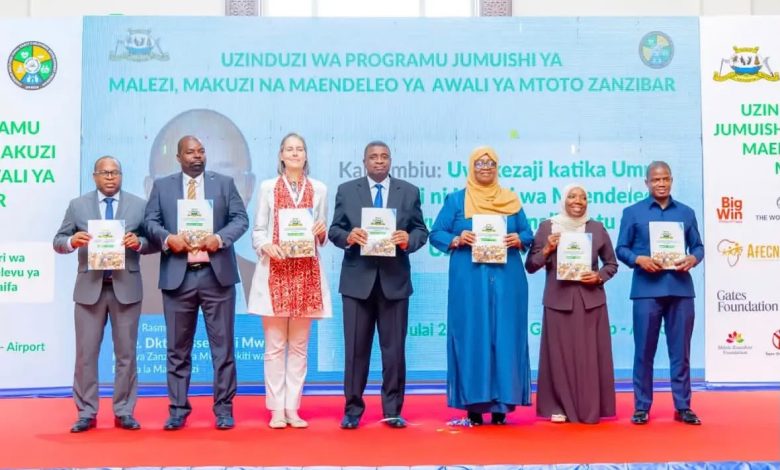
ZANZIBAR: THE launch of the Zanzibar Multisectoral Early Childhood Development Programme 2026–2031 on July 22, 2026, marked more than the unveiling of a new government initiative.
It was Zanzibar’s declaration that the foundations of its future economy, education system and social wellbeing are being laid today, in the health, nutrition, protection, care and early learning of its youngest children. With nearly one in every four Zanzibaris below the age of eight, the programme places the early years at the heart of national development and challenges government, partners, communities and the media to turn political commitment into visible, measurable change in the lives of children.
The commitment was made by the President of Zanzibar and Chairman of the Revolutionary Council, Dr Hussein Ali Mwinyi, whose message was delivered by the Second VicePresident of Zanzibar, Hemed Suleiman Abdulla, during the launch of the Zanzibar Multisectoral Early Childhood Development Programme 2026– 2031 on July 22, 2026.
Speaking on behalf of President Mwinyi, Mr Abdulla said the programme should not become another well-written government document or a successful meeting remembered only for speeches and photographs.
“Today must not be remembered only as a successful discussion,” the President’s message said. “It must be remembered as the moment when we strengthened our collective resolve to act.”
The President called upon government institutions, development partners, philanthropic organisations, civil society, communities and the private sector to convert their commitments into coordinated investment and measurable improvements in the lives of Zanzibar’s children and families.
He described investment in the earliest years as the foundation of sustainable human-capital development and national prosperity.
The Government, he said, would work with partners to prepare a coordinated implementation and investment roadmap aligning expertise, resources and responsibilities with national priorities and measurable outcomes.
The significance of that commitment is difficult to overstate.
Nearly 26 per cent of Zanzibar’s population is below eight years of age. In everyday language, approximately one out of every four people in Zanzibar is currently passing through the most sensitive period of human development.
That generation could become Zanzibar’s greatest asset, or its greatest missed opportunity.
The programme is built around the five pillars of the internationally recognised Nurturing Care Framework: Good health, adequate nutrition, responsive caregiving, opportunities for early learning and safety and security. A national promise to every child.
Together, these pillars recognise that a child does not develop through education alone. Children need nutritious food, protection from violence and neglect, access to healthcare, emotional security, stimulation, play and meaningful interaction with adults.
The programme therefore brings together ministries responsible for health, education, community development, agriculture, local government, finance and planning under a common national framework.
The Zanzibar Declaration on Investing in Early Years, adopted during the event, commits the Government and its partners to strengthen national leadership and multisectoral coordination; increase sustainable and predictable financing; expand access to quality nurturing-care services; improve research, data and accountability and build stronger partnerships.
It also calls for an annual review of progress, meaning the programme’s success should be judged not merely by activities conducted, but by measurable changes in children’s lives.
Opening the Partners Round Table Discussion, the Minister of State in the President’s Office, Ms Saada Mkuya Salum described the programme as a milestone in Zanzibar’s development journey. Not social welfare, but national development.
She said evidence from around the world demonstrated that investment in early childhood was among the most effective strategies for strengthening human capital, social cohesion and sustainable economic growth.
“The earliest years of life shape children’s health, learning, productivity and resilience, ultimately determining the strength and competitiveness of our nation,” she said.
Ms Saada asked each participating partner to identify the particular expertise, resources or institutional strength it could contribute to the programme.
The round table, she emphasised, was intended to be a working session, not a ceremonial gathering. Its outcome should be a practical roadmap connecting partner contributions with government priorities and results that can be seen in homes, clinics, childcare centres and classrooms.
That framing changes how ECD should be understood. It is not merely a welfare programme for vulnerable children. It is an economic strategy.
A child who is well nourished, protected, stimulated and prepared for school is more likely to learn successfully, remain in education, acquire productive skills and participate effectively in the economy.
A child deprived of those foundations may carry the consequences into school, employment, family life and adulthood.
Presenting the programme, Dr Ibrahim Kabole, Social Services Sector Lead in the Office of the President, State House–Zanzibar, said early childhood, from conception to eight years, is the period in which the foundations of school readiness, health, future earnings and national productivity are formed. Hence, why Zanzibar cannot wait.
Zanzibar’s youthful population presents an opportunity for a demographic dividend, he said, but only if the country invests deliberately in the capabilities of its youngest citizens.
The new coordination structure places an interministerial committee in charge of strategic direction, oversight and resource mobilisation. A technical coordination committee will guide planning, implementation, monitoring and reporting, while districts and communities will support integrated delivery at the local level.
Dr Kabole said effective coordination would reduce duplication, improve use of resources and strengthen accountability. “When sectors work together, they deliver greater impact than when they work alone,” his presentation emphasised.
The urgency of the programme is underlined by findings from the Baseline Early Childhood Development Study in Zanzibar, presented by Edward Kija of the Department of Paediatrics and Child Health at Muhimbili University of Health and Allied Sciences.
The study involved more than 1,050 children and caregivers drawn from 70 shehias across all five regions and all 11 districts of Zanzibar.
The findings show that about three in every ten young children are either developmentally delayed or at risk of delay.
Cognitive and language development were among the areas of greatest concern. These are the abilities children depend upon to think, communicate, understand instructions and begin learning successfully.
The study also found that children in urban communities were generally better prepared for school than those in rural areas.
Children in rural areas recorded an overall school-readiness score of approximately 40 per cent, compared with about 49 per cent among urban children. Put simply, where a child is born may already be influencing how prepared that child is when entering school.
Access to learning materials in the home was also limited. Only four out of every ten households had materials that could support children’s learning. Among families with children below three years, the proportion fell to roughly three out of ten.
Responsive caregiving was another concern. Only around one-third of caregivers reported undertaking all seven practices assessed by the study. One in every ten fathers reportedly did nothing connected to responsive caregiving.
Knowledge of childhood illness was particularly weak. Fewer than one in ten caregivers could identify between four and eight danger signs of childhood illness.
Nutrition data added another layer of concern: between 60 and 76 per cent of children aged six to 59 months had anaemia, while 18 per cent were stunted and eight per cent were wasted.
These figures describe children whose bodies and brains may not be receiving what they need to develop fully.
The development of Zanzibar’s ECD agenda has benefited from the expertise, financial support and institutional commitment of Big Win Philanthropy, UNICEF, Save the Children, D-tree, Milele Foundation, Zanzibar Maisha Bora Foundation, The Lady Fatma Trust, the World Health Organisation, Mwanamke Initiatives Foundation, the African Early Childhood Network, VitolFoundation, Gates Foundation, echidna giving, SoS Children’s Village, Conrad Hilton Foundation and the Aga Khan Foundation.
Their contribution is helping Zanzibar move from isolated interventions towards a coordinated national system.
Such partnerships support evidence generation, policy development, parental education, nutrition, health, early learning, child protection and stronger delivery institutions.
But financial and technical contributions alone are not enough. Their value must be made visible.
This is where the media becomes essential. Journalists can take programme commitments from conference halls into homes. They can explain that talking, singing, reading and playing with a young child are not merely expressions of affection, they are investments in brain development.
ALSO READ: Zanzibar rallies support for early childhood
They can visit clinics, preprimary schools and communities to document what is changing. They can show partners where their investment is producing results and demonstrate to potential supporters that Zanzibar has created a credible national platform worthy of further investment.
They can also follow the money, track promises and ask whether rural children, children with disabilities and those living in vulnerable households are being reached.
Visibility creates public understanding. Public understanding creates ownership. Ownership generates accountability and credible accountability attracts further investment.
The future of the islands is not waiting somewhere in 2050. It is already being formed today in the food given to a child, the protection provided at home, the words spoken by a caregiver, the quality of a clinic visit and the opportunities to play and learn before the first school bell rings.
By investing in those moments, Zanzibar is investing where its future truly begins.