Young Tanzanian women turn Agriculture into a pathway to jobs and economic transformation
MANYARA: FOR many young people in Tanzania, especially young women in rural areas, finding dignified work remains a challenge.
Limited access to resources, training, finance and reliable markets often prevents them from reaching their full potential. Yet across the country, a growing number of young entrepreneurs are proving that agriculture can be more than a means of survival.
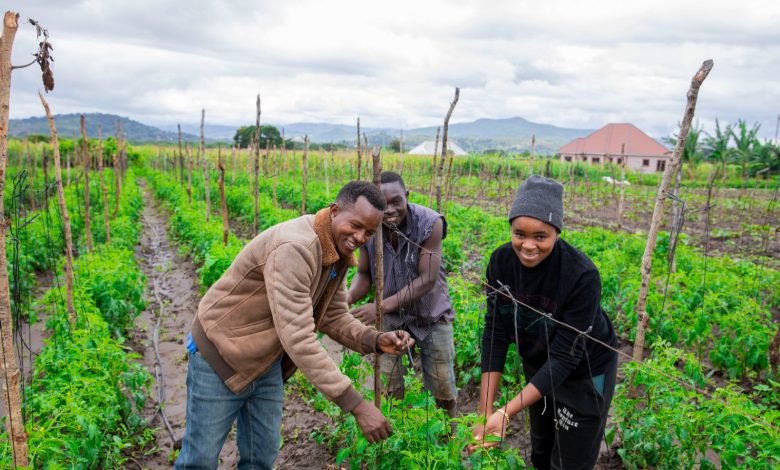
With the right support, it can become a pathway to self-employment, job creation and economic transformation. One of them is 30-year-old Jessica Lyatuu, a horticulture farmer from Babati in Manyara Region. Today, Jessica can look across her thriving tomato fields with confidence.
But behind the green fields is a story of setbacks, uncertainty and determination. After completing her studies in agriculture and livestock, Jessica began her career as an intern in an agrovet shop, where she gained valuable practical experience but earned no income. Later, she secured a job in Mbeya and received her first salary of just 200,000 Tanzanian Shillings.
Determined to build a future in farming, she rented a quarter-acre plot and planted tomatoes and cucumbers. Her harvests were promising, but turning production into a profitable business proved difficult. Without reliable access to markets, she depended on middlemen who bought her produce at low prices.
Much of what she earned was quickly consumed by production costs, leaving her with little profit. Eventually, discouraged and without a reliable source of income, Jessica returned home.
“Watching other youth succeed while I struggled affected my confidence. But I still saw farming as something I wanted to pursue,” she recalls.
Her turning point came in 2023 when she joined the Vijana Kilimo Biashara (VKB) programme, an initiative implemented by the World Food Programme (WFP) with support from the Mastercard Foundation. Since 2022, the partnership has been working across eight African countries to help young people, particularly young women, access skills, markets, finance and entrepreneurship opportunities that enable them to secure employment and build sustainable businesses.
In Tanzania, VKB is helping change the way young people view agriculture. Rather than seeing farming simply as a traditional livelihood, the programme encourages youth to approach agriculture as a business and explore opportunities across the wider agricultural value chain.
Working across eight regions, including Arusha, Dodoma, Manyara, Morogoro, Shinyanga, Simiyu, Singida and Tabora, VKB supports young people in the sorghum, sunflower and horticulture value chains through climate-smart agriculture, business development, financial inclusion and market linkages.
For Jessica, the support was both practical and transformative. Through field demonstrations, mentoring and regular visits from trained community facilitators, she learned improved crop management techniques, proper application of agricultural inputs, pest management and post- harvest handling.
She also joined collective marketing groups, which enabled farmers to combine their produce, negotiate better prices and gain access to larger markets. The experience changed more than her farming practices. It changed the way she thought about farming itself. Jessica began to look at her farm as a business.
She started paying greater attention to production costs, market opportunities, profitability and reinvestment. What began as a quarter-acre plot producing around 100 crates of tomatoes has grown into a two-acre enterprise producing up to 700 crates per acre.
Her income has increased considerably, allowing her to reinvest in her farm, support her children's education and contribute to building her family home.
Her success has also created opportunities for others. Jessica now employs one permanent worker and up to six young people during peak farming seasons.
“VKB training has given me more than technical skills. It has given me confidence to dream big and farm with a business mindset,” she said Jessica’s experience illustrates an important reality facing many young farmers.
Access to land alone is not enough to build a successful agricultural enterprise. Young people also need knowledge, finance, technology, market connections and the confidence to turn farming into a sustainable business.
Hundreds of kilometres away in Ilkidinga village in Arusha Region, another young woman is proving that agricultural opportunities extend far beyond the farm.
Turning the coin at 26, Wema Paulo has built an agribusiness by identifying and addressing a problem affecting onion farmers in her community. For many onion producers, the lack of proper storage facilities meant they had little choice but to sell their crops immediately after harvest, often when prices were at their lowest.
The result was reduced income for farmers and significant post-harvest losses. After joining VKB in 2024, she participated in entrepreneurship and business development training that encouraged young people to look beyond agricultural production and identify opportunities across the value chain.
ALSO READ: Tanzania embarks on modernization of Muhimbili Hospital for super-specialist healthcare services
She developed an idea for an onion storage facility and presented it during a VKB youth entrepreneurship competition. Using the prize money, Wema constructed a storage facility capable of holding up to 2,000 kilograms of onions.
Today, farmers can store their produce for up to six months, reducing post- harvest losses and giving them the flexibility to wait for more favorable market prices before selling. For Wema, what began as an idea has become a business solution that benefits other farmers in her community.
Her story also highlights how agriculture offers opportunities beyond production. Young people can build businesses in storage, processing, transportation, marketing, mechanization and other services that support farmers and strengthen agricultural value chains.
The experiences of Jessica and Wema reflect a wider change taking place among young people participating in the VKB programme. As of July 2026, VKB had supported more than 65,600 young people, with nearly half of all participants being young women. Programme monitoring shows that 98.5 percent of participants transitioned into work, while 92.5 percent progressed toward or accessed dignified and fulfilling employment.
Behind these figures are stories of young people who are not only looking for jobs but are also creating them. Jessica’s expanding farm now provides employment for other young people, while Wema’s storage facility is helping farmers reduce losses and make better decisions about when to sell their produce.
Together, their stories demonstrate the potential of investing in young people as entrepreneurs and job creators rather than viewing them only as job seekers.
Through a combination of technical training, entrepreneurship support, financial literacy, business coaching and stronger links to markets and financial services, VKB is helping young women and men move beyond subsistence livelihoods and build sustainable enterprises.
The programme is also working with the Bank of Tanzania to strengthen financial inclusion, while partnerships with private-sector companies are helping young people access improved technologies, mechanisation services and reliable markets.
For young women in rural areas, these opportunities can be particularly important. Limited access to finance, training and productive resources can make it difficult for them to turn their ideas into viable businesses. Removing some of these barriers can therefore benefit not only individual entrepreneurs but also their families and wider communities.
Tanzania’s agricultural sector remains an important source of employment, food production and economic growth. Yet for many young people, agriculture has traditionally been viewed as a sector of last resort rather than one filled with business opportunities.
Jessica turned a small plot of land into a growing agricultural enterprise that now creates employment. Wema turned a challenge facing onion farmers into a business opportunity that provides a much-needed service to her community. Their journeys show that agriculture can offer young people much more than a livelihood. It can provide a platform for entrepreneurship, innovation, employment and community development.
As the world marks International Youth Day, Jessica and Wema represent a growing generation of young Tanzanians reshaping the future of agriculture. Their stories show that when young people are given the skills, confidence, market access and opportunities they need, they can do more than build better futures for themselves.