Workers’ savings create jobs for more than 700 youths through Arusha MICE project
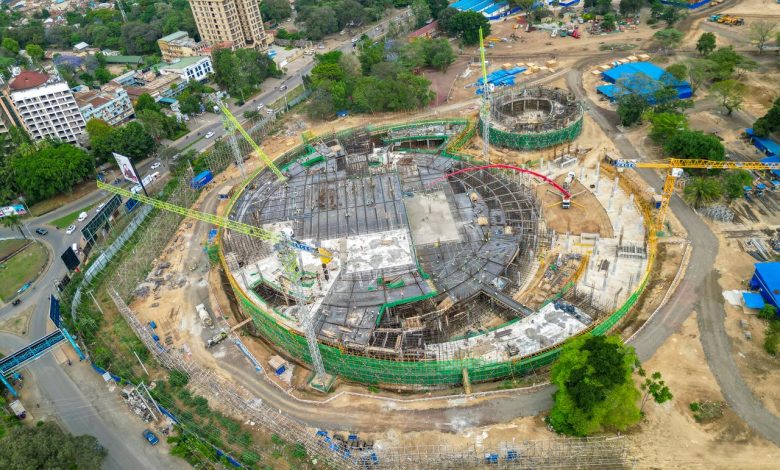
ARUSHA: MORE than 700 young people are earning a living daily through employment opportunities created by the construction of the Mount Kilimanjaro International Convention Centre (MKICC) in Kijenge, Arusha, an investment financed through workers’ contributions managed by the Public Service Social Security Fund (PSSSF) in partnership with the Arusha International Conference Centre (AICC).
For some workers, the project has meant travelling from distant regions in search of employment, while for others, it has provided an opportunity to acquire practical skills, support their families and improve their livelihoods.
This local surge in job creation aligns with data from the NBS Formal Sector Employment and Earnings Survey, which ranks Arusha Region second nationwide, behind Dar es Salaam, in private sector employment, accounting for 7 per cent of all adult private sector jobs and 6 per cent of youth private sector jobs across the country.
The investment also demonstrates how savings contributed by workers to PSSSF can be channelled into development projects that create employment, stimulate economic activities and contribute to the country’s infrastructure development. According to national labour assessments, formal employment in the construction sector has experienced significant growth, expanding by 50.7 per cent.
Speaking with journalists during a media tour organised by PSSSF at the construction site recently, workers said the project had enabled them to earn an income and meet their families’ daily needs, including food, education and other household expenses.
Mr Christopher Crispin, a carpenter from Sumbawanga, said he travelled to Arusha after learning about the employment opportunities available at the construction site. Having worked on the project for more than six months, he said the opportunity had improved his ability to provide for his family, including his mother, child and siblings.
“My income helps me provide food for my mother, support my child’s education and assist my siblings,” he said. He added that securing employment had enabled him to take greater responsibility for his family and given him a reliable source of income.
Another worker, Mr Nelson Mwanyula, a carpenter from Kilimanjaro Region who has also worked at the site for six months, said the project had allowed him to provide for his family.
“I am grateful to the government for bringing this project here because, since I started working, I have been able to support my family in meeting its daily needs. Without this project, we would have been left struggling to find something to do, with some of us potentially engaging in criminal activities in the streets,” he said.
Such project-based job creation comes at a vital time for the country’s youth population. Data from the NBS Integrated Labour Force Survey (ILFS) indicates that while overall national unemployment declined from 8.7 per cent to 6.2 per cent, youth unemployment remains elevated at 10.0 per cent.
Furthermore, young adults aged 15 to 35 now constitute between 61 per cent and 68.8 per cent of Tanzania’s total formal workforce, emphasising the critical role of strategic infrastructure investments in absorbing young job seekers.
For the two workers, the benefits of the investment are reflected in their ability to earn an income and provide for their families. Their experiences also illustrate how large infrastructure investments can create employment opportunities beyond the specialised professionals directly involved in construction.
Apart from providing jobs, the construction site has become a practical learning environment where workers without specialised experience can acquire new skills by working alongside experienced professionals.
The project’s Workers’ Representative and lifting equipment supervisor, Mr Khalid Msala, said employees were gaining practical knowledge through their daily involvement in different construction activities.
“Some people come here without skills, but as they work with experienced colleagues, they learn. In that way, this project also becomes like a college where people gain practical knowledge,” he said.
Mr Msala added that the use of modern lifting equipment had made some construction operations faster and easier, while giving workers an opportunity to gain experience in handling advanced machinery, a key step towards addressing national technical skills gaps.
The project’s Risk Manager, Mr Dennis Bennito, said between 750 and 800 workers were engaged at the construction site on a typical working day.
He said the workforce included engineers, machine operators, electricians, plumbers, carpenters and general assistants, reflecting the different professional and technical skills required to deliver a project of such scale.
Mr Bennito said the investment had also created opportunities for students pursuing technical and engineering courses to gain practical exposure before completing their studies.
More than 50 students from institutions including Arusha Technical College and the Dar es Salaam Institute of Technology had visited the construction site to learn about different aspects of the project.
“Some students and interns have had the opportunity to learn about equipment operation, construction activities and design-related work,” he said.
The exposure provides students with an opportunity to connect classroom knowledge with actual construction processes, while familiarising them with modern equipment, workplace procedures and the technical demands of large infrastructure projects.
The economic benefits have also extended beyond those directly employed in construction. Approximately 40 women food vendors have secured business opportunities by selling meals to workers at the site.
The presence of hundreds of employees has created a ready market for their food businesses, allowing the women to generate income from daily sales and support their households.
The project has also extended its contribution to the surrounding community through support to a neighbouring school in Kijenge. The assistance included school bags, notebooks, pens and pencils for pupils, as well as the provision of fill material to improve parts of the school’s grounds.
These interventions demonstrate how large investments can extend their benefits beyond the construction site through support for local businesses, educational institutions and communities.
The first phase of the MKICC project comprises a main convention centre designed to accommodate 5,000 people, an exhibition hall covering approximately 20,000 square metres, an operations building and supporting infrastructure.
Valued at 398.92bn/-, the project is being implemented by China Railway Construction Engineering Group Company Limited and is scheduled for completion on July 11, 2027.
Upon completion, the facility is expected to strengthen Tanzania’s position in the international Meetings, Incentives, Conferences and Exhibitions (MICE) tourism market by providing infrastructure capable of hosting large international conferences, exhibitions and business events.
The investment is also expected to create opportunities for businesses operating in hospitality, accommodation, transport, catering, event management and other services associated with international meetings and conferences.
For PSSSF, the project represents an investment of workers’ contributions in infrastructure with the potential to generate wider economic benefits. The Fund manages members’ contributions and invests them in different areas to support its financial obligations while contributing to national development.
ALSO READ: Govt, PPP projects open doors to jobs and economic growth
The project therefore connects workers’ savings with opportunities for employment, skills development and business growth, with its long-term contribution also depending on the centre’s ability to attract international events and sustain economic activities after construction.
For workers such as Mr Crispin and Mr Mwanyula, however, the benefits are already part of their daily lives. Their earnings have given them an opportunity to provide for their families, while the skills acquired by workers and students could open doors to further opportunities in Tanzania’s construction industry.