UK: Soldier accused of ‘Bloody Sunday’ killings on trial
UNITED KINGDOM: For five decades, victims’ families have sought justice since the 1972 killings of unarmed civilians in Northern Ireland. An anonymous defendant now stands in court, although he denies all charges.
A former British soldier referred to only as Soldier F went before a judge on Monday for the alleged killing of two men and the attempted murder of five others during a deadly 1972 incident in Northern Ireland.
Soldier F, an ex-paratrooper, has been granted anonymity as the proceedings get underway in Belfast. In court, he will be concealed behind a curtain where he will stand before a judge with no jury.
He is accused of the murder of James Wray, 22, and William McKinney, 26.
“The civilians … did not pose a threat to the soldiers and nor could the soldiers have believed that they did,” prosecutor Louis Mably said of the victims in his opening statements. “The civilians were unarmed and they were simply shot as they ran away.”
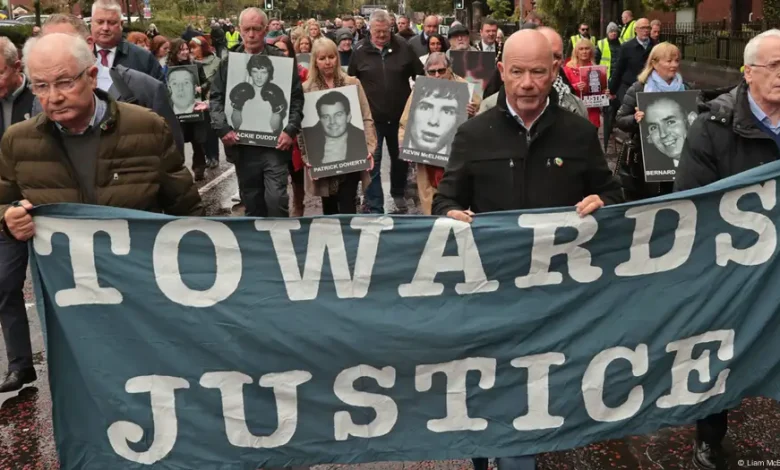
Family members of victims gathered outside the courthouse, holding posters with pictures of their relatives as the landmark case got underway.
John McKinney, speaking on behalf of the McKinney family, said it was “a momentous day in our battle to secure justice for our loved ones.”
What happened on ‘Bloody Sunday?’
Unarmed civil rights protesters were attacked by British soldiers, who killed 13 and injured at least 15 others on the streets of Derry on January 30, 1972.
The protest was part of a violent conflict between mostly Catholic supporters of a united Ireland and predominantly Protestant groups that wanted to remain part of the United Kingdom, as well as British soldiers stationed in Northern Ireland.
ALSO READ: It’s Bloody and barbaric, says Putin as Moscow death toll hits 115
It remains the worst single shooting incident of three decades of sectarian violencea period of time known as the Troubles.
Investigations conducted at the time concluded that the soldiers returned fire at the protesters in self defense after stones were thrown. A later inquiry revealed that there was no justification for the killings.
Former UK Prime Minister David Cameron apologized in 2010 and admitted the killings were “unjustified and unjustifiable.”
Why has it taken so long?
For decades, the UK government’s policy was that the 16 soldiers involved had acted in self defense. A 2010 attempt to try them was dismissed on the grounds that there was insufficient evidence. Relatives of the victims appealed the case against Soldier F and it was reinstated. He pled not guilty and asked to have the case dimissed, but his motion was denied.
“We’re here now, at last, after all this time. It’s not nervousness, it’s anticipation more so. I’m not even sure that it’s really sunk in yet that we’re here now,” a relative of one of the victims told PA media group.