TZ-Kenya business council to push trade to 2.6tri/-
- Kenya’s Ruto calls for trust, unity and decisive steps toward deeper regional ties
- Urges EAC to move from rivalry to cooperation, unlock its full economic potential
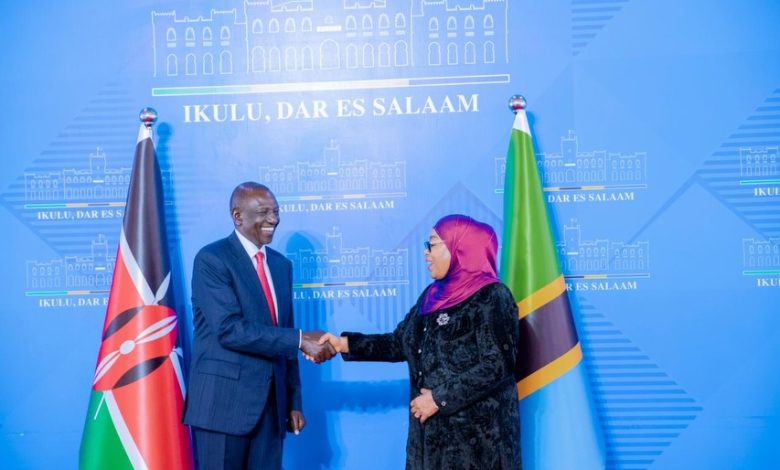
DAR ES SALAAM: PRESIDENT Samia Suluhu Hassan and her Kenyan counterpart William Ruto have approved the establishment of the Joint Tanzania–Kenya Business Council and an annual private sector business forum aimed at boosting bilateral trade and investment.
The approval followed a daylong Tanzania–Kenya Business Forum held on Monday at the Julius Nyerere International Convention Centre (JNICC) in Dar es Salaam, where private sector stakeholders from both countries recommended the creation of the council as a key platform to strengthen trade and investment partnerships.
The main objective of the initiative is to accelerate the movement of goods and services between Nairobi and Dodoma, with the ambition of pushing bilateral trade beyond the 1 billion US dollars (about 2.6tri/-) mark within the next three years.
Currently, trade between the two countries stands at about 860 million US dollars (about 2.2tri/-).
Addressing the forum, President Samia said the initiative reflects the strong interdependence between the two neighbouring countries, which should leverage their comparative advantages for mutual prosperity.
“Tanzania and Kenya must move forward together. We cannot be divided by perceptions or selfish interests. We are one, and we are ready to work closely,” she said.
She added: “Kenya and Tanzania are joined at the hip.” President Samia noted that the two countries share a common history, culture and deep economic interdependence.
She stressed that despite occasional misunderstandings driven by narrow interests, the longstanding bond between Dodoma and Nairobi remains essential.
She further highlighted the role of the private sector, noting that it is expected to contribute up to 70 per cent in the implementation of Tanzania’s upcoming National Development Vision 2050.
President Samia commended Kenyan investors operating in Tanzania, including KCB Bank and Kenya Airways, for creating jobs and contributing to tax revenue.
She assured continued government support in creating a favourable business environment.
She also urged Tanzanian investors to comply with tax laws and encouraged those operating in Kenya to respect regulations in both countries to strengthen national economic interests.
Notable Tanzanian investors in Kenya include Bakhresa Group, Taifa Gas and Amsons Group.
In addition, President Samia expressed Tanzania’s readiness to host the annual business forum, describing it as a key platform for strengthening economic ties.
She noted that the forum will operate on a one-year cycle, with the next edition expected to be held in Nairobi in 2027.
ALSO READ: Ruto hails the 400-kilovolt power project for cementing Kenya-Tanzania ties in energy sector
She further recalled that the forum had not been held since 2021, when she last made a state visit to Kenya, stressing that its revival will help continuously strengthen economic relations.
For his part, President William Ruto echoed similar sentiments, saying the two countries share a common destiny.
“The Joint Business Council will institutionalise the annual Tanzania–Kenya Business Forum as a permanent platform,” he said.
He said that prosperity for both countries depends on leveraging complementary resources through joint investments in infrastructure such as railways, power interconnectors and integrated agricultural value chains.
Dr Ruto also called for the development of a single commercial system to facilitate seamless business operations between the two countries.
“You cannot share poverty; you can share wealth. We want to re-engineer our engagements,” he said.
He added: “1 billion US dollars in trade over the next three years is ambitious but entirely achievable if we act with purpose and alignment.”
President Ruto thanked the government and people of Tanzania for their hospitality, describing it as a symbol of strong neighbourly relations rooted in long-standing diplomatic ties.
He also highlighted progress in removing non-tariff barriers following discussions with President Samia, including improved border efficiency, harmonised standards and reduced delays at crossing points.
He noted that non-tariff barriers had previously cost both countries an estimated 100 million US dollars (about 259bn/-) in lost trade opportunities.
Dr Ruto further emphasised that free movement of people remains a cornerstone of the strong bilateral relationship