Tanzania’s resilience reinforces position as East Africa’s investment powerhouse
DAR ES SALAAM: IN a world where political shocks often unsettle markets and deter investment, Tanzania offers a compelling story of resilience and recovery.
East Africa’s most peaceful nation extends a confident invitation to the international community, anchored in the strength of its economy, the richness of its natural assets and the breadth of opportunities available across key sectors.
In the wake of unrest surrounding the 2025 General Election, concerns emerged about the potential impact on the country’s economic trajectory.
Yet, rather than faltering, Tanzania moved swiftly to stabilise the situation, reassuring both citizens and international partners that it remains open for business.
Home to Africa’s highest peak, Mount Kilimanjaro, the vast plains of the Serengeti National Park, the iconic Ngorongoro Crater and the white coral sands and turquoise waters of the Zanzibar archipelago, the country stands as both a premier global tourism destination and a steadily advancing economy.
These attractions continue to draw millions of visitors, underpinning a tourism sector that remains among the strongest on the continent. But the story extends beyond natural beauty.
Beneath this global appeal lies an economy supported by abundant natural resources and expanding opportunities across key industries.
Even in the face of disruption, Tanzania demonstrated its capacity to absorb shocks, restore confidence and maintain momentum.
When confronted with a rare episode of political unrest following the 2025 General Election, the country did not retreat.
It stabilised quickly and sustained its development path, reinforcing its reputation as a resilient and dependable destination for investment, trade and tourism in an increasingly uncertain global environment.
Today, Tanzania positions itself as a reliable and attractive destination for global investment and engagement. In an unpredictable world, it stands out for its stability and forward momentum.
For investors, partners and travellers alike, the message is clear: Tanzania is not simply enduring; it is moving forward with confidence.
According to the report of the Commission of Inquiry established to investigate incidents of violence and breaches of peace surrounding the October 2025 General Election, there is credible evidence that the unrest was not spontaneous.
Rather, it was planned, coordinated, financed and executed by individuals who had undergone prior training. This resulted in the destruction of public and private property and sent troubling signals to the economy.
The Commission estimated the total value of destroyed property at approximately 125bn/-, equivalent to about 48.1 million US dollars or GBP 37.9 million.
Beyond these direct losses, the unrest introduced uncertainty that unsettled investors and raised concerns within the business community about the operating environment.
Disruptions to infrastructure and services also carried wider economic implications, affecting service delivery and constraining activity across both public and private sectors.
Ranked among the most peaceful countries in East Africa and maintaining a strong position on the continent in the 2025 Global Peace Index published by the Institute for Economics and Peace, Tanzania has long been regarded as a regional beacon of stability.
The events of October 2025 therefore represented a significant test of that reputation. Upon receiving the Commission’s report, President Samia Suluhu Hassan reassured both citizens and the international community that the country had returned to normalcy, stating: “I am proud to declare that stability, peace and tranquillity prevail in our country.”
The President further observed that the acts of violence appeared aimed at weakening the government by targeting key infrastructure, disrupting social service delivery and undermining economic activity. Despite the scale of the disruption, security agencies moved to restore order.
President Samia further commended security institutions for containing the unrest made it possible for the country to regain stability quickly.
What followed was even more telling. Rather than sliding into prolonged disruption, the months after the election revealed an economy that continued to operate, adjust, and in key respects advance.
Beyond the immediate narrative, a quieter but more enduring reality emerged, defined less by instability and more by resilience. This resilience is perhaps best understood through investor behaviour.
Investment decisions are rarely driven by short-term reactions; they are anchored in confidence. This includes confidence in policy direction, institutional reliability and long term opportunity.
ALSO READ: Tanzania targets media alliance to reposition itself in Africa’s investment narrative
Periods of political uncertainty typically test that confidence and often lead to hesitation or withdrawal.
In Tanzania’s case, however, such retreat was limited. Between November 2025 and March 2026, the Tanzania Investment and Special Economic Zones Authority recorded 656 investment projects valued at approximately 1.8 billion US dollars.
This was not marginal activity. It reflected continued economic engagement at a time when caution might reasonably have prevailed. These figures suggest more than short term optimism.
They indicate that both domestic and international investors continued to view Tanzania’s economic fundamentals as broadly stable.
Confidence remained anchored in long term prospects rather than short term political developments. Macroeconomic indicators reinforce this picture.
Data from the Bank of Tanzania and the National Bureau of Statistics show that inflation remained within single digit levels, declining to about 3.2 per cent by March 2026. Price stability was maintained across essential commodities.
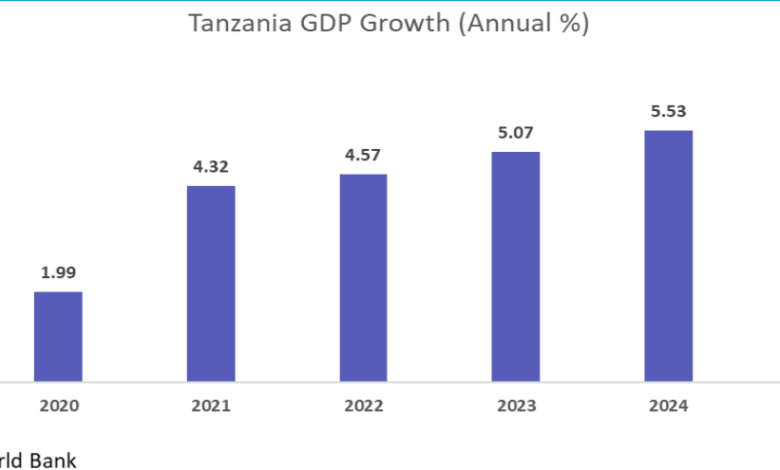
Economic growth had already been on a strong footing prior to the unrest, with GDP expanding at around 6.4 per cent in the third quarter of 2025. This provided a solid base from which the economy could absorb shocks.
This stability is further reflected in external assessments. According to a February 2026 report by Moody’s, Tanzania’s sovereign credit rating remained at B1.
This indicates continued confidence among international lenders at levels comparable to the period before the General Election. Within this broader context of stability and sustained confidence, Tanzania’s tourism sector offers one of the clearest signals of resilience.
Visitor numbers have continued to rise in the post pandemic period, increasing from about 1.45 million in 2022 to over 1.8 million in 2023, and reaching an estimated 2.09 million international arrivals in 2025.
Tourism earnings have followed a similar trajectory, reaching approximately 4.2 billion US dollars and reinforcing the sector’s role as a major source of foreign exchange and employment.
This momentum has been matched by sustained global recognition. Tanzania was named the World’s Leading Safari Destination for 2025 at the World Travel Awards, while Serengeti National Park was recognised as the World’s Leading National Park for 2025. The country was also named Africa’s Leading Destination for 2025 at the Africa and Indian Ocean Travel Awards.
Taken together, these outcomes reflect more than a story of recovery. They point to an economy that continues to expand, strengthen its reputation and project confidence to global partners.
This resilience is not confined to headline sectors. It is also evident in everyday life. Businesses remained open, supply chains functioned and essential services were maintained.
For many Tanzanians, resilience was a lived reality. Such outcomes are rarely accidental. They are underpinned by consistent policy direction.
In the years leading up to 2025, Tanzania pursued a development path centred on infrastructure expansion, industrialisation and inclusive growth.
This trajectory remained steady and avoided abrupt shifts in response to short term pressures. Large-scale investments have played a central role in strengthening the country’s productive capacity and connectivity.
The Standard Gauge Railway (SGR), a 2,562-kilometre flagship infrastructure project valued at over 10 billion US dollars, is being developed in phases to connect Dar es Salaam to the interior and neighbouring countries, including Rwanda, Burundi and the Democratic Republic of Congo.
Once completed, the railway will significantly reduce cargo transport costs and transit times, improve trade efficiency and strengthen Tanzania’s position as a regional logistics hub. Complementing this is the Julius Nyerere Hydropower Project, with an installed capacity of 2115 megawatts, making it one of the largest energy projects in East Africa.
The project is expected to substantially increase electricity generation, enhance energy security and support industrial growth by providing reliable and affordable power to businesses and households.
At the same time, investments in port infrastructure, including the ongoing expansion and modernisation of the Dar es Salaam Port with a rated capacity of 14.1 million metric tonnes of dry cargo, 6.0 million metric tonnes of bulk liquid cargo, and the planned Bagamoyo Port project, are strengthening Tanzania’s position as a key maritime gateway for the EAC and SADC regional blocs.
If completed, the 10 billion US dollars Bagamoyo Port is designed to handle up to 20 million TEUs annually, far exceeding the capacity of Dar es Salaam Port.
These developments are intended to expand cargo handling capacity, reduce congestion and improve efficiency in regional and international trade. Policy consistency has played an equally important role.
Institutions such as the International Monetary Fund and the World Bank have highlighted the importance of stable macroeconomic management and clear development priorities in sustaining investor confidence.
In Tanzania’s case, this stability appears to have softened the impact of political shocks on economic expectations. Institutional capacity has also been a key stabilising factor.
Economic performance depends not only on policy design, but also on the systems that implement it.
Regulatory authorities, administrative processes and public service delivery form the backbone of economic activity. Beyond immediate responses, Tanzania’s resilience reflects deeper structural changes.
Over the past decade, the economy has become more diversified, with growth supported by sectors such as construction, mining, agriculture and services.
This diversification reduces vulnerability and allows different sectors to sustain momentum even when others face pressure.
For external observers, Tanzania’s experience offers an important perspective.
Economic narratives often focus on moments of crisis, while stability receives less attention. Yet resilience, particularly when sustained under pressure, is a meaningful achievement.
The country’s performance during this period shows that political events, while important, do not automatically determine economic outcomes.
The relationship between politics and economics is shaped by institutions, policy consistency and the credibility of long-term development strategies.
As Prof Kitila Mkumbo, State Minister for Investment and Planning, recently emphasised during his budget speech in Parliament, sustaining Tanzania’s development trajectory will depend not only on continued investment, but also on strengthening institutions and ensuring effective implementation of priorities.
As he noted, “The transformation of Tanzania’s economy will not be driven only by the policies we design, but also by the strength, competitiveness and confidence of our private sector.”
Looking ahead, there is an opportunity to translate this resilience into broader social gains. Growth that creates jobs, expands opportunity and supports inclusive development can reinforce both economic and social stability.
In a global environment shaped by geopolitical tensions, economic uncertainty and climate related risks, resilience is becoming a defining economic quality.
It is not simply the absence of crisis, but the ability to absorb shocks, adapt and continue progressing. Tanzania’s experience in the months following October 2025 reflects this reality.
While the unrest drew significant attention, the steadiness of the economy tells a deeper story of preparedness, institutional continuity and sustained confidence.
It is, in many ways, a quiet achievement. Yet in an uncertain world, such resilience sends a powerful signal about the strength of an economy.
The more pressing test ahead may come not from political shocks, but from external pressures such as rising global commodity prices, a challenge the country has already shown the capacity to manage.