Tanzania moves to eliminate lead-based paint to protect children’s Health
DAR ES SALAAM: For decades lead has remained one of the silent threats to human health, particularly among children whose developing bodies are more vulnerable to its effects.
While many people associate lead exposure with industrial activities and environmental pollution, lead-based paint remains an important and often overlooked source of exposure, especially in homes, schools and other places where children spend much of their time.
Once lead-containing paint begins to deteriorate, it can contaminate household dust and soil, creating a long-term health risk that may continue for years after the paint was applied. With an estimated 600,000 children worldwide suffering intellectual impairment every year as a result of lead exposure, the need to eliminate lead from paint has become an urgent public health and environmental priority.
Available reports indicate that about 90 percent of children exposed to high levels of lead live in low- and middle-income countries, where regulations, enforcement mechanisms and public awareness may still face significant challenges.
Tanzania, as one of the world’s middle-income countries, is therefore among the countries that need strong and coordinated measures to prevent lead exposure and protect vulnerable populations, particularly children.
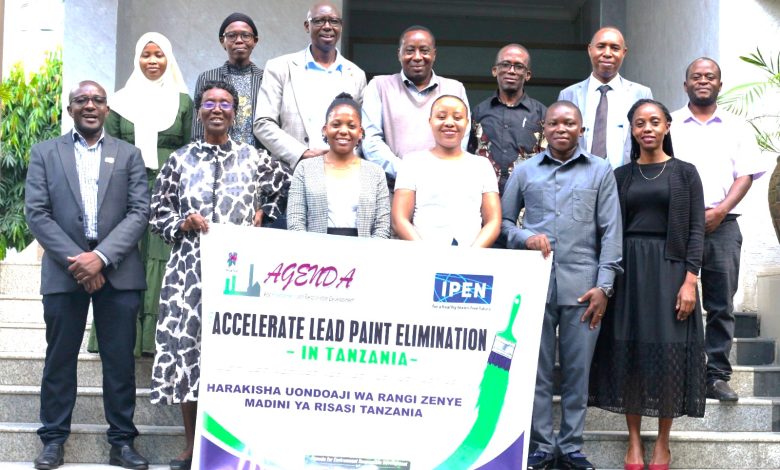
It is against this background that key stakeholders from the environmental, health, occupational safety and standards sectors in Tanzania met recently in Dar es Salaam to discuss strategies for accelerating the elimination of lead-based paint in the country.
The meeting brought together experts from government institutions and civil society under the coordination of the Environmental Action Network and related stakeholders, commonly referred to as AGENDA.
The discussions focused on strengthening cooperation among institutions, improving awareness among paint manufacturers and consumers, enforcing existing regulations and standards, and ultimately achieving a target of zero intentionally added lead in paint.
The initiative reflects growing recognition that addressing lead in paint cannot be the responsibility of one institution alone. Instead, it requires cooperation among environmental authorities, health professionals, standards regulators, occupational safety agencies, government laboratories, manufacturers and civil society organizations.
The participation of these institutions was significant because each plays a different but interconnected role in protecting Tanzanians from the dangers associated with hazardous substances.
Environmental authorities are responsible for environmental protection and monitoring, occupational safety authorities protect workers, the standards body establishes and promotes compliance with product standards, while government laboratories provide scientific testing and evidence that can support regulatory action. The working session was officially opened by AGENDA’s Senior Programme Officer, Silvan Mnganya.
The meeting marked another step towards building a coordinated national response to lead exposure, particularly through paint.
“Eliminating lead-based paint is important because it is directly connected to the protection of human health, particularly the health and development of children. Lead is a toxic substance that can enter the human body through contaminated dust, soil and paint particles,” he mentioned.
He said that, “When lead-containing paint begins to peel, crack or deteriorate, it can contaminate the surrounding environment and expose people who live, work or play in those areas. Children are especially vulnerable because their brains and nervous systems are still developing,” He addressed that, preventing exposure to lead in paint is therefore an important step towards creating safer homes, schools and communities in Tanzania.
“One of the most important reasons for eliminating lead from paint is to protect children’s intellectual and cognitive development. Lead exposure can interfere with the normal development of the brain and nervous system, potentially reducing a child’s ability to learn, understand and concentrate,” Mnganya noted.
During the meeting, representatives from the participating institutions outlined what their respective organizations could do following the discussions. AGENDA, represented by Executive Secretary Dorah Swai, proposed the establishment of a broader coalition of stakeholders to address the problem of lead-containing paint in a coordinated manner.
“The organization also proposed the establishment of a dedicated task force that would visit paint manufacturers, promote public awareness and educate both consumers and manufacturers about the dangers associated with lead-based paint,” she noted.
She added that, “AGENDA we called on TBS to strengthen its education and engagement of paint manufacturers and, where necessary, ensure that manufacturers are held accountable for complying with standards aimed at eliminating lead from paint,” She highlighted that, the ultimate objective, according to the stakeholders, is to move Tanzania towards achieving zero intentionally added lead in paint as quickly as possible.
She indicated that, “Lead-based paint does not necessarily pose its greatest danger when it is still inside a paint container or immediately after it has been applied to a previously unpainted surface.
The risk becomes more significant as the paint ages, deteriorates, cracks, peels or begins to flake,” “Over time, old paint can produce contaminated dust and paint particles that settle on floors, windows, doors, walls and surrounding soil.
In homes, schools and playgrounds, children can come into contact with this contaminated dust and soil while playing,” she addressed “Young children are particularly vulnerable because of their normal tendency to put their hands and other objects into their mouths,” she briefed.
To his part The Occupational Safety and Health Authority (OSHA) Director of Safety and Health, Dr Jerome Materu mentioned that, A child playing on a contaminated floor or in contaminated soil may pick up lead-containing dust on their hands and later swallow it.
“Children aged six years and below are considered particularly vulnerable to the harmful effects of lead because their brains and nervous systems are still developing,” he said.
“Research published in 2014 estimated that children between one and six years of age may invest approximately 100 milligrams of household dust and soil every day. Where that dust or soil is contaminated with lead, even small amounts of exposure can become a serious health concern,” he indicated.
She briefed that, “As old paint continues to deteriorate, children can also be exposed by swallowing paint chips, breathing contaminated dust or coming into contact with contaminated soil around buildings. This means that the danger may remain long after lead-based paint was originally applied,”
“The greatest concern surrounding lead exposure is its impact on the developing brain. During early childhood, the brain undergoes rapid development, and exposure to lead can interfere with processes that are essential for learning, understanding and normal development,” he mentioned.
He added that, “Lead exposure can reduce a child’s ability to learn and understand information and may contribute to behavioral problems, including increased aggression and irritability,” He highlighted that, Exposure can also affect other body systems and may have consequences for reproductive health, particularly when exposure occurs during critical stages of development.
“One of the most worrying aspects of lead poisoning is that the damage caused by exposure may not be reversible. Children who suffer health and developmental consequences from lead exposure can carry those effects into adulthood, affecting not only their personal lives but also their ability to participate fully in education and the economy,” he indicated.
The international community has recognised the dangers of lead in paint for many years. During the 1970s and 1980s, many developed countries introduced laws, regulations and legally enforceable standards to limit the amount of lead permitted in paint.
In the United States, for example, the legal limit for lead in paint was set at 90 parts per million, or 90 ppm, for dry paint. Other countries have adopted maximum limits ranging from 90 ppm to 600 ppm, depending on their regulatory frameworks.
The adoption and enforcement of such standards are intended to prevent manufacturers from adding lead to paint and to reduce the risk of exposure among consumers and workers. For Tanzania, stakeholders believe that strengthening standards, monitoring compliance and increasing public awareness can play a significant role in reducing exposure.
Ensuring that manufacturers understand the dangers and responsibilities associated with lead-free production is equally important. Beyond its impact on health, lead exposure also carries a significant economic cost. Reduced cognitive ability and developmental problems can affect educational achievement, employment opportunities and productivity later in life.
Studies have estimated that low- and middle-income countries collectively lose about US$977 billion every year as a result of the economic consequences associated with lead exposure. In Africa alone, the estimated annual economic loss has been placed at approximately US$134.7 billion, equivalent to around four percent of the continent's gross domestic product.
These figures demonstrate that preventing lead exposure is not simply about treating people after they become sick. It is also about protecting human capital and ensuring that children have the opportunity to develop their full potential. Every child affected by preventable lead exposure represents not only a personal tragedy but also a potential loss to society.
A child whose learning ability is impaired may face difficulties throughout school and later in the workplace. At a national level, widespread exposure can therefore contribute to lower productivity and higher social and economic costs. The most effective way to protect children from lead-based paint is to prevent exposure before it happens.
Consumers can contribute by asking paint suppliers and manufacturers whether their products contain intentionally added lead and by choosing lead-free alternatives whenever possible. Paint sellers also have an important role to play by ensuring that the products they stock and sell comply with established safety standards.
Manufacturers, meanwhile, can protect consumers by producing paint without intentionally adding lead and by ensuring that their products meet national and international safety requirements.
Households can also reduce exposure to deteriorating paint by regularly cleaning surfaces with water, particularly around windows and doors where paint is more likely to peel, crack or deteriorate. Parents and caregivers should pay particular attention to areas where young children play.
Public awareness is equally important. Communities need clear information about the dangers of lead, how exposure occurs and what they can do to protect themselves. Awareness campaigns targeting parents, schools, paint manufacturers, retailers, painters and construction workers can help reduce unnecessary exposure.