Tanzania eyes bigger blue economy gains by turning marine resources into highvalue commercial products
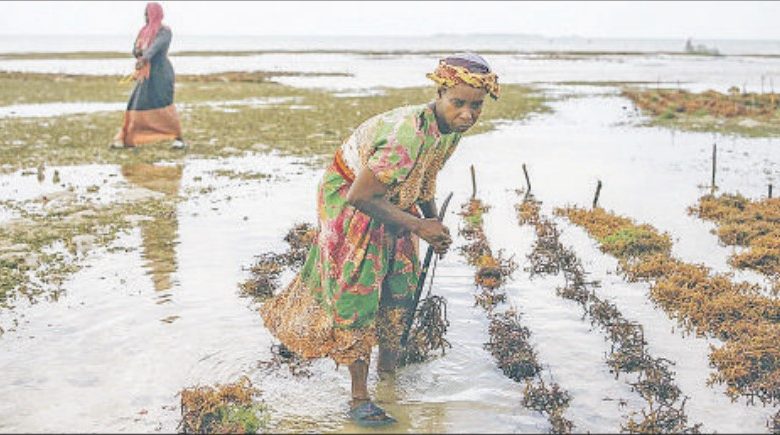
ZANZIBAR: TANZANIA is intensifying efforts to transform seaweed and other marine resources into higher-value commercial opportunities, with growing attention on production, processing, financing and access to markets across the fisheries value chain. The shift is increasingly visible in businesses emerging beyond traditional coastal fisheries.
One example is Tanzanian entrepreneur Fransic Pentzel, who has developed an organic fertiliser made from seaweed, turning a marine resource traditionally associated with coastal farming into an agricultural product serving farmers. His company, Fivestar Agrovet Fertiliser, has produced about 40,000 litres of the fertiliser and sold it to more than 100,000 farmers and livestock keepers since 2022.
The business demonstrates how marine resources can generate commercial opportunities far beyond the communities where they are harvested. It also illustrates the broader potential of Tanzania’s blue economy as the country seeks to move away from dependence on raw-resource sales towards processing, value addition and businesses capable of generating greater incomes and employment. FAO is supporting this transition through partnerships with Tanzania’s fisheries institutions.
One planned collaboration with the School of Aquatic Sciences and Fisheries Technology is expected to focus on increasing seaweed and sea cucumber production, strengthening value addition and improving livelihoods in coastal communities and protecting aquatic ecosystems for future generations.
FAO Representative in Tanzania Dr Nyabenyi Tipo has said the objective is not simply to increase production. Development must also ensure that local communities benefit from expanding fisheries activities while aquatic ecosystems are protected.
“Our goal is not only to increase production and incomes but also to ensure that the benefits of fisheries development reach local communities while protecting aquatic resources for future generations,” Dr Tipo said.
The proposed partnership forms part of a broader FAO fisheries programme covering research, innovation, improved production systems and stronger market connections. For Tanzania, the commercial opportunity lies not merely in producing more fish, seaweed and other aquatic resources, but in developing enterprises capable of processing them, meeting quality requirements, reaching larger markets and attracting investment. Pentzel’s experience provides a practical example of both the opportunity and the challenges involved in making that transition.
He began developing his seaweed-based fertiliser after visiting horticultural and commercial crop farmers in Tanga and Mbeya in 2019. During those visits, he found farmers struggling with high fertiliser and pesticide costs, declining soil fertility and crop yields that were often below expectations.
“I realised that farmers needed an affordable solution that could improve both soil fertility and crop performance,” he said.
Pentzel had studied animal production at Uyole Agricultural Centre before pursuing General Science at the Open University of Tanzania. After completing his studies in 2021, he returned to Tanga and began developing the technology behind the fertiliser. He experimented with different seaweed species and tested their composition before submitting samples to the Tanzania Fertiliser Regulatory Authority (TFRA) for analysis.
The tests identified several nutrients, including nitrogen, phosphorus, potassium, magnesium, calcium, iron, zinc, sulphur and boron. Commercial production began in 2022, initially at a capacity of about 500 litres per month. A 30 millionshilling COSTECH grant helped strengthen production and infrastructure.
The grant, provided through the Dar Teknohama Business Incubator, enabled the company to purchase a 5,000-litre fiberglass tank and construct two wells for soaking seaweed at its factory in Tanga. By August 2026, Fivestar had produced approximately 40,000 litres and sold the fertiliser to more than 100,000 farmers and livestock keepers across Lushoto, Korogwe, Muheza, Songwe, Ruvuma, Morogoro, Moshi, Arusha, Mbeya, Zanzibar and Mkuranga.
The enterprise currently employs six people, while Pentzel says farmers have reported production increases of between 20 and 50 per cent for crops including maize, paddy, bananas, amaranth, mnafu, sweet potato leaves and cashew as reported. The fertiliser is marketed not simply as a source of nutrients, but as a product intended to support soil and plant health.
ALSO READ: Dar’s Keko strengthens flood preparedness plan
According to Pentzel, it promotes root development, improves resistance to drought and other environmental stresses, and introduces beneficial microorganisms that can contribute to restoring soil health.
The product sells for 10,000/- per litre, with typical application rates of two to three litres per acre. However, expanding the business will require additional capital. Pentzel estimates that about 400m/- is needed to increase farmer education, expand distribution, promote the product in regions and improve formulations for different crops.
That requirement reflects a wider challenge facing Tanzania’s fisheries and blue-economy enterprises. Innovative businesses can develop products and reach commercial markets, but many remain too small to finance equipment, certification, distribution networks and market development required for sustained expansion.
TFRA has certified the seaweed fertiliser as safe for agricultural and livestock activities, removing one regulatory barrier to broader commercialisation. COSTECH Director General Dr Amos Nungu has said the commission will continue supporting innovators and researchers seeking to move ideas from development into commercial production.
Innovators requiring capital can access the Samia Innovation Commercialisation Fund, while COSTECH can guarantee CRDB financing. Similar efforts are being pursued across Tanzania’s fisheries sector. In Lake Tanganyika, FAO is facilitating a multi-stakeholder fisheries value-chain platform.
It will bring producers, processors, traders, researchers and other stakeholders together to strengthen coordination and address business challenges. Better market information and stronger links across the value chain can help businesses identify opportunities that individual operators may struggle to capture alone.
FAO is also using its Rural Invest methodology to identify fisheries business models and help entrepreneurs prepare investment proposals and financial plans for potential funding. FAO also supports sustainable fisheries through EAFNansen assessments in the Indian Ocean scientifically.
Skills development is another important part of the transition. Zakaria Kaaya, a Nyegezi Fisheries Institute graduate and founder of a fish-products business in Mwabe Pande, said training had helped entrepreneurs improve processing, add value and reach markets.
He called for expanding fisheries education institutions so Tanzanians can gain skills in production, processing, quality control and business management. Pentzel’s fertiliser enterprise shows a pathway: converting seaweed into an agricultural input creates markets beyond communities.
For the blue economy to generate returns, enterprises must become bankable, scalable and sustainable. That requires research, certification, finance, skills and links between producers, processors, investors and buyers.