‘Strengthen conservation efforts’
PRIME Minister Dr Mwigulu Nchemba has called for a change in public attitudes towards tree conservation, warning that continued deforestation is worsening the country’s vulnerability to climate change.
He called on Tanzanians to take climate change seriously, saying deforestation requires a fundamental change in people’s upbringing, traditions and attitudes rather than political rhetoric.
The Premier noted that many people do not consider cutting down trees a serious matter despite their importance in environmental protection.
“Our traditions and upbringing, I think, have shaped this attitude because we were not born in a country characterised by drought and deserts. The protection of the environment and trees is not a political issue; it is a matter of upbringing. “We have a serious problem with this in many parts of the country. Therefore, I would like, on behalf of the government, to urge Tanzanians to continue taking the issue of climate change very seriously,” he said.
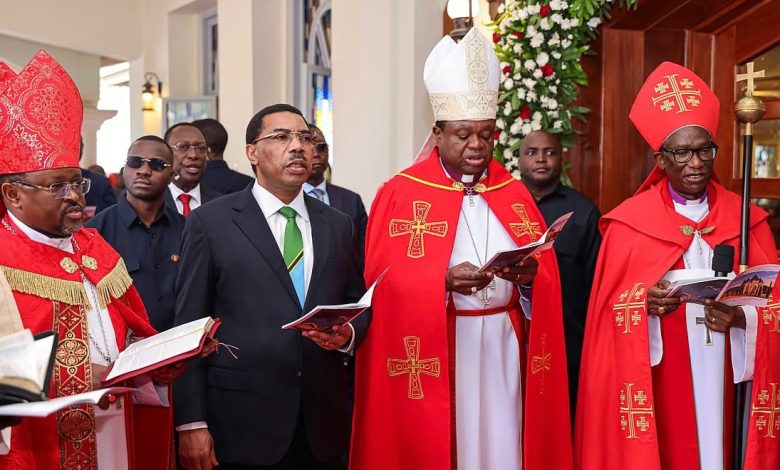
Dr Nchemba made the remarks yesterday during the inauguration of the Evangelical Lutheran Church in Tanzania (ELCT), Nshara Congregation, in Hai District, Kilimanjaro Region, following concerns raised by a member of the congregation and former Chama Cha Demokrasia na Maendeleo (CHADEMA) Chairperson, Mr Freeman Mbowe, over the cutting of jacaranda trees planted along Machame Road.
Mr Mbowe told the Prime Minister that the trees were planted under the Keep Kilimanjaro Beautiful Project, an initiative aimed at promoting jacaranda tourism through tree planting along a 47-kilometre stretch in Hai District.
He said the trees, planted with permission from the Tanzania National Roads Agency (TANROADS) and financed through the initiative, had been affected by electricityline installation works, which resulted in some being cut down.
Responding, Dr Nchemba directed regional leaders to work with relevant authorities and the area Member of Parliament to examine the matter, saying the concerns deserved attention.
He said Tanzanians had grown accustomed to a natural environment that did not expose them to severe drought and desert conditions, a situation that might have contributed to a relaxed attitude towards tree conservation.
He contrasted this with practices in some other countries, where cutting down a tree, even one planted by an individual, requires several permits. To illustrate the problem, Dr Nchemba shared experiences from his own home, where trees were cut down despite his instructions that they should be preserved during construction.
He recalled that when building his house in 2014, he directed the engineer to design it in a way that would preserve the existing trees.
“However, when I returned to the site, I found that a large tree had been cut down. When I questioned the worker responsible, he told me that he had removed it to make the house look more attractive,” he said.
He also recalled another incident in which workers installing electricity at his property cut through an area with large trees despite the availability of another section with fewer trees.
Dr Nchemba said such experiences demonstrated how people could destroy trees without appreciating their environmental value.
ALSO READ: Dr Nchemba jets in Moscow as 3rd Russia-Africa Summit begins today
He warned that deforestation was a serious matter, linking environmental destruction to climate-related challenges, including floods in some areas and the growing threat of drought.
On relations with religious institutions, Dr Nchemba said the government will continue honouring and strengthening its cooperation with churches and other faithbased institutions, recognising their contribution to national development, particularly in education and healthcare.
“President Dr Samia Suluhu Hassan has asked me to assure religious leaders that her administration remains committed to maintaining strong relations with churches and other faith-based institutions,” he said.
Dr Nchemba recalled that during President Samia’s first term, she directed him to meet religious leaders, including bishops, to discuss concerns surrounding government policies, taxation and other matters affecting religious institutions.
“The consultations led to government action on concerns over the recognition of religious institutions as charitable organisations, including amendments to the law to remove restrictions that had previously affected their recognition,” he said.
He added that the government has also reviewed tax exemption arrangements following complaints from religious institutions over tax demands issued by the Tanzania Revenue Authority (TRA).
Earlier, ELCT Presiding Bishop Dr Alex Malasusa commended Nshara Congregation and the Hai Diocese for completing the new church building, saying its appearance reflected the value for money invested in the project.
He said a church building should be attractive and well maintained because its appearance also communicated the glory of the God worshipped by its congregation.