Serengeti Balloon Safaris backs government push to close tourism skills gap
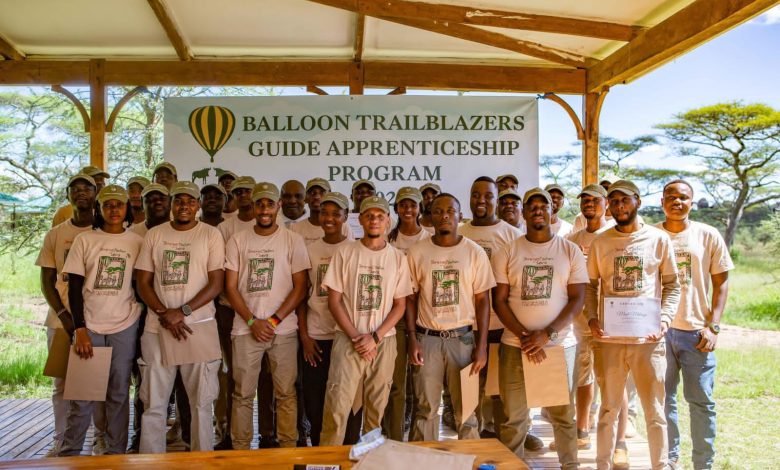
ARUSHA: AN award-winning tourism operator in Arusha is betting that the future of Tanzania’s safari industry depends as much on skills as it does on scenery.
Serengeti Balloon Safaris, a pioneer of balloon tourism with more than 35 years of operations, is expanding its focus beyond luxury travel experiences to workforce development launching an intensive apprenticeship programme aimed at closing the gap between academic training and job readiness.
The company, which has earned back-to-back global accolades as one of the world’s leading balloon safari operators, is now applying the same standards of precision and excellence to human capital through its Trailblazers Guide Apprenticeship Program 2026.
The initiative combines technical instruction with hands-on field training, targeting a long-standing challenge in Tanzania’s labour market: graduates who leave institutions with qualifications but lack practical, deployable skills.
“Internships are increasingly becoming the bridge between education and employment,” said Managing Director John Corse. “For us, investing in people is just as critical as delivering exceptional guest experiences.”
The move comes as tourism consolidates its position as one of Tanzania’s key economic pillars. The sector attracts more than 1.8 million visitors annually, generates about 4.2 billion US dollars in revenue, contributes roughly 17 perrcent to gross domestic product, and supports around 1.5 million jobs.
Despite that growth, employers continue to report a mismatch between what graduates know and what the job requires.
Commercial Manager Pascal Kirigiti said the apprenticeship programme was designed to address that disconnect directly.
“We are investing in training the next generation of experts for this multi-billion-dollar industry,” he said.
Launched in 2025, the programme has completed its second intake, with participant numbers rising to 28 from 22 in the first year. The cohort includes three women, reflecting incremental progress toward gender inclusion in a traditionally male-dominated field.
The training model builds on the company’s decades-long internal systems, formalised into a three-week intensive course followed by extended, structured mentorship. Participants are trained in defensive and off-road driving, wilderness first aid, vehicle maintenance, safety protocols, Tanzania National Parks (TANAPA) regulations, and high-end customer service.
From the group, the top 10 trainees progress into a two-year apprenticeship as transfer drivers, while the remaining participants are supported in securing roles across the broader tourism sector.
For participants such as Shamsila Kiula, the impact is immediate.
“At present, I feel fully competent to work anywhere,” he said. “I am confident I can be employed by any tourism company because I have received far more than classroom training through hands-on experience.”
The programme is fully funded by Serengeti Balloon Safaris, removing financial barriers to entry while aligning training with industry needs.
It also reflects a broader regional challenge. According to studies by the Inter-University Council for East Africa (IUCEA) and the East African Business Council (EABC), more than half of university graduates lack basic workplace competencies.
In Tanzania, only 39 percent of graduates are considered fully job-ready, compared with 49 percent in Kenya, 48 percent in Rwanda, 45 percent in Burundi, and 37 percent in Uganda, underscoring a systemic gap between education systems and labour market expectations.
For analysts, the programme highlights the growing role of private-sector intervention in workforce development, particularly in industries where operational demands outpace academic preparation.
For Serengeti Balloon Safaris, the strategy is both philanthropic and pragmatic.
As Tanzania positions itself as a premium safari destination, the quality of its workforce will increasingly define its competitiveness. By investing in practical training, the company is not only addressing an immediate skills shortage but also safeguarding the long-term sustainability of an industry that relies heavily on human expertise.