

Protest led by India’s ‘cockroach party’ enters its third day
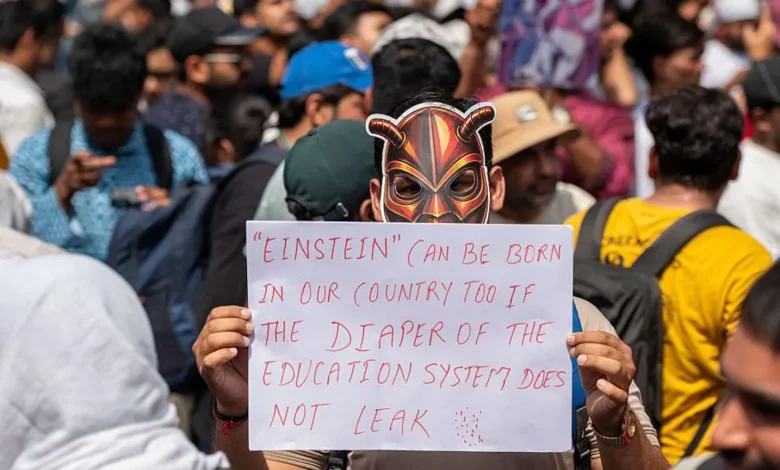
INDIA: HUNDREDS of students, young professionals and job seekers have gathered in India’s capital for a third day of protests demanding Education Minister Dharmendra Pradhan’s resignation over a controversial medical exam.
The demonstration at Delhi’s Jantar Mantar is being led by the Cockroach Janata Party (CJP), a new collective that gained attention online for its satirical take on Indian politics.
The group, whose mascot is a cockroach, takes its name from PM Narendra Modi’s BJP party and says it is campaigning for greater accountability in education.
The protests centre on NEET-UG, one of India’s most competitive medical tests, which was thrown into turmoil after allegations of a paper leak.
The controversy sparked outrage among students and parents, prompting authorities to cancel the results and order a fresh examination.
On Sunday, millions of candidates returned to exam centres across India to sit the test again under heightened security measures, including biometric checks.
The National Testing Agency (NTA), which conducts the exam, later said the re-test had been completed smoothly and that it had received no complaints of paper leaks.
For protesters gathered at Jantar Mantar, however, the re-test has not ended the controversy.
Many say the issue is no longer just about one test, but about accountability for a system they believe has failed millions of students.
“We are here for accountability,” CJP founder Abhijeet Dipke told supporters on Sunday, calling on more people to join the protest.
Dipke, a student at Boston University in the US, arrived in India earlier this month and held the group’s first protest at the same venue before travelling to other cities.
Since then, the collective has drawn growing attention online and organised demonstrations in several parts of the country.
The sit-in began on 19 June after police approved a protest scheduled to end at 17:00 local time (11:30 GMT) on 20 June. When the permit expired, supporters refused to leave, saying they would continue demonstrating until Pradhan resigns.
Several protesters spent the weekend sleeping on mattresses on pavements and blocked roads. Volunteers provided food and water as demonstrators sang, debated education reforms and endured rising temperatures.
Organisers accused police of cutting lights and restricting access to water and toilets after the permit expired, but later said those services had been restored. Delhi Police has not responded to the allegations.
The protest has also drawn support from people with no direct connection to the examination.
“I came because I believe they are doing the right thing,” said Jyoti Thakur, a 23-year-old storekeeper from Delhi.
“The path to a better society is through a better education system.”
Gaurav Jain, a 39-year-old lawyer who spent a night at the protest site, said he joined over concerns about accountability, calling for a more “accountable” education system.
The Education Ministry and the BJP have not publicly responded to demands for Pradhan’s resignation. The BBC has sought comment from both.
The CJP emerged last month after remarks by Surya Kant, India’s chief justice, sparked online outrage.
During a court hearing, he compared some unemployed young people to “cockroaches” and “parasites”, comments critics said belittled a generation struggling to find work.
The judge later said he was referring to people with fake degrees, not young people in general, but the backlash had already spread.




I enjoyed replaying songs in FNF because improving my accuracy little by little felt rewarding, especially after finally clearing tracks that once seemed almost impossible.
One lucky jump in Crossy Road can completely change the feeling of a run, especially when you squeeze through a narrow opening between vehicles and realize you survived by only a fraction of a second.
In Subway Surfers, every swipe can determine whether you keep running for thousands of meters or suddenly get caught by the security guard, forcing players to stay focused from start to finish.
This is such a powerful reminder that young people won’t stay silent when the system fails them. The CJP’s creative, satirical approach makes their message impossible to ignore—and that’s exactly what real change needs. Wishing them strength and a system that finally listens. mermade game