PM names SGR among mega development projects Tanzania implements
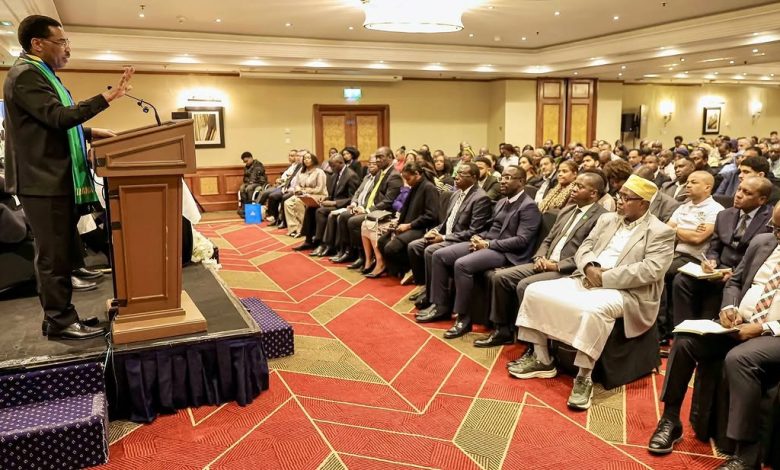
LONDON: PRIME Minister Mwigulu Nchemba has met Tanzanians living in the United Kingdom and neighbouring areas, briefing them on development initiatives undertaken by the Sixth-Phase Government across various sectors.
The meeting brought together approximately 350 Tanzanians representing diaspora groups, including TZ-UK, ATUK, Zanzibar Welfare Association in the UK and Tanzania-UK Business Group, whose members come from different parts of the United Kingdom.
Speaking at the meeting held at the Marble Arch Hotel in London, Dr Nchemba outlined government plans to improve infrastructure, particularly railway transport, oil pipeline construction, education, water supply, electricity and agriculture.
He said Tanzania’s economy had continued to improve despite challenges arising from the COVID-19 pandemic, changes in global trade policies, armed conflicts in various parts of the world, including the Middle East, foreign currency shortages and the floods in Hanang.
On the Standard Gauge Railway (SGR), the Prime Minister said the government had completed construction of the Dar es Salaam–Morogoro–Dodoma section, while contractors were working on the remaining sections, including the proposed railway connection from Kigoma to Musongati in Burundi.
He said construction of the Isaka–Mwanza section was nearing completion, while the government was prioritising the Isaka–Tabora and Isaka–Manyoni sections to connect with Makutupora in Singida Region.
“Our expectation is that before President Dr Samia Suluhu Hassan completes her second term, she will inaugurate the railway connecting Dar es Salaam to Mwanza,” he said.
Regarding the proposed railway linking Uvinza, Kigoma, Musongati in Burundi and Uvira in the Democratic Republic of Congo (DRC), Dr Mwigulu said feasibility studies were ongoing.
He explained that the planned route would extend through Uvinza, Kigoma, Musongati, Gitega, Kindu and Uvira. According to the Prime Minister, once completed, the railway would be the longest in Africa and the fifth-longest in the world.
Dr Mwigulu said implementation of oil pipeline projects was continuing, while the government was still seeking a contractor for the proposed Mtwara–Mbamba Bay railway line.
On water supply, he said fewer than 1,000 villages remained to be reached under the government’s efforts to expand access to clean and safe water.
He added that the government had completed rural electrification in all villages and was now extending electricity to smaller settlements and addressing remaining coverage gaps.
ALSO READ: Forum highlights diaspora investment opportunities
The government was also continuing to promote clean cooking energy as part of efforts to improve household energy access and reduce reliance on traditional cooking fuels.
On education, the Prime Minister said preparations were underway to introduce compulsory education up to Form Four, beginning in January 2028.
He noted that the policy would extend compulsory education beyond the current primary-school level, under which pupils generally complete seven years of primary education.
“By 2028, compulsory education will extend to Form Four instead of ending at Standard Seven, as is currently the case. A total of 3,021,177 pupils are expected to join Form One,” he said.
Dr Mwigulu said preparations included the construction of classrooms, laboratories and workshops to accommodate the requirements of the new curriculum.
“To meet the demands of the new curriculum, we need 80,000 laboratories, 16,000 classrooms and an adequate number of teachers,” he said.
In the health sector, Dr Mwigulu said the government had continued to improve healthcare delivery through the renovation of hospitals and the construction of health centres and dispensaries across the country.
He said the initiatives were intended to bring healthcare services closer to communities, reduce travel distances and improve access to quality medical care.
The Prime Minister added that the Sixth-Phase Government had invested significantly in medical equipment, including diagnostic technologies that were previously available mainly abroad or at the country’s national referral hospital.
“Today, diagnostic services such as magnetic resonance imaging (MRI), computed tomography (CT) scans and ultrasound are available at district hospitals,” he said.
Addressing investment opportunities, Dr Mwigulu said Tanzania’s Development Vision 2050 sets out the country’s ambition to attain upper-middle-income status, supported by a knowledge-driven economy and industrial development.
He emphasised that achieving the vision would require contributions from both the government and the private sector, noting that the government’s primary responsibility was to create an enabling environment for economic growth.
“Numerous opportunities exist in mining, agriculture, livestock, fisheries, tourism and the blue economy. We need all Tanzanians, both at home and abroad, to contribute to this major development agenda,” he said.
The Prime Minister’s engagement with the diaspora was part of his five-day official visit to the United Kingdom, which concluded with discussions on Tanzania’s development priorities and opportunities for investment and cooperation.
Dr Mwigulu was accompanied by Minister for Communication and Information Technology Angella Kairuki, Permanent Secretaries from the President’s Office responsible for Planning and Investment and the Blue Economy, as well as senior executives from the Tanzania Investment and Special Economic Zones Authority (TISEZA) and the Zanzibar Investment Promotion Authority (ZIPA).