Mwinyi commits to improve school infrastructure
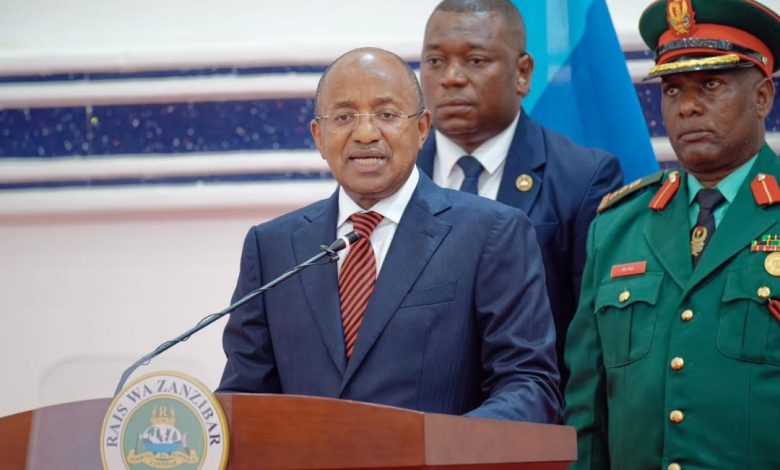
ZANZIBAR: ZANZIBAR President, Dr Hussein Mwinyi, has reaffirmed the government’s commitment to strengthening teaching and learning infrastructure in all public schools across Unguja and Pemba, saying the move is key to enhancing students’ academic performance and improving overall education sector.
President Mwinyi made the remarks recently while inaugurating the model Ramadhan Haji Faki Gamba Secondary School in Unguja North ‘A’ District, an event held as part of celebrating the 62nd anniversary of the Zanzibar Revolution.
The school was officially opened on behalf of a similar technical secondary school recently established on Pemba Island, reflecting the government’s balanced approach to education development across the isles.
The President said the availability of modern infrastructure, including well equipped science laboratories, information and communication technology (ICT) facilities and adequately stocked libraries plays a critical role in enhancing students’ understanding of lessons and improving performance in national examinations.
He expressed satisfaction with the progress achieved by the government in improving teaching and learning environments, noting that a significant number of primary and secondary schools now meet the standards required for the delivery of modern, competitive education.
“With the infrastructure now in place, there is no reason why academic performance should not continue to improve,” said Dr Mwinyi.
He added: “the government has created a conducive environment for both learners and teachers to excel.”
The President further pointed out that the newly inaugurated school is fully equipped with key support facilities, including a cafeteria to provide students with meals, residential houses for teachers and dormitories for students.
“We are moving away from temporary and makeshift schools. Instead, we are building modern institutions with dormitories, cafeterias and teachers’ residences to ensure stability, comfort and efficiency in learning,” he stressed.
Dr Mwinyi explained that students who live far from school often face challenges that negatively affect their learning, including fatigue and poor attendance.
He cited studies showing that students who reside in school dormitories tend to perform better academically due to improved study discipline, time management and access to learning resources.
“There is no doubt that at this school our young people will enjoy a conducive learning and living environment, which will enable them to perform well and excel in national examinations,” he said.
ALSO READ: Govt instructs DEDs to allocate funds for school infrastructure
The President reiterated that the government will continue investing heavily in the education sector by addressing teachers’ welfare and professional needs, improving the availability of teaching and learning materials, and expanding the use of modern technology to ensure that students acquire skills aligned with labour market demands.
Addressing compensation matters, Dr Mwinyi said residents who had been engaged in farming activities on the project site would receive their rightful compensation.
He added that he had also received a request from village elders for the construction of development houses, assuring them that the government would consider the matter in line with existing policies.
On the proposal to name the school after the late revolutionary leader Ramadhan Haji Faki, the President acknowledged his historic contribution to the country’s independence struggle and his distinguished service in government.
He also commended the Ministry of Education and Vocational Training for its effective supervision of the construction of various primary and secondary schools across Unguja and Pemba, as well as the contractor, Zeccon Company Limited, and the project consultant, Arqes Africa, for delivering quality infrastructure.
Deputy Minister for Education and Vocational Training, Ms Khadija Salum Ali, said the compensation process for residents affected by the project was ongoing, assuring that the ministry would ensure all eligible citizens receive their payments through established compensation committees.
She formally requested the President’s approval to name the school after Ramadhan Haji Faki in honour of the revolutionary leader, noting that the area where the school is located is both his birthplace and final resting place.
Ms Khadija said the late Ramadhan was among the 14 members of the 1964 Zanzibar Revolutionary Committee and served the government in several senior leadership positions, including twice as Chief Minister.
North Unguja Regional Commissioner, Mr Galos Nyimbo, praised President Mwinyi as a hardworking leader who listens to citizens’ concerns and delivers development projects at a commendable pace.
He said Zanzibar residents were fortunate to have a leader committed to improving social services such as education and healthcare, as well as physical infrastructure, particularly road networks, and urged him to maintain the same development momentum.
Providing technical details of the project, Permanent Secretary in the Ministry of Education and Vocational Training, Mr Khamis Abdulla Said, said the school was constructed under joint financing by the African Development Bank and the Revolutionary Government of Zanzibar.
He explained that the project includes classrooms, teachers’ houses, student dormitories and a cafeteria, all designed to meet modern education standards.
Mr Khamis said construction began in March, last year under Zeccon Company Limited, with Arqes Africa Limited serving as the supervising consultant.
The project has reached 97 per cent completion at a total cost of 11.02bn/-, of which 8.8bn/- has already been paid to the contractor.
Regarding the technical secondary school on Pemba Island, Mr Khamis said it was constructed by Salem Construction at a cost of 9.4bn/-, with 9.2bn/- equivalent to 98 per cent of the contract value already disbursed.
He added that the singlestorey school comprises 18 classrooms, a head teacher’s office, staff offices, three laboratories, a computer room, a library, a guidance and counselling room, and a cafeteria.
Each of the two schools has the capacity to enroll 810 students, with an average of 45 students per classroom.
Teachers’ houses can accommodate eight families, while separate male and female dormitories can each house up to 152 students.