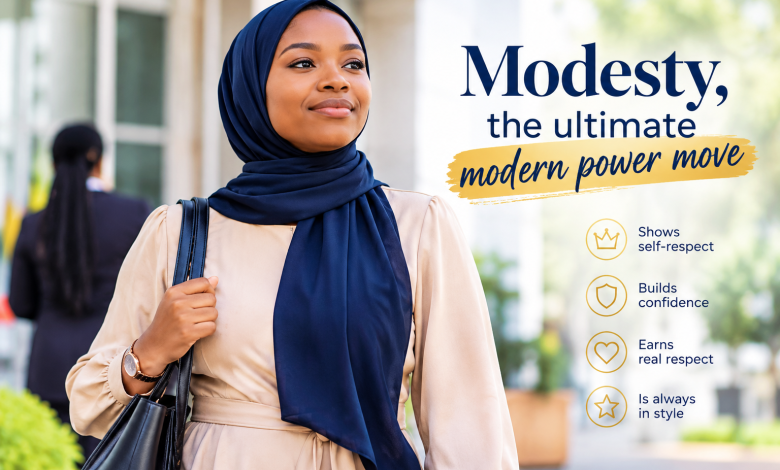
Modesty, the ultimate modern power move
DAR ES SALAAM: WE live in an age of aggressive exposure, where privacy is treated as a liability and visibility as a form of currency. Modern culture not only encourages self-promotion but increasingly demands the commercialisation of human experience.
In a world where algorithms influence perceptions of human worth and private moments are harvested for public consumption, a quiet form of resistance is emerging.
It is rooted in the ancient Islamic concept of Haya, an Arabic term commonly translated as modesty, whose meaning extends far beyond outward appearance.
Rather than a restrictive relic of the past, modesty is proving to be a powerful modern virtue, serving as a psychological shield, a spiritual anchor and a declaration of personal sovereignty. In a fractured, overstimulated society, it also offers a timeless path towards inner tranquillity and peaceful coexistence.
To appreciate its liberating power, we must look beyond misconceptions that reduce modesty to clothing and physical appearance. Although dress remains an important aspect of Islamic practice, Haya is a holistic principle that applies equally to men and women. It encompasses speech, behaviour, intentions and thoughts, shaping how individuals conduct themselves in private and public life.
The Prophet Muhammad emphasised the centrality of modesty in Islam, teaching that every religion has a distinctive characteristic and that modesty is the characteristic of Islam.
At its heart, Haya is an internal sense of dignity that naturally influences outward conduct. It guides professionals to conduct business ethically, individuals to exercise discipline in their online activities, neighbours to treat one another with kindness and everyone to move through public spaces with respect and consideration. It is a conscious commitment to navigating life with grace, composure and restraint.
Such restraint is particularly valuable in today’s attention economy, where visibility and digital popularity are increasingly mistaken for personal worth. From an early age, people are encouraged to seek validation through likes, views, shares and followers. This pressure can contribute to anxiety, dissatisfaction with one’s appearance and psychological exhaustion. Authentic modesty offers an alternative.
By establishing healthy boundaries around what others can see, analyse and know about their lives, individuals reclaim control over their privacy and self-worth. Their bodies are not public property, nor must their private experiences become entertainment for strangers.
Modesty encourages people to look beyond fickle public opinion and changing digital trends, recognising that human dignity is not determined by online engagement. For believers, worth is ultimately grounded in their relationship with the Creator.
ALSO READ: Experts tasked with mobilising climate financing
This perspective offers freedom from the exhausting pursuit of constant approval and peace in living according to deeply held values. However, the peace cultivated through modesty is not meant to remain an individual possession. It should extend into the wider community.
In professional, political and social settings, aggression and excessive self-assertion are often mistaken for strength. Islam offers a different understanding, placing humility, gentleness and restraint at the heart of genuine character.
A person guided by modesty avoids vanity, refrains from harmful gossip, handles disagreements with dignity and speaks with kindness. In leadership, these qualities encourage accountability, ethical responsibility and respect for others—virtues urgently needed in corporate, social and political institutions.
Such gentleness is not weakness; it is disciplined strength that earns lasting respect rather than temporary attention. When people engage with others from a position of humility rather than ego, hostility can give way to understanding. The relevance of Haya also extends beyond religious boundaries, offering a common foundation for people of different cultures and beliefs to live harmoniously.
At its core, modesty challenges arrogance, which encourages individuals and groups to regard themselves as superior to others. Such attitudes have contributed to discrimination, division and conflict throughout history. Humility, by contrast, reminds us of our shared vulnerabilities and mutual dependence.
It encourages us to see others not as rivals to defeat or objects to exploit, but as fellow human beings navigating the complexities of life. Whether practised by Muslims or people from other religious, cultural or secular backgrounds, the principles of humility, respect for privacy, responsible speech and ethical restraint can strengthen mutual understanding and reduce social tensions.
As society moves deeper into the digital age, protecting personal privacy and human dignity will become increasingly challenging. Generative artificial intelligence, immersive virtual realities and expanding digital platforms are continually reshaping personal boundaries.
Without responsible limits, human experiences risk becoming commodities shaped by commercial interests and algorithms. Islamic modesty offers a valuable framework for navigating these changes without sacrificing our humanity.
It reminds us that some experiences are too sacred to broadcast, some values too precious to trade for online attention, and human character too complex to be measured through a camera lens or digital profile.
Choosing modesty today is therefore a deliberate act of resistance against a culture of constant exposure. It means valuing substance over appearance, treating others with dignity and recognising the freedom that comes from living beyond the relentless demand for public approval.
Through this quiet revolution of character, Haya can help individuals find inner peace and communities discover common ground. Ultimately, modesty is not about disappearing from the world; it is about participating in it with dignity, responsibility and compassion.
In a society increasingly driven by visibility and self-promotion, it reminds us that true power lies not in attracting the most attention, but in building character, respecting others and creating the conditions for lasting peace.