Kapologwe eyes ECSA-HC expansion as São Tomé and Príncipe moves closer to membership
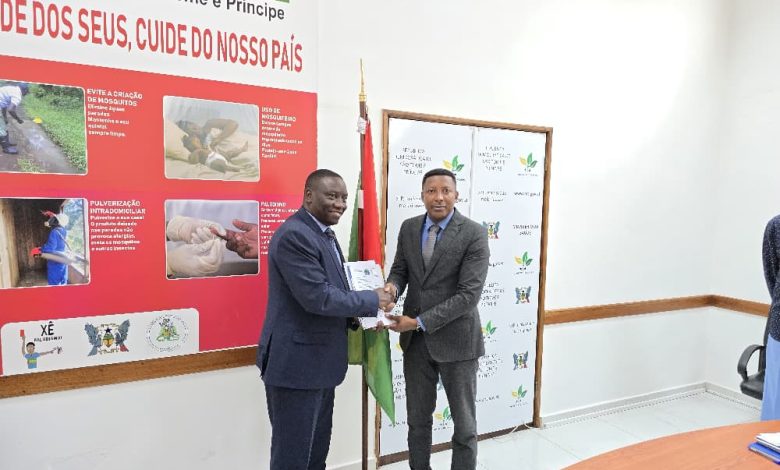
SAO TOME: The East, Central, and Southern Africa Health Community (ECSA-HC) is poised to broaden its regional footprint after Director General Dr. Ntuli Kapologwe led a high-level mission to the Democratic Republic of São Tomé and Príncipe this week.
The visit was followed by an official invitation from the island nation to join the regional health body as a full member state.
During the mission, Dr. Kapologwe met with Sao Tome’s Minister of Health Dr. Celso Vaz do Nascimento Matos for discussions on cooperation and potential membership where the two leaders exchanged documents marking the beginning of what could become a historic expansion of ECSA-HC, ahead of the signing of a binding memorandum of understanding.
Dr. Kapologwe, the Tanzanian national who was elected as Director General of ECSA-HC earlier this year in Malawi by the Ministers of Health, underscored the mutual benefits of the move, noting that the membership would grant São Tomé and Príncipe access to ECSA-HC’s wide range of initiatives and training opportunities through its colleges, while the community would gain from the island nation’s experience in health systems management.
Although not yet a member, São Tomé and Príncipe is already a close partner of ECSA-HC through the World Bank–funded Health Emergency Preparedness, Response and Resilience (HEPRR) program, which is helping to build capacity for outbreak detection and crisis management.
ALSO READ: US reaffirms strong partnership with Tanzania
The country has also been included in the Pandemic Fund proposal and other regional projects coordinated by ECSA-HC that are expected to enhance service delivery and health system resilience.
Over the coming two weeks, ECSA-HC technical team will provide São Tomé and Príncipe with technical support that covers the development of a two-year operational plan for surveillance, preparedness and response, the co-design of digital antimicrobial resistance surveillance tools with experts from Zambia and Kenya, the strengthening of digital health systems through a pilot on border screening, and the advancement of laboratory quality through WHO/AFRO SLIPTA audits.
These interventions are intended to boost preparedness, improve surveillance, and enhance resilience while positioning São Tomé and Príncipe as a source of lessons for other countries in the HEPRR program.
Dr. Kapologwe stressed that while ECSA-HC primarily operates through its member states, several projects extend beyond membership to ensure Africa as a whole benefits from cross-border health initiatives. He pointed out that São Tomé and Príncipe’s progress under the HEPRR program already reflects this vision, citing the completion of a Strategic Risk Assessment, the validation of the Public Health Emergency Operations Center’s Business Continuity Plan, the development of contingency plans for national and hazard-specific threats, a full-scale outbreak simulation exercise, and improvements in International Health Regulations compliance at four Points of Entry.
Admitting São Tomé and Príncipe, a Lusophone island nation of about 240,000 people, would symbolically extend ECSA-HC’s reach beyond mainland Africa for the first time.
“With a population of 240,000, São Tomé and Príncipe may be small in size, but its contribution to regional health security could be enormous,” Dr. Kapologwe observed. “Its experience in managing health systems on islands will enrich our collective response to pandemics and emergencies.”
The potential membership underscores a broader recognition that health threats do not respect borders. By strengthening networks of cooperation, ECSA-HC is building a more resilient region ready to face the challenges of future public health crises.