How SBL is investing in Tanzania’s youth to build a better future
DAR ES SALAAM: “THE future belongs to those who prepare for it today.” While this saying popularised by Malcom X has endured for generations, its relevance has perhaps never been greater than it is today.
Tanzania is home to one of Africa’s youngest populations, with millions of young people entering the labour market every year carrying ambition, determination and dreams of building better lives. Yet for many, the greatest obstacle is not a lack of potential, but limited access to practical skills and opportunities that connect education with the realities of the workplace.
As the world marks World Youth Skills Day, the conversation goes beyond employment statistics. It is about ensuring that young people possess the knowledge, confidence, and experience needed to participate meaningfully in the country’s economic transformation. Governments cannot achieve this alone. Educational institutions need industry partnerships, and businesses have an increasingly important role to play in preparing the workforce of tomorrow.
For Serengeti Breweries Limited (SBL), investing in youth skills has become one of the company’s most enduring contributions to sustainable development. Beyond brewing some of Tanzania’s most recognised brands, SBL has spent years investing in programmes that create opportunities for young people across sectors critical to the country’s growth. Whether supporting future agricultural professionals through the Kilimo Viwanda Scholarship Programme or preparing aspiring hospitality professionals through the Learning for Life Programme, the company’s approach is built on a simple belief: when young people are equipped with the right skills, entire communities benefit.
That investment has already reached hundreds of lives. Through the Kilimo Viwanda Scholarship Programme, more than 300 young Tanzanians from farming communities have received support to pursue agricultural education, enabling them to acquire modern farming knowledge and technical expertise that they are now taking back to their communities.
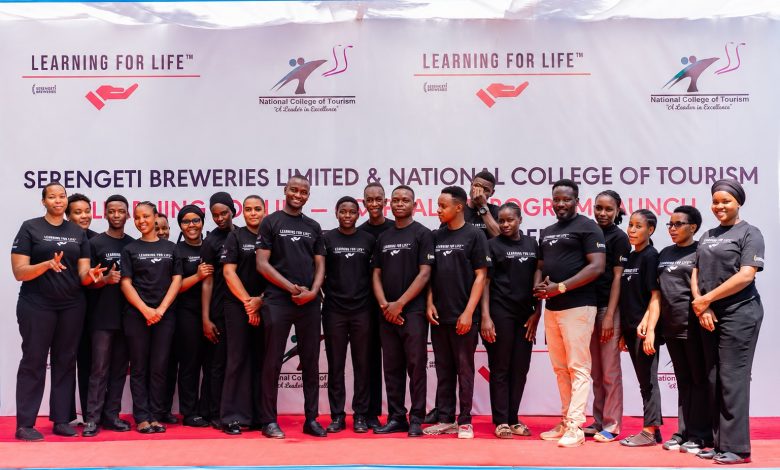
At the same time, SBL’s Learning for Life programme, delivered in partnership with the National College of Tourism (NCT), has opened new doors for young people aspiring to build careers in Tanzania’s rapidly growing tourism and hospitality industry. The first cohort empowered 100 young people, many of whom have already transitioned into employment, while the second cohort of 200 students is recently completed the hospitality training course.
For Hansen Morris, one of the beneficiaries of the Learning for Life programme, the opportunity represented much more than acquiring technical hospitality skills.
“Before joining Learning for Life, I knew I wanted to pursue a career in hospitality, but I wasn’t confident enough to compete in the job market. The programme gave me practical experience, improved my communication skills and taught me what employers expect in a professional environment. Today, I feel proud that I am building a long-term career in the hospitality industry. The skills and confidence I gained through this programme have opened doors for me and given me a clear path towards achieving my goals in an industry I genuinely love.”
The impact of this initiative is perhaps most visible inside the classroom, where educators witness first-hand how industry partnerships prepare students for life beyond graduation. According to Miss Mariam Mambosasa a Learning for Life programme supervisor at the National College of Tourism, combining academic learning with practical workplace experience significantly improves students’ readiness for employment.
“Learning for Life complements what students learn in the classroom by exposing them to real industry expectations. Beyond hospitality techniques, they develop confidence, teamwork, communication and problem-solving skills that employers consistently look for. As educators, it is encouraging to see students become more self-assured and career-ready because of programmes like this. Partnerships with organisations such as Serengeti Breweries Limited help bridge the gap between education and employment while giving our students a clearer pathway into the workforce.”
While some young people found opportunity in hotels and restaurants, others discovered a future in agriculture. For many participants of the Kilimo Viwanda Scholarship Programme, agriculture has evolved from being viewed as a traditional livelihood into a profession driven by innovation, sustainability and entrepreneurship.
One of the scholarship beneficiaries Octavian Burchard, says the programme transformed both his perspective and his aspirations.
“The scholarship allowed me to study agriculture without worrying about financial barriers. More importantly, it helped me understand that agriculture is one of Tanzania’s biggest economic opportunities. I now have the knowledge to help farmers improve productivity while creating opportunities for myself and my community. I want young people to see agriculture not as a last option, but as a profession with endless possibilities.”
The Kilimo Viwanda Scholarship Programme continues to strengthen agriculture by nurturing young professionals who understand modern farming practices, sustainable production and agribusiness. Many graduates return to farming communities equipped not only to improve productivity but also to inspire other young people to see agriculture as a viable and rewarding career.
Collectively, these initiatives demonstrate that meaningful investment in youth extends far beyond financial support. It requires long-term partnerships, practical learning opportunities and a commitment to helping young people transition successfully from education into employment. They also highlight the increasingly important role the private sector can play in addressing one of Tanzania’s greatest development priorities building a skilled, competitive and resilient workforce.
ALSO READ: Youth employment: Informal markets as opportunity or survival
As Tanzania commemorates World Youth Skills Day, this year’s commemoration carries special significance for the country as the implementing of the country’s Development Vision (DIRA) 2050 unfolds. At the heart of the Vision is a bold ambition to build an educated, highly skilled and globally competitive workforce capable of driving innovation, entrepreneurship and sustainable economic growth. It recognises that Tanzania’s greatest asset is its people, particularly its young population, and calls for greater investment in practical skills, technology, creativity and lifelong learning to prepare them for the jobs and industries of the future.
Achieving these ambitions will require close collaboration between government, academia and the private sector to ensure young Tanzanians are equipped not only to find employment, but also to create opportunities, solve challenges and contribute meaningfully to national development.