

From historic friendship to strategic partnership, Tanzania, China build shared future together peacefully
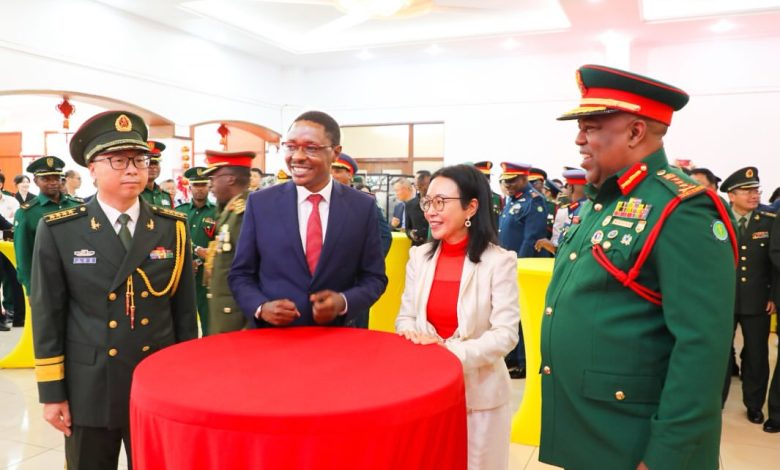
DAR ES SALAAM: THE longstanding friendship between Tanzania and China continues to evolve into a broader strategic partnership built on mutual trust, shared development aspirations and cooperation across multiple sectors.
From infrastructure and economic development to defense, education, technology and people to-people exchanges, relations between the two countries have remained among the strongest examples of enduring bilateral cooperation in Africa.
This shared commitment featured prominently during celebrations marking the 99th anniversary of the founding of the Chinese People’s Liberation Army (PLA) in Dar es Salaam, where senior leaders from both countries reaffirmed their dedication to strengthening diplomatic, security and development ties while promoting regional and global peace.
Chinese Ambassador to Tanzania Chen Mingjian described the PLA’s nearly century-long history as one shaped by resilience, national service and continuous modernisation.
Founded on August 1, 1927, the PLA has played a central role in safeguarding China’s sovereignty, territorial integrity, national development and the security of its people.
Beyond its national responsibilities, the Ambassador said the PLA has increasingly contributed to international peace through participation in United Nations peacekeeping operations, maritime security missions, humanitarian assistance, arms control cooperation and efforts addressing global security challenges, including terrorism and cybersecurity.
She emphasised that China’s defense policy remains defensive in nature, guided by principles of self-defense and active defense while supporting peaceful international cooperation.
According to Ambassador Chen, a stronger China contributes positively to international peace and stability by promoting cooperation rather than confrontation.
Looking ahead to the PLA’s centenary in 2027, she said China will continue modernising its armed forces while safeguarding national sovereignty, supporting development and contributing to global peace.
While outlining China’s defence priorities, Ambassador Chen devoted considerable attention to the enduring friendship between China and Tanzania, describing it as one of the strongest and most consistent bilateral relationships on the African continent.
She noted that the relationship was established during the 1960s by the founding leaders of both countries and has continued to strengthen through successive generations.
According to her, China has consistently regarded Tanzania as a trusted friend and important strategic partner, with both countries supporting one another throughout their respective journeys toward national development and modernisation.
She cited the TanzaniaZambia Railway (TAZARA) as one of the most enduring symbols of this friendship, alongside numerous defence cooperation projects, including the Tanzania Military Academy, Kigamboni Naval Base, the Military Aviation School and the National Defence College of Tanzania.
These institutions, she said, stand as lasting reminders of decades of practical cooperation between the two nations.
ALSO READ: Tanzania, China deepen ties
Ambassador Chen also highlighted growing political engagement between the leadership of both countries. Since 2022, Chinese President Xi Jinping and President Samia Suluhu Hassan have met on three occasions, leading to the elevation of bilateral relations to a Comprehensive Strategic Cooperative Partnership.
She described this milestone as reflecting the increasing importance both governments attach to strengthening cooperation across political, economic, security and cultural sectors. Military cooperation continues to form an important pillar of the broader partnership.
According to Ambassador Chen, the Chinese People’s Liberation Army and the Tanzania People’s Defence Force (TPDF) have maintained close cooperation through high-level exchanges, professional training, joint exercises, infrastructure development, equipment support and institutional capacity-building.
She reaffirmed China’s commitment to supporting the continued modernisation of the TPDF while expanding practical cooperation that contributes to peace, security and stability across Africa.
Addressing the gathering, Chinese Defence Attaché Senior Colonel Wang Haiju reflected on the historical development of the PLA, describing the Long March between 1934 and 1936 as one of the defining moments in modern Chinese history.
He explained that despite overwhelming military challenges, the Red Army completed the arduous journey, laying the foundation for China’s future development while establishing enduring values of discipline, resilience, unity and determination.
According to him, these principles continue to shape the professional character of today’s PLA. Senior Colonel Wang said the contemporary security environment remains increasingly complex, requiring stronger international cooperation rather than unilateral responses.
He noted that China continues contributing to global peace through United Nations peacekeeping missions, humanitarian operations and maritime security.
Since joining UN peacekeeping operations in 1990, China has participated in 26 missions, deploying more than 50,000 peacekeepers to over 20 countries and regions.
Currently, more than 1,600 Chinese peacekeepers serve in countries including South Sudan and the Democratic Republic of Congo, undertaking responsibilities such as civilian protection, demining, medical assistance and stabilisation operations.
China has also deployed dozens of naval escort missions to the Gulf of Aden and waters off Somalia to help secure international shipping against piracy.
According to Senior Colonel Wang, these activities demonstrate China’s commitment to supporting international peace and stability through practical cooperation.
Turning to bilateral defence relations, he described the PLA and TPDF as trusted partners whose cooperation spans military education, professional exchanges, technical collaboration, joint exercises and equipment support.
He announced that military equipment valued at approximately 15 million US dollars had been donated by China and was expected to arrive in Tanzania before the end of the month, further supporting the modernisation of the Tanzania People’s Defence Force.
The significance of the partnership was equally underscored by Tanzania’s Minister for Defence and National Service, Dr Rhimo Nyansaho, who described relations between the two countries as being founded upon decades of friendship, mutual respect and shared aspirations for peace and development.
He acknowledged the contribution made by the PLA in protecting China’s sovereignty while also participating in international peacekeeping, humanitarian assistance and defence diplomacy.
According to Dr Nyansaho, these values closely align with those upheld by the Tanzania People’s Defence Force, whose guiding principles include patriotism, discipline, professionalism, loyalty and service to the nation.
He traced the origins of bilateral defence relations to the visionary leadership of the late Mwalimu Julius Nyerere and Chairman Mao Zedong, whose commitment established the enduring friendship that continues to unite Tanzania and China today.
The Minister said Tanzania highly values this longstanding relationship, describing China as a trusted and reliable partner whose cooperation has benefited both countries across numerous sectors.
He welcomed the elevation of bilateral relations to a Comprehensive Strategic Cooperative Partnership, describing it as an important milestone achieved through the leadership of President Samia Suluhu Hassan and President Xi Jinping.
According to Dr Nyansaho, cooperation between the two countries now extends far beyond defence, encompassing infrastructure development, trade, investment, education, agriculture, health, science, technology and cultural exchanges.
Within the defence sector, collaboration continues through military training, exchange programmes, capacity building, defence diplomacy, joint exercises and medical outreach initiatives.
He said these programmes strengthen institutional capabilities while promoting mutual understanding and professional cooperation between the armed forces of both countries.
Dr Nyansaho observed that today’s international security landscape presents increasingly complex challenges, including terrorism, cybercrime, maritime insecurity, transnational organised crime, pandemics, natural disasters and the rapid evolution of technology.
Addressing such threats, he said, requires international cooperation, innovation, information sharing and sustained partnerships.
“No country can effectively confront contemporary security challenges alone,” he noted, emphasising the importance of strengthening defence cooperation and building collective capacity.
He expressed confidence that the PLA would continue contributing to regional and international peace while further strengthening cooperation with friendly nations, including Tanzania.
The Minister reaffirmed Tanzania’s commitment to working closely with China in advancing mutually beneficial defence cooperation while supporting broader development objectives.
He also noted that both countries attach importance to preserving and promoting their national languages as part of cultural identity and international engagement.
Just as China promotes the Chinese language globally, Tanzania continues expanding the international use of Kiswahili as a language of unity, cultural exchange and diplomacy.
Throughout the commemorative event, one message remained consistent across all speakers: Tanzania-China relations continue to be guided by friendship, mutual respect, equality and practical cooperation.
Both countries view their partnership not simply as a bilateral relationship but as a platform for advancing peace, development, security and shared prosperity.
As global challenges continue evolving, Tanzania and China reaffirmed their determination to deepen cooperation across defence, diplomacy, economic development and people-to-people exchanges, strengthening a partnership that has endured for more than six decades and continues to contribute to regional stability and sustainable development.



References:
Sg Casino Bewertung https://ntsr.info