EACJ hits silver jubilee with commitment to accelerate development, protect regional trade
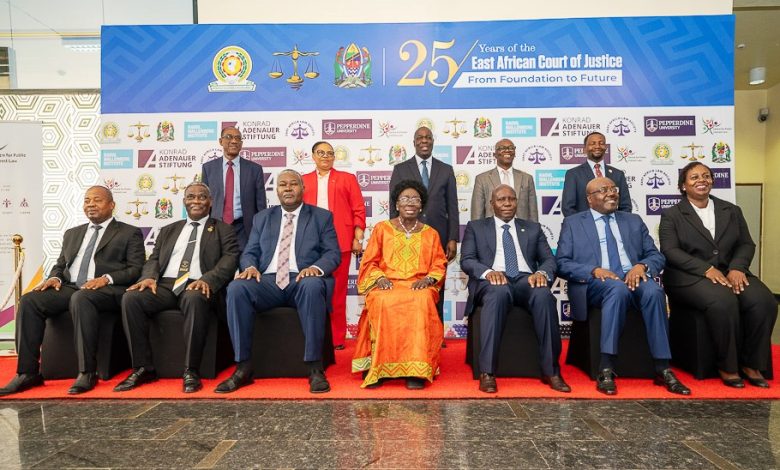
ARUSHA: THE first Deputy Prime Minister, who serves as the minister for East African Community Affairs, Rebecca Kadaga, has urged the East African Court of Justice (EACJ) to ensure member states implement its judgments and remove unnecessary barriers to regional trade to accelerate the Community’s development.
Speaking during the 25th Anniversary Celebrations of the East African Court of Justice Silver Jubilee held on November 12 at the East African Community Headquarters in Arusha, Kadaga, who was the guest of honour, said the Court was established to safeguard the Community and ensure that its Treaty provisions are respected by member states.
She said the success of regional integration depends on the production of goods and services as well as access to wider markets, stressing that member states should remove barriers that prevent goods from crossing borders and reaching consumers.
“The Court should ensure that traders and investors operate in an environment of fairness and legal certainty. Delays in development projects caused by prolonged legal proceedings can undermine the development of citizens,” she said.
Ms Kadaga said the administration of justice should take into account Africa’s economic and social realities, emphasising that law should serve as an instrument for social transformation and economic liberation rather than being treated solely as an academic subject.
On his part, President of the East African Court of Justice (EACJ) Justice Nestor Kayobera, said that despite the achievements made over the past 25 years, ensuring that member states implement the Court’s judgments remained a major challenge.
He said the Court’s authority should not be measured only by the quality of its decisions but also by their implementation, urging member states to cooperate in ensuring that judgments are respected to strengthen the rule of law and public confidence in the institution.
He also said the question of securing a permanent seat for the Court should continue to receive attention as part of its long-term institutional development.
“We are celebrating 25 years of the Court, but it is still operating in Arusha from temporary premises. Therefore, 25 years have passed without a permanent seat, and we believe that leaders, particularly political leaders, should reflect on this matter,” he said.
Justice Kayobera also highlighted the importance of expanding the Court’s jurisdiction to cover trade, investment and the East African Monetary Union, while increasing public awareness of its work through legal education, the media and digital platforms.
EAC Secretary General Stephen Mbundi said the Court had registered a total of 1,032 cases by August 2026, reflecting its growing importance in resolving disputes relating to the interpretation and implementation of the Community Treaty.
He said the expansion of EAC membership from three countries when the Court began operating in 2001 to eight currently requires increased investment in human, financial and technological resources to enable the institution to effectively discharge its mandate.
He added that the use of alternative dispute resolution mechanisms should be strengthened, particularly in trade and investment matters, to provide traders and investors with timely and affordable access to justice.
“The EAC Secretariat will continue working with the Court and member states to identify ways of strengthening its capacity and ensuring that recommendations from this meeting are presented to the relevant Community organs,” Mr Mbundi said.
Meanwhile, Tanzania’s Solicitor General, Dr Ally Possi, said the country plays an important role in the operations of the East African Court of Justice because it hosts the EAC Headquarters and the Court conducts its activities in Arusha.
He said Tanzania is among the stakeholders involved in the Court’s judicial proceedings and therefore has a responsibility to ensure that the institution contributes to the economic development of people across the East African Community.
“The Court should give greater attention to cases involving trade, investment and economic matters in order to strengthen the business environment and enable citizens, including Tanzanians, to benefit from regional integration,” Dr Possi said.
He added that, as emphasised by the chief guest, judges should ensure that court decisions do not create unnecessary obstacles to development projects being implemented by member states, noting that such projects contribute to the growth of national economies and improve citizens’ livelihoods.
Dr Possi stressed that the Court has an important role in promoting domestic and regional trade and investment by ensuring that justice is administered while also taking into account the EAC’s economic development needs.
The anniversary celebrations were held under the theme “From Foundation to the Future”, focusing on reviewing the Court’s journey since it began operations on November 30, 2001, and setting out priorities for strengthening its performance over the next 25 years.
ALSO READ: Office of Solicitor General takes lesson from EACJ
Arumeru District Commissioner Neema Lungangira, representing Arusha Regional Commissioner Amos Makalla, said the East African Court of Justice should keep pace with changes in digital technology, particularly the use of social media and digital tools in electoral processes across Africa.
She said she had participated in a technical committee that developed guidelines on the use of social media and digital tools in elections through the Association of African Election Authorities, emphasising that as these technologies increasingly influence elections, democracy and cross-border governance, judicial systems must prepare to address the emerging challenges.
She added that the Court’s next 25 years should not focus solely on the delivery of justice but also on ensuring that justice keeps pace with global changes.