EAC urged to shield economies from global shocks
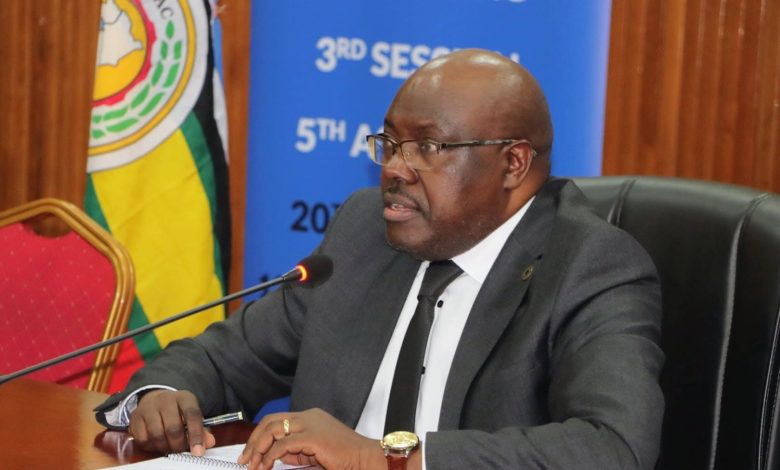
ARUSHA: EAST African Community (EAC) member states must boost intra-regional trade, diversify markets and build resilient supply chains to protect their economies from global shocks, the head of the bloc’s regional parliament said.
Speaking at the opening of an East African Legislative Assembly (EALA) seminar in Arusha yesterday, EALA Speaker, Joseph Ntakirutimana said rising geopolitical tensions, wars, protectionism and supply chain disruptions required a coordinated regional response.
While geographically distant from major global conflict zones, EAC economies remain exposed to international commodity price swings, food and energy insecurity, and rising transport costs, Ntakirutimana told lawmakers.
“These developments remind us that economic security is increasingly becoming an integral component of national and regional security,” he said, urging member states to accelerate regional integration, improve infrastructure and promote local value addition.
Ntakirutimana called on national and regional lawmakers to use legislation, oversight and budget approvals to ease cross-border trade, protect strategic industries and prevent regional conflicts.
Held under the theme ‘Global Conflicts and Changing Trade Dynamics: Parliamentary Strategies for Safeguarding EAC Trade, Regional Economic Security and Integration’, the seminar focused on how regional parliaments can help protect member states’ economic interests amid growing global uncertainties.
Mr Ntakirutimana said rising geopolitical tensions, ongoing wars, increasing protectionism and disruptions in global supply chains were creating economic uncertainties that required coordinated regional responses.
He said the changing global economic environment presented both challenges and opportunities for the regional bloc, making it necessary for member states to strengthen economic resilience, promote value addition, diversify markets, improve strategic infrastructure and accelerate the implementation of regional integration commitments.
He emphasised that parliaments had a critical responsibility to promote regional economic cooperation through legislation, government oversight, budget approval, accountability and engagement with stakeholders.
Such interventions, he said, could help strengthen regional value chains, facilitate cross-border trade, enhance food security, protect strategic industries and promote sustainable economic growth.
He expressed confidence that discussions would generate practical recommendations to help the EAC address emerging global challenges while advancing its vision of a prosperous, peaceful and integrated East Africa.
ALSO READ: Liberation parties vow to strengthen regional economies
“Our region should never experience conflicts. We must ask ourselves what can cause conflicts and wars in East Africa, how we can prevent them and which mechanisms can provide solutions when conflicts arise,” he said.
President of the AfricanEuropean Parliamentarians Initiative (AEPI), Mr Brendan Howlin, echoed the call, saying global conflicts have exposed Africa’s vulnerability in food and energy supplies.
He called on African countries to strengthen intracontinental trade, reduce dependence on external supply chains and build economic self-reliance amid growing global uncertainties.
“Both Africa and Europe need to urgently address our dependence on no longer reliable supply chains. We have to stimulate intra-continental trade, decrease reliance on external supply chains and build self-reliance,” he said.
The Chairperson of the Committee on Regional Affairs and Conflict Resolution, Mr Godfrey Mwangi, said conflicts in different parts of the world, including the Russia-Ukraine war and tensions in the Middle East, had far-reaching economic consequences for East African countries.
“Whatever happens in any part of the world has a ripple effect elsewhere. We are living in a global village, where when one member is affected, the consequences are felt by others,” he said.
He said the seminar was expected to examine the implications of changing global trade dynamics for the EAC, identify strategies for protecting regional economic and trade interests, particularly under the African Continental Free Trade Area (AfCFTA), and explore ways of strengthening regional integration.
EALA Member of Parliament from Tanzania, Mr Cosato Chumi, said lasting peace and security were essential for promoting trade among partner states, reducing business costs and attracting investment.
He said regional integration should go beyond bringing citizens of member states together to creating opportunities for trade, investment and collective economic growth.
“Instead of depending heavily on goods and services from distant markets, we should strengthen trade among ourselves. If our region is peaceful and stable, we can trade with one another and reduce the costs associated with importing products from faraway countries,” he said.
Mr Chumi said the EAC, with a population of more than 360 million people, represented a huge potential market whose benefits could only be fully realised if member states-maintained peace, security and political stability