DSE turnover falls 22 pc as market holds firm, reforms deepen liquidity
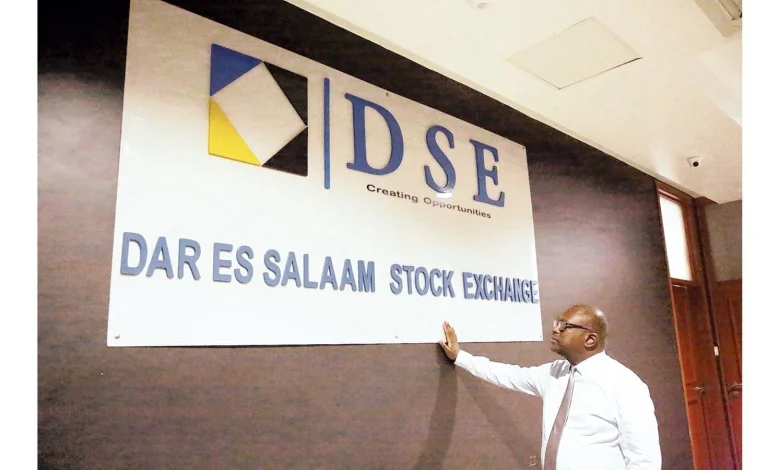
DAR ES SALAAM: TRADING activity on the Dar es Salaam Stock Exchange (DSE) moderated during the week ended August 21st, 2026, with total turnover declining by 22.5 per cent to 23.30bn/-, from 30.05bn/- in the preceding week.
The decline in turnover was accompanied by a 13.9 per cent reduction in share volume, from 8.43 million shares to 7.26 million shares, suggesting a broad moderation in trading activity.
Despite the softer turnover, the market’s overall capitalisation remained relatively stable, increasing marginally by 0.4 per cent to 37.05tri/- from 36.90tri/-, indicating that the decline in trading activity did not translate into significant broad-based price weakness.
Trading remained highly concentrated among a few counters, with NMB, CRDB and NICO accounting for the bulk of market activity.
NMB led turnover with approximately 11.53bn/-, equivalent to 49.5 per cent of total market turnover, followed by CRDB at 6.10bn/- or 26.2 per cent.
NICO contributed 2.25bn/-, representing 9.7 per cent of turnover, while KCB and DCB accounted for 3.9 per cent and 3.0 per cent, respectively.
Collectively, the five most actively traded counters generated approximately 21.47bn/-, representing about 92 per cent of weekly turnover.
This concentration points to continued investor preference for a relatively small group of liquid counters.
The week’s strongest price appreciation was recorded in TOL, whose share price increased by 17.45 per cent to 1,750/-.
The counter was followed by MBP, which gained 9.52 per cent to 1,840/-, while DCB rose by 8.60 per cent to 505/-.
MCB and TTP also recorded positive movements of 6.17 per cent and 5.56 per cent, respectively.
The gains across these counters indicate selective buying interest, particularly in stocks outside the market’s largest and most actively traded counters.
On the downside, PAL recorded the largest decline, falling 8.70 per cent to 315/-, followed by NMG, which declined by 7.27 per cent to 255/-.
NICO fell by 1.57 per cent to 3,760/-, while TCC and DSE each declined by 1.44 per cent and 1.37 per cent, respectively.
The relatively moderate declines among most of the leading losers, combined with the gains recorded across several counters, suggest that the week’s market movement was characterised more by stock-specific price adjustments than by broadbased selling pressure.
Total market capitalisation increased to 37.05ri/-, while domestic market capitalisation was broadly unchanged at 25.34tri/-, compared with 25.37tri/- in the previous week.
Foreign investor access to deepen capital markets
Tanzania is taking steps to attract more foreign investors and strengthen its capital markets following the government’s decision to open the market to non-resident investors through the 2026 Foreign Exchange (Amendment) Regulations.
The reforms are expected to improve foreign exchange inflows, increase market liquidity and broaden the investor base.
They also allow foreign investors greater access to Tanzania’s government securities and capital markets, creating opportunities for increased participation in local financial markets.
Opening Tanzania’s capital markets to foreign investors could increase market liquidity, attract foreign capital, reduce reliance on external borrowing and deepen the country’s financial markets.
DSE pushes for alternative mining SMEs funding
The Dar es Salaam Stock Exchange (DSE) is encouraging mining SMEs to diversify their funding sources beyond traditional bank loans and explore private investment, venture capital and capital-market financing.
Through its DSE Enterprise Acceleration Programme (DEAP), DSE brought together 43 mining-related companies in Mwanza to introduce alternative financing opportunities and help businesses become more investment-ready.
The initiative aims to help mining SMEs to access long term capital for growth and expansion, strengthen financial management, internal controls and corporate governance, become better prepared to attract investors, reduce reliance on bank loans, and increase local participation in Tanzania’s mining value chain.
The initiative supports Tanzania’s Mining Vision 2030, which seeks greater local participation in mining and related businesses.
ALSO READ: DSE pushes for alternative mining SMEs funding
Highlights: Debt Market
On Wednesday, August 12, 2026, the Bank of Tanzania offered 165.82bn/- worth of a reopened 15-year Treasury bond, carrying an annual coupon rate of 12.25 per cent.
The auction was oversubscribed, receiving 118.91 per cent subscription, the auction received bids totalling 674.085bn/- and accepted bids worth 165.820bn/-.
This was the re-opening of the 15-year Treasury Bond No. 696. The auction recorded a strong subscription rate of 406.52 per cent, highlighting continued strong investor demand for government securities.
However, the subscription level was lower compared to the bond’s original issuance. The minimum successful price increased slightly compared to the original issuance and recorded a significant increase from the previous auction, rising from 100 to 109.2189.
Meanwhile, the weighted average yield (WAY) increased by 16.54 basis points, from 10.3861 per cent in May to 10.5515 per cent in the current auction.
However, when compared to the original issuance, the yield has declined from 10.7834 per cent to 10.5515 per cent.
Overall, the strong subscription rate continues to underscore investors’ confidence in long term government securities as a safe and stable investment option, despite the slight increase in yields compared to the previous auction.
In this auction, the amount offered increased from 124.12bn/- to 165.82bn/-and BoT allotted exactly the amount that was offered.
Secondary Market Activity
The secondary bond market recorded a total turnover of 84.22bn/- across 155 trades during the trading week of 17 to 21 August, 2026.
Trading activity was heavily anchored in long- and mediumterm sovereign instruments, with the 10-year, 15-year and 20-year tenors driving the vast majority of secondary market liquidity, alongside steady participation across corporate debt issuances.
Trading in 20-year government bonds dominated overall exchange turnover, contributing 48.00bn/- across 97 trades and accounting for 57.00 per cent of total weekly market activity.
Liquidity within this bucket was primarily propelled by the benchmark Bond No. 710 (20yr, 12.25 per cent), which registered 21.88bn/- across 75 trades at a weighted average yield of 11.21 per cent, and Bond No. 698 (20yr, 12.00 percent), which contributed 20.50bn/- across 3 trades at a 10.66 per cent weighted average yield.
High-coupon legacy 20- year papers, notably Bond No. 533 (15.49 per cent), added further liquidity with 3.41bn/- changing hands at a weighted average yield of 12.83 per cent.
Market Outlook:
Equities are likely to stay in a broadly range-bound but modestly constructive pattern over the next two to three weeks, with the NMB share split standing out as the dominant near-term catalyst.
Cum-split trading closed on 19 August, followed by a two day suspension, with post-split trading set to resume on 24 August at a nominal price reset to roughly a tenth of current levels, a change likely to drive elevated positioning, higher volatility and a step-up in retail participation in the counter.
Given that NMB and CRDB alone accounted for roughly 85 per cent of turnover in the latest week, market concentration is likely to remain elevated, with activity continuing to be centred on a narrow group of liquid counters.
Meanwhile, the softer turnover and largely stock-specific price movements, led by gains in TOL, MBP and DCB and declines in PAL and NMG, suggest that broad-based selling pressure remains limited.
On the fixed income side, yields are expected to stay firm in the coming weeks, with subscription momentum at upcoming auctions the key variable to watch rather than any single result in isolation.
A more polished, analytical version: The more significant structural development is the government’s decision to liberalise non-resident access to Shillings, denominated government securities under the 2026 Foreign Exchange (Amendment) Regulations.
The reform should broaden the investor base and support demand for government securities over time.
In the near term, its impact is more likely to be reflected in stronger auction participation, improved bid coverage and deeper secondary market liquidity, particularly in longer-dated bonds, rather than an immediate shift in headline yields.
Two key factors will shape market breadth over the coming weeks: Whether foreign investors return as net buyers, following a narrowing of this week’s outflows and whether the sharper decline in weekly turnover proves to be a temporary post-auction liquidity lull or signals the start of a more subdued trading period.
The fact that total market capitalisation held broadly steady despite the turnover decline is a constructive early signal.
Separately, continued policy efforts to widen market participation, including DSE’s push to bring mining SMEs into capital market financing through its Enterprise Acceleration Programme, reinforce a longer term deepening trend for the local market, even if their effect on weekly trading activity will take longer to show up in the numbers.