DIRA 2050: Govt touts logistics role
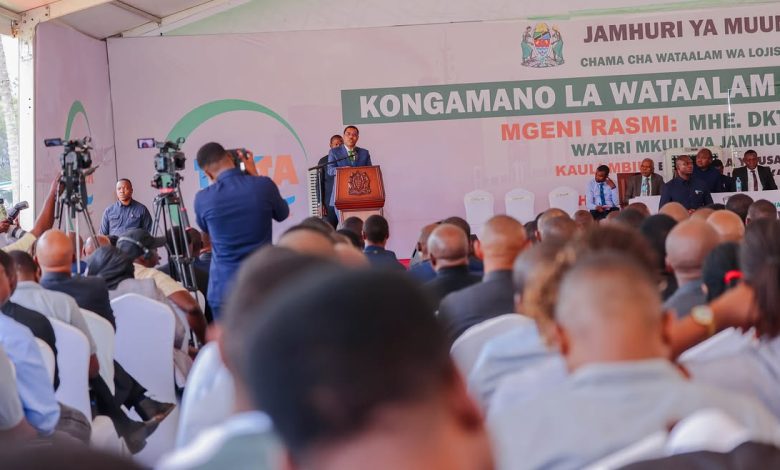
DAR ES SALAAM: PRIME Minister Mwigulu Nchemba has called for faster expansion and modernisation of Tanzania’s transport and logistics infrastructure, saying an efficient network will be critical to achieving the economic ambitions of the National Development Vision 2050.
Officiating at the Tanzania Logistics and Transport Association (TALTA) Symposium at the National Institute of Transport (NIT) in Dar es Salaam, Dr Nchemba said integrating roads, railways, ports and airports would facilitate trade, attract investment and strengthen regional economic integration.
The Prime Minister said the government would continue investing heavily in railways, ports, roads and airports to strengthen the country’s logistics network and support the rapid economic growth envisaged under Vision 2050, including the ambition to build a trillion-dollar economy.
“The transport sector has continued to strengthen Tanzania’s influence in the region due to our strategic geographical location. Recognising this advantage, the government will continue improving transport infrastructure to ensure the sector remains a national priority and a key enabler of economic transformation,” Dr Nchemba said.
He likened the transport system to the human circulatory system, saying just as blood cannot sustain life without an effective network of vessels, an economy cannot thrive without efficient transport and logistics systems linking producers, markets and consumers.
Dr Nchemba said Tanzania has consolidated its position as a strategic logistics hub for East, Central and Southern Africa, serving as the main gateway for cargo destined for land-linked countries.
He said the country serves the region through the Central Corridor anchored by the Port of Dar es Salaam, the Northern Corridor via the Port of Tanga and the Southern Corridor through the Port of Mtwara.
Highlighting ongoing infrastructure projects, Dr Nchemba said passenger and freight services on the Standard Gauge Railway (SGR) between Dar es Salaam and Dodoma were already operational, while construction continued on sections linking Singida, Tabora, Isaka, Mwanza and Kigoma.
He expressed optimism that the Isaka-Mwanza section, now about 70 per cent complete, would be finished by the end of the year, while work on the Tabora-Kigoma section and the extension to Burundi is on course.
He also said rehabilitation of the Tanzania-Zambia Railway Authority (TAZARA) line would begin soon following the conclusion of contractual arrangements.
Beyond railways, Dr Nchemba said the government was modernising ports and expanding airport infrastructure to improve connectivity and stimulate economic activities.
ALSO READ: ‘Make Dira 2050 deliver real change to citizens’
He cited the completion of Msalato Airport, where trial landings have already been conducted, alongside completed upgrades at Sumbawanga, Arusha, Tabora, Bukoba, Mtwara and Kilimanjaro airports.
“Preparations are also underway to upgrade Mwanza Airport after the government advertised for a contractor,” Dr Nchemba said.
However, he stressed that infrastructure alone cannot transform the economy without skilled professionals capable of managing modern logistics systems.
Dr Nchemba said physical infrastructure must be complemented by a highly skilled workforce and commended NIT for producing professionals needed to operate the country’s increasingly sophisticated transport systems.
Addressing concerns raised during the symposium, the Prime Minister welcomed stakeholders’ proposal to establish a statutory professional registration board for transport experts, saying the government had already initiated the process.
He directed the Ministry of Transport to expedite preparation of the Cabinet paper to facilitate approval and operationalisation of the proposed board.
He also acknowledged concerns over the absence of dedicated transport departments in many public institutions, assuring stakeholders that the government would address the institutional gap.
Dr Nchemba further commended NIT’s transformation into one of Africa’s leading transport universities through sustained government investment.
He assured the institute of continued support to strengthen infrastructure, improve training facilities and produce professionals capable of driving Tanzania’s logistics and transport agenda.
Earlier, NIT Rector Professor Prosper Mgaya said the government has invested more than 70bn/- in establishing the Centre of Excellence for Aviation Training, making it the second such facility in Africa after Ethiopia and the first in East Africa.
He said the centre has already attracted interest from regional airlines, including Kenya Airways and Uganda Airlines, seeking to use its training facilities.
“We are well prepared to provide training that will equip graduates with the skills needed to compete in both domestic and international labour markets,” Prof Mgaya said.
He added that the institute’s programmes are aligned with labour market demands, particularly following the government’s substantial investment in Air Tanzania Company Limited (ATCL), whose expanding fleet has created growing demand for aviation professionals.
Prof Mgaya said NIT’s Aircraft Maintenance programme has already produced graduates who are now employed by ATCL and aviation companies in Dubai.
Tanzania Logistics and Transport Association (TALTA) president Alphonce Mwingira said the association remains committed to promoting quality, safe and affordable logistics and transport services while providing technical advice to the government on sector reforms.
He said discussions during the symposium focused on structural, managerial and operational challenges that continue to increase logistics costs for both public and private-sector players.
Mr Mwingira expressed confidence that the recommendations would improve operational efficiency, reduce logistics costs and enhance the competitiveness of Tanzania’s transport sector.