China’s CIPS, Africa’s race toward payment independence
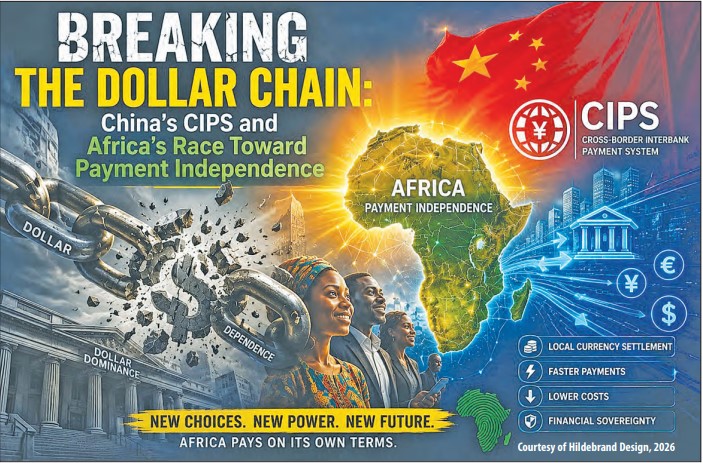
DAR ES SALAAM: CHINA’S Cross-Border Interbank Payment System (CIPS) is steadily gaining ground and has the potential to become a major pillar of a more multipolar global payments architecture.
By providing dedicated infrastructure for clearing and settling cross-border transactions in renminbi (RMB), CIPS can promote currency diversification in global trade and gradually reduce reliance on conventional dollar-based settlement routes. CIPS handled more than RMB175 trillion in 2024, more than three times its 2020 volume, and indications suggest its 2026 performance could potentially more than double the 2024 figure.
As China’s trading partners seek to diversify their settlement arrangements, China continues expanding CIPS connectivity and interoperability. In 2026, Indonesia’s Bank Mandiri and Ghana’s Stanbic Bank became additional direct participants.
By mid-2026, CIPS was connected directly and indirectly to 130 countries and regions, with its broader network extending to approximately 191 countries and territories through more than 5,200 banking institutions.
As China consolidates its position as a global economic power and competes for leadership in areas such as artificial intelligence, CIPS’s importance lies not only in providing a potential marketdriven alternative but also in enhancing financial stability and choice in international transactions. In practical terms, CIPS enables China and its trading partners to invoice, clear, and settle more transactions directly in RMB.
This can lower conversion costs, reduce exposure to dollar liquidity and sanctions-related payment risks, and encourage central banks and businesses to diversify their payment channels.
As of July 2026, the International Monetary Fund (IMF) recognises CIPS as a significant and growing part of China’s efforts to internationalise the renminbi, but not as a short-term replacement for the dollar-based global payments system.
The IMF continues to emphasise that the RMB’s international role remains relatively small, while the dollar retains substantial advantages through deep financial markets, liquidity, convertibility, institutional trust, and network effects. The IMF reported that CIPS transaction volumes had more than quadrupled since 2020, exceeding RMB175 trillion.
Thus, CIPS is better understood as potentially reducing reliance on conventional offshore clearing routes and contributing to a more diversified, multipolar payments system rather than replacing the dollar. The shift remains evolutionary rather than revolutionary. In Q4 2025, the RMB accounted for only 1.95 per cent of global official foreign-exchange reserves, compared with 56.77 per cent for the US dollar.
The figures demonstrate the enormous gap between growing RMB use and continued dollar dominance. Nevertheless, CIPS is gradually reducing dollar dependence in selected cross-border transactions, a trend that could expand over time.
ALSO READ: Cooperatives urged to unlock affordable finance
Why CIPS matters for Africa For Africa, this development could reduce transaction costs, diversify currencies in international trade, strengthen financial connections with China, and improve the continent’s capacity to attract Chinese trade and investment. China remains Africa’s leading trading partner, with bilateral trade reaching 11.28 US dollar billion in 2025.
From May 2026, China introduced zero-tariff treatment for products from 53 African countries, including Tanzania. Standard Bank, the first African bank authorised for direct CIPS transactions, has also expanded CIPS-enabled RMB settlement services from South Africa to Angola, Ghana, Kenya, Lesotho, and Tanzania.
CIPS is therefore more than a payment system; it is China’s infrastructure for clearing and settling crossborder RMB transactions. For African countries, the key issue is not simply replacing the US dollar with the yuan. Rather, it is whether RMB settlement can be used alongside the dollar and other currencies to improve the efficiency, resilience, and competitiveness of trade and investment with China.
The likely answer is yes. Consider a Ghanaian importer purchasing machinery such as ball mills for gold processing from China.
The transaction may involve Ghanaian cedi, US dollars, correspondent banks, and RMB. Each currency exchange and intermediary can add costs, delay settlement, and complicate operations. CIPS provides infrastructure for direct RMB settlement, reducing dependence on intermediary currencies and streamlining payments.
This is significant because China accounted for approximately 20 per cent of Africa’s total goods imports and about 11 per cent of its total exports according to 2024/25 data. Even modest reductions in transaction costs on Africa’s large imports from China could therefore produce substantial savings.
Most African countries do not need to de-dollarise to benefit from CIPS. They can introduce RMB as an additional settlement currency where there is a natural commercial relationship with China.
For example, an African business importing Chinese equipment worth RMB 10 million could settle directly in RMB and avoid additional exposure to USD-to-RMB conversion. When the US dollar strengthens against currencies such as Ghana’s cedi, companies purchasing RMB through dollars face risks from both the cedi/USD and USD/RMB exchange rates.
Direct RMB settlement can reduce these exposures. Export and investment opportunities The opportunity may be even greater on the export side. China’s zero-tariff policy for 53 African countries, effective from 1 May 2026, creates significant potential for African exporters.
Products with potential in the Chinese market include cashew nuts, sesame, honey, coffee, avocados, fish products, gold, gemstones, and graphite. An African cashew or sisal exporter receiving payment directly in RMB from a Chinese buyer would create a natural RMB revenue stream. The exporter could use RMB to pay Chinese suppliers, purchase machinery, service RMB-denominated loans, pay Chinese contractors, reinvest in Chinese equipment, or hold RMB for future trade.
This creates a natural currency ecosystem and reduces the need to repeatedly convert between RMB, US dollars, and local currencies. Such an arrangement could be particularly useful as Tanzania seeks to move from raw commodity exports towards processed and branded products. CIPS can also improve the efficiency and profitability of Chinese investments in Africa. Chinese-owned enterprises account for roughly 12 per cent of Africa’s industrial production, while around 10,000 Chinese firms operate across the continent.
They capture nearly half of Africa’s internationally contracted construction market and generate hundreds of thousands of direct jobs. The challenge has therefore shifted from simply attracting Chinese investors to facilitating their financial transactions. African countries, particularly within the SADC and EAC regions, should make it easier for investors to fund projects, pay suppliers, receive earnings, and repatriate profits.
ALSO READ: Govt deepens tax reforms for stronger growth
A stronger RMB payment ecosystem could reduce obstacles and increase Africa’s attractiveness to Chinese investment in manufacturing, logistics, energy, AI, mining, agriculture, and tourism. Infrastructure finance and SMEs CIPS could also support Africa’s infrastructure financing needs. African countries require substantial long-term capital to develop infrastructure capable of unlocking economic opportunities for a rapidly growing young population.
An African development-finance institution could, for example, arrange RMB financing for a project requiring Chinese equipment. Instead of routing RMB through a US dollar intermediary before conversion into local currency and eventual payment to the Chinese supplier, an African bank could receive RMB financing, fund the local project, and settle the Chinese supplier directly in RMB.
This could reduce currency mismatches and transaction costs. Banks such as Tanzania’s CRDB, NBC, and NMB, and other African institutions engaged in Chinese trade, could consider RMB-denominated or RMB-linked financing for projects involving Chinese contractors, equipment, and investors.
The benefits should also extend to SMEs. Thousands of African businesses import machinery, electronics, textiles, construction materials, solar equipment, and other goods from China. If banks provide RMB accounts, letters of credit, trade finance, foreign-exchange services, payment platforms, and hedging instruments, smaller businesses could participate more efficiently in Chinarelated trade.
Greater use of CIPS would also encourage African banks to strengthen expertise in RMB liquidity, foreign exchange, trade finance, compliance, digital payments, treasury management, and risk management, thereby deepening domestic financial systems.
South Africa provides an important example. Standard Bank, the first African bank approved for direct CIPS transactions, processed more than RMB 8 billion, approximately 1.2 US dollar billion through CIPS by July 2026 and has expanded the service to several African countries.
The lesson is not that other African countries should copy South Africa’s banking system. Rather, CIPS becomes economically significant when integrated into a wider trade-finance ecosystem. Payment infrastructure alone does not generate exports, investment, or industrialisation; its impact comes when it connects trade, financing, logistics, production, investment, and settlement.
Toward a China–Africa financial architecture Other African developments show that RMB use is expanding beyond payment settlement. Angola’s Banco de Fomento Angola intends to join CIPS because of increasing demand for direct yuan transactions. Angola’s central bank has added the yuan to currencies eligible for hard-currency reserve requirements, while the government is exploring yuandenominated debt financing.
Zambia has used RMB in parts of its economic relationship with China, including mining-related payments, while Kenya has explored converting some Chinese railway financing into yuan. These examples show how RMB settlement can evolve from a payment instrument into a broader financial architecture.
The writer is a Tanzanian economist and investment advisor, currently at TIB development bank, a wholly government of Tanzania owned DFI with a deep understanding of China’s development experience, economic diplomacy, commerce, infrastructure, and financial cooperation from an African viewpoint. 13520643096@163.com