

A Silent shift: How Zanzibar’s cities are evolving
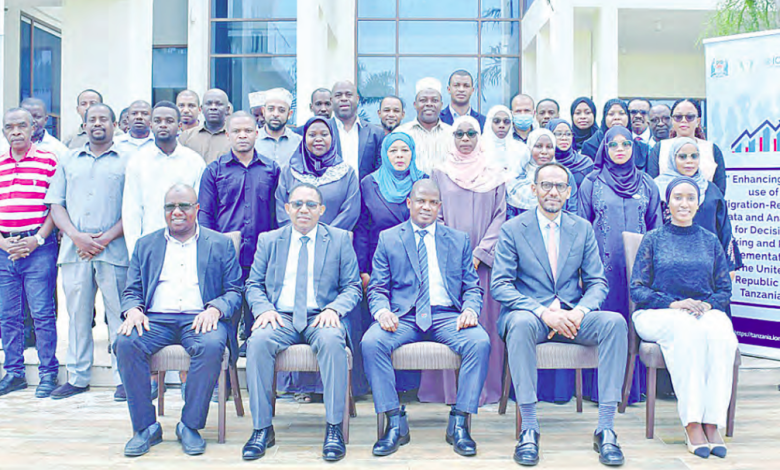
ZANZIBAR: ON one warm morning recently, policymakers, statisticians and development partners gathered in Zanzibar not just to launch a report, but to confront a reality already reshaping everyday life across Tanzania.
Beneath the formal speeches and neatly printed charts lay a deeply human story: Millions of people on the move, chasing opportunity, and in doing so, transforming the future of cities.
For 29-year-old Saada Hamad Juma, the journey from a quiet rural village in Pemba to the bustling roadside stalls of Unguja’s Urban West region was driven by simple necessity.
Like many young Tanzanians, she left home in search of employment and better access to basic services.
“Life is faster here,” she says, adjusting a basket of fruit she now sells in a roadside stall. “But it is also harder. Everything depends on how you survive each day.”
Her story echoes the findings presented during the dissemination of the 2022 Population and Housing Census Monograph on Migration and Urbanisation, officially launched by the Zanzibar Ministry of Finance and Planning Deputy Minister Dr Hamad Omar Bakar.
The report reveals how Tanzania, and Zanzibar in particular, is undergoing rapid demographic change driven by mobility. According to the census, 18.6 per cent of Tanzanians had changed their place of residence within five years prior to the 2022 census.
In simple terms, nearly one in five citizens is on the move, relocating for jobs, education, business or access to social services. This constant movement is quietly but profoundly reshaping communities.
“Migration and urbanisation are among the most powerful forces transforming our development landscape,” Dr Bakar told participants, emphasising that these shifts are increasing pressure on essential services while simultaneously creating new economic opportunities.
Nowhere is this transformation more visible than in Zanzibar’s urban centres. Over the past decade, the share of people living in urban areas in Tanzania rose from 29.6 per cent in 2012 to 37.4 per cent in 2022. In Zanzibar, the change is even more striking.
Urban population growth surged to nearly 49 per cent in 2022, up from 46.3 per cent in 2012, bringing the islands to the brink of becoming predominantly urban.
Experts say this trend will only accelerate. By 2032, more than half of Zanzibar’s population is expected to live in towns and cities. Chief Government Statistician Salum Kassim Ali described the report as more than a technical publication. “This is not just about numbers,” he said.
“It is about understanding how people live, move and what they need. Migration and urban growth touch directly on employment, housing, health, water and infrastructure.”
Indeed, the report shows that migration is not only contributing to population growth, it is driving it.
In some areas, migrants account for more than a third of urban population increases. In the Urban West Region, urban growth has reached an astonishing 79.5 per cent, signalling a future where nearly the entire population may reside in urban settings.
For residents like Saada, this growth brings both hope and strain. Access to healthcare and education has improved compared to rural areas, but competition for jobs is fierce, housing is expensive and infrastructure struggles to keep pace.
ALSO READ: Collective investment schemes: Silent financial shift
Urban planner and researcher Ms Fatma Haji, who attended the event, says the findings should serve as a wake-up call.
“We are seeing the human side of statistics, crowded classrooms, long commutes, rising rents,” she explains. “If we don’t plan properly, cities can become places of inequality instead of opportunity.”
Yet, amid the challenges, leaders insist the story is not one of crisis, but of possibility. “Urbanisation is not a problem in itself,” Dr Bakar noted.
“It is an opportunity for economic growth, innovation and investment, if it is managed with proper planning and reliable data.”
Development partners are equally invested in this transformation.
Speaking at the event, IOM Chief of Mission, Mr Ashraf Hassan underscored the importance of evidence-based planning and collaboration, highlighting how migration data can support smarter policies and inclusive development.
The role of data emerged as a central theme throughout the discussions. Officials repeatedly emphasised that statistics must move beyond reports and into real decisionmaking. “Statistics are not just numbers,” Dr Bakar stressed. “They are tools for making the right decisions.”
This means translating data into policies, better landuse planning, expanded infrastructure, improved housing strategies and targeted investments in health and education.
It also means ensuring that both mainland Tanzania and Zanzibar align their development efforts with the realities revealed by the census.
For Saada and millions like her, these decisions will shape the future in tangible ways, whether they can afford rent, access healthcare or build a stable livelihood.
Back in Mtoni, as the workshop drew to a close, participants expressed hope that the report would not gather dust on office shelves. Instead, it would guide the next generation of urban planning in Tanzania.
“We must ensure these findings reach policymakers, leaders, and communities,” said Salum Kassim Ali. “Only then can they bring real change.”
Outside the conference hall, life continued as usual, vendors calling out to customers, buses weaving through traffic and new arrivals stepping into the city with dreams in their pockets.
Their journeys, once invisible in national conversations, are now captured in data, and increasingly, at the centre of Tanzania’s development story.


Any inexoensice accomodation in stone town?