Tanzania leads ocean conservation
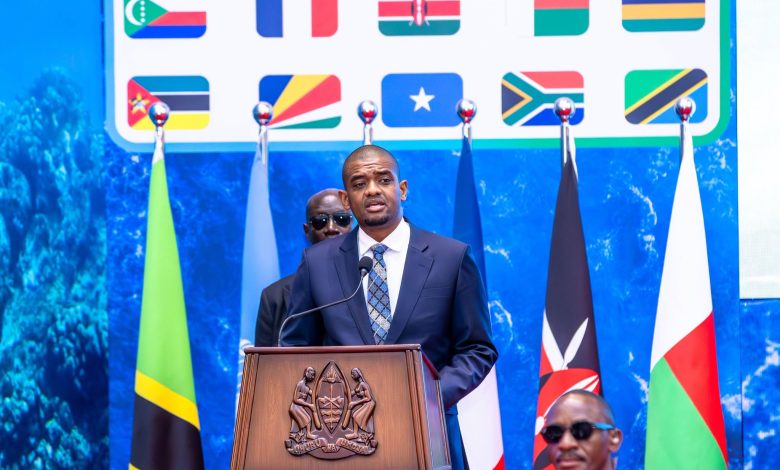
DAR ES SALAAM: TANZANIA has called for stronger regional cooperation to protect the Western Indian Ocean and its resources, valued at more than 300 billion US dollars (about 790.1tril/-), as countries marked four decades of efforts to promote sustainable use of the marine environment under the Nairobi Convention.
Vice-President Mr Deogratius Ndejembi, who represented President Dr Samia Suluhu Hassan at the official opening of the 12th Conference of the Parties (COP12) to the Nairobi Convention in Dar es Salaam yesterday, said Tanzania had made significant contributions to protecting and sustainably using the Western Indian Ocean through marine conservation, ocean research and restoration of critical coastal ecosystems.
He said the call was necessary because the region’s ocean wealth faced growing threats from climate change, pollution, illegal and unsustainable activities, habitat loss and poorly planned development, which could undermine livelihoods and economic benefits derived from the marine environment.
“Addressing these interconnected challenges requires combined regional cooperation, environmental protection, economic development and social inclusion,” Mr Ndejembi said.
COP12 is the meeting of countries that are parties to the Nairobi Convention, where they review progress and agree on priorities for protecting and sustainably managing the marine and coastal environment of the Western Indian Ocean.
The current meeting in Dar es Salaam also marks 40 years of the Convention. The Nairobi Convention is a regional environmental agreement adopted in 1985 under the United Nations Environment Programme (UNEP) to promote the protection, management and sustainable development of the Western Indian Ocean’s marine and coastal environment.
Its ten contracting parties are Tanzania, Kenya, Mozambique, Somalia, South Africa, Madagascar, Mauritius, Seychelles, Comoros and France.
Mr Ndejembi said Tanzania had established effectively managed marine protected areas to protect critical habitats while supporting sustainable fisheries and tourism.
He said the country had also adopted the National Blue Economy Policy in 2024 and Zanzibar Blue Economy Policy in 2020, providing frameworks for sustainable development of marine and coastal resources.
“We have invested in marine science and monitoring, thus strengthening the evidence base for policy and management decisions,” he said.
He said Tanzania had also strengthened marine research through investment in infrastructure, including a new academic and administrative building inaugurated earlier this year at the Institute of Marine Sciences in Zanzibar, a constituent institute of the University of Dar es Salaam that has anchored marine research since 1973.
The Vice-President said Tanzania had implemented measures to address marine pollution, climate change adaptation and sustainable fisheries management, while learning important lessons from its conservation efforts.
“We have learned that community engagement is essential for effective conservation and that integrated approaches must link the environment, economy and society,” he said.
Mr Ndejembi said Tanzania was proud to be among the ten contracting parties to the Nairobi Convention, which had evolved over four decades into an important regional framework for marine and coastal environmental governance.
He said the Convention had supported the establishment of marine protected areas, strengthened scientific cooperation and facilitated regional action plans while building trust and partnerships among countries in the Western Indian Ocean.
Mr Ndejembi said the Western Indian Ocean generated about 20.8 billion US dollars annually, while ecosystem services were estimated to be worth about 25 billion US dollars a year.
He said tourism alone accounted for about 70 per cent of these benefits, while more than 65 million people in the region depended directly on the ocean for food and livelihoods.
He added that about 90 per cent of Sub-Saharan Africa’s trade passed through ports in the region, making the ocean an important pillar of regional trade, employment, food security and economic development.
However, the Vice-President said climate change was among the major threats facing the region, with rising ocean temperatures contributing to coral bleaching, sea-level rise and coastal erosion.
Mr Ndejembi said a sustainable blue economy should not simply expand economic activity at sea but must maintain healthy ecosystems, create decent livelihoods and ensure that benefits were shared fairly.
“Tanzania is therefore championing marine spatial planning, marine protected areas and regional ocean governance to ensure that economic growth does not undermine the natural assets on which the blue economy depends,” he said.
He outlined six priorities for COP12, including translating the Convention and its protocols into national laws, institutions, budgets and effective enforcement.
ALSO READ: Nairobi Convention records progress in Ocean conservation
He also called for stronger climate action through restoration of mangroves, seagrasses and coral reefs, intensified efforts against marine pollution, biodiversity protection, greater investment in science and data sharing, sustainable financing and stronger participation of the private sector, women and young people in the blue economy.
“As we prepare for the next 40 years of the Nairobi Convention, I envision a Western Indian Ocean where ecosystems are healthy and resilient, fisheries are sustainable and productive, pollution is prevented and managed, coastal communities are prosperous and secure, and the benefits of the blue economy are shared equitably,” he said.
United Nations Assistant Secretary-General and Deputy Executive Director of UNEP, Ms Elizabeth Mrema, said the 40 years of the Nairobi Convention had laid a strong foundation for regional cooperation in conserving marine ecosystems and strengthening joint management of ocean resources.
She said COP12 provided an opportunity for countries to exchange experiences and strengthen legal, policy and regulatory systems to address emerging challenges in ocean management.
Ms Mrema called for stronger cooperation among governments, scientific institutions, civil society organisations and other stakeholders, saying public financing alone could not meet the needs of developing a sustainable blue economy.
Minister of State in the VicePresident’s Office (Union and Environment), Eng Hamad Masauni, said COP12 provided an opportunity to strengthen regional cooperation, exchange knowledge and identify economic opportunities from ocean resources.
He said Tanzania had benefited from Nairobi Convention cooperation through technical support in marine environmental management, pollution control and stronger engagement with regional and international partners.
“Let us build on these gains through strategic cooperation and sustainable use of blue economy opportunities to create jobs, protect marine resources and benefit current and future generations,” he said.