FAREWELL MAMA KARUME

- Samia, Mwinyi comfort family
- Mourners reflect on her contribution to national causes
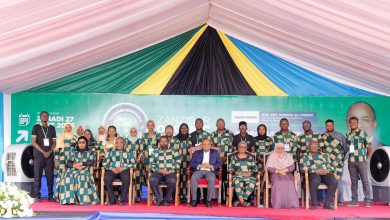
ZANZIBAR: ZANZIBAR President Dr Hussein Mwinyi yesterday led hundreds of mourners at the funeral of Fatma Karume, widow of Zanzibar’s first President, the late Abeid Amani Karume.
Fatma, who died on Monday aged 97, was laid to rest at the Karume family cemetery in Mbweni, on the outskirts of Zanzibar City, following funeral prayers led by Zanzibar’s Chief Mufti, Sheikh Saleh Omar Kabi, at Jamii Zenjibar Mosque in Mazizini.
Among the dignitaries who attended the funeral were First Vice-President Othman Masoud Othman, Second Vice-President Hemed Suleiman Abdulla and other senior government officials, who paid their final respects and placed soil on the grave.
Former Zanzibar President Dr Ali Mohamed Shein and former Chief Minister Shamsi Vuai Nahodha were also among senior leaders who attended the funeral, alongside religious leaders, politicians and hundreds of ordinary citizens from Zanzibar and mainland Tanzania.
President Dr Samia Suluhu Hassan sent condolences to President Mwinyi, former President Amani Karume, Ambassador Ali Karume and the wider family, describing Fatma’s death as a painful loss.
In a message issued by State House and signed by its Director of Communications, Bakari Machumu, President Samia expressed her sorrow and urged the bereaved family to remain patient and find comfort during the difficult period.
Mama Fatma was remembered by mourners as a woman of courage, wisdom and conviction who devoted much of her life to supporting social causes, promoting peace and advocating greater participation of women in public affairs.
ALSO READ: Dr Samia sends condolence following the death of Fatma Karume, widow of Zanzibar’s first President
Speaking at the funeral, CCM National Executive Committee member Mohammed Aboud Mohammed said Fatma’s death was a loss not only to Zanzibar but also to Tanzania and beyond because of her contribution to society.
“We have lost a mother who was a mirror of our country, a person who was always ready to help people in different circumstances,” Mr Aboud said.
He described Fatma as a woman who closely followed political and national development issues and was never reluctant to offer advice or raise concerns when she believed something was against the interests of the country.
Minister of State in the Second Vice-President’s Office, Policy, Coordination and House of Representatives, Hamza Hassan Juma, said Fatma had played an important role as an adviser to leaders, drawing on her experience and wisdom.
“I was among those who were close to her and we benefited from her advice, which demonstrated the important role she played in providing guidance and ideas aimed at supporting leadership and national development,” he said.
Deputy Minister for Water, Energy and Minerals Zawadi Amour Nassor said Fatma remained committed to Zanzibar and the advancement of women even after the death of her husband.
She said Fatma consistently stressed the importance of protecting peace and stability in Zanzibar and encouraging women to take an active role in the country’s development.
Ms Nassor recalled meeting Fatma at a function in Zanzibar only a month ago, saying that despite her advanced age, she remained articulate and deeply interested in issues affecting Zanzibar and its people.
“Despite her old age, God had blessed her with a mind that remained focused on what Zanzibar is, who Zanzibaris are and the position of women in Zanzibar,” Ms Nassor said.
Former women’s representative Asha Abdalla Juma described Fatma as a role model for women seeking education, leadership and greater participation in public life.

“Bibi Fatuma Karume was a role model in showing that women can make significant progress in leadership, including through education that enables them to take up leadership positions,” she said.
Former UWT Deputy Chairperson Ambassador Amina Salum Ali also described Fatma as a courageous woman whose example inspired other women to pursue political leadership.
UWT Deputy Chairperson Zainab Shomari said Fatma was among the pioneers of the women’s organisation and had devoted part of her youth to liberation struggles and efforts to empower women.
Fatma, whose full name was Fatuma Gulamhussein Ismail, was born in Bumbwini, northern Unguja, in 1929.
She was the wife of Abeid Amani Karume, Zanzibar’s first President and they had three children, namely the late Asha Karume, former President Amani Karume and Ambassador Ali Karume.
Her biography records that before and during the 1964 Revolution, she joined her husband in the struggle for independence and social justice, while also advocating women’s rights, including their right to participate in leadership and voting.
She was also remembered for encouraging women to participate in political activities.
According to accounts of her life, she advocated women’s right to vote and participate in elections during the colonial period, contributing to the expansion of women’s political participation.