From education to economic independence
DAR ES SALAAM: FOR Elizabeth Makoye, the road to entrepreneurship began not with capital, but with volunteering. For Sharifa Hamidu, it began with a chance to complete secondary education.
Today, Elizabeth runs a metal fabrication business in Chanika Zingiziwa, Dar es Salaam, employing two people, while Sharifa operates a growing food-processing enterprise in Mbagala Kuu that has created eight jobs.
Their journeys are different, but both illustrate how the Campaign for Female Education (CAMFED) is helping young women move beyond education to skills development, entrepreneurship, employment and community leadership.
Elizabeth, 28, completed Form Four in 2016. The following year, she joined a CAMFED programme supporting young women facing difficult circumstances and underwent an intensive 11-day training programme.
In 2018, she became a volunteer Learner Guide, teaching life skills to secondary school students through the ‘Dunia Yangu Bora’ (My Better World) programme.
“After completing the training, I began teaching life skills through the ‘Dunia Yangu Bora’ programme in secondary schools,” Elizabeth recalls.
The experience developed her confidence and leadership skills while exposing her to the challenges facing young people.
It also encouraged her to seek practical skills that could provide a sustainable livelihood. In 2019, CAMFED supported her to pursue a short course in electrical installation and maintenance at VETA Kigamboni College.
“CAMFED paid my tuition fees,” she says. After completing the course, Elizabeth undertook practical training with the Tanzania Electric Supply Company (TANESCO).
Her performance led to temporary contract opportunities. “After finishing technical college, I did my practical training at TANESCO. They liked my work and offered me temporary contracts,” she says.
However, Elizabeth wanted to build a business of her own. Between 2020 and 2021, CAMFED provided her with a 200,000/- business loan, which she used to establish a metal fabrication and welding enterprise.
She initially operated in Mbezi before moving to Chanika Zingiziwa, where she produces gates, doors and windows. “I have hired technicians who fabricate the gates, doors and windows at the workshop,” she says.
Her experience reflects CAMFED’s wider approach, which seeks to equip young women not only with education but also with the skills, networks and financial knowledge needed to become economically independent.
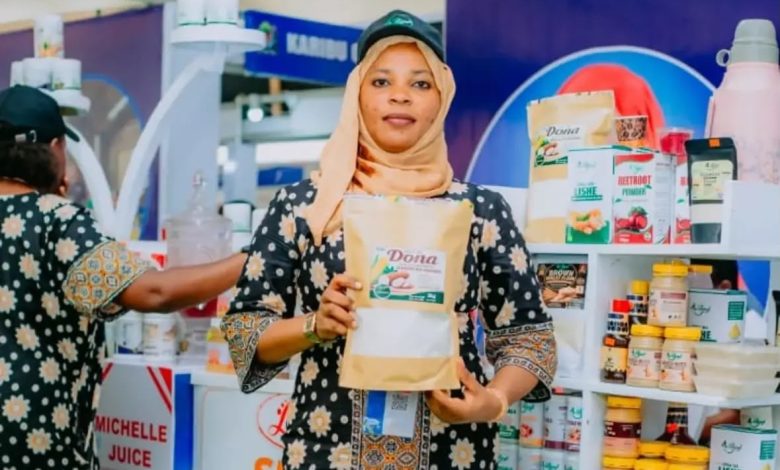
Sharifa’s journey began with education. Now 30, she lives in Mbagala Kuu and runs a business processing nutritional food products, spices and seaweed.
CAMFED supported her education from Form One through Form Four. Years later, she reconnected with the organisation in 2024 through CAMA Tanzania, the network of young women supported through CAMFED.
She met members of the network during International Women’s Day and was welcomed back. Through CAMA Tanzania, she received business guidance training and became a Business Guide, mentoring fellow young women on entrepreneurship.
Her enterprise has since created eight jobs. Two mothers in her neighbourhood help wash, sort and process grains and other produce, while young women assist with distribution and one works in her shop.
Sharifa also extends her support beyond employment. She provides school supplies, including notebooks and uniforms, to two children in her community and helps their mother with small expenses when necessary.
She has also supported a single mother with two children, including a six-month-old baby, by providing nutritional products, healthy food and diapers.
For Sharifa, business success is therefore closely linked to helping others improve their lives. CAMFED provided her with an initial business loan of 2 million/-, which she is completing repayment for this month.
Because of her progress, she has been selected for further support through a larger capital grant. She is using the funding to purchase milling machines and establish a small processing facility.
She is working with technicians and experts from the Small Industries Development Organisation (SIDO) to prepare the premises and plans to obtain certification from the Tanzania Bureau of Standards (TBS).
The expansion is intended to increase production, open access to wider markets and create more employment.
“When you have an idea, don’t keep it hidden inside. Work on it, hustle, and the solutions will follow,” Sharifa says.
She says attending exhibitions helped her learn about business and connect with SIDO, demonstrating the importance of taking initiative before seeking support.
The experiences of Elizabeth and Sharifa form part of a wider effort by CAMFED to promote economic independence among its former beneficiaries.
Since 2006, young women supported through CAMFED and the CAMFED Association (CAMA) have been establishing and growing small businesses while supporting one another to achieve economic independence.
The CAMFED Business Programme seeks to strengthen this foundation by providing practical business skills, mentoring and connections needed to build sustainable enterprises.
The programme focuses particularly on young rural women, who often have limited access to formal business-support services.
It is led by CAMA members through needs assessments, training, mentoring and reporting, allowing support to respond to the circumstances of individual communities.
The programme also takes a gender-responsive approach, using peer support, mentoring and community ambassadors to help women overcome barriers to business development.
Training focuses on practical skills such as calculating costs, setting prices, determining profits and managing finances.
Participants also develop financial literacy and learn how to use credit responsibly. CAMFED also links young women with district business offices, markets, financial institutions and other organisations that can provide technical or commercial support. The benefits extend beyond business management.
ALSO READ: Karagwe youth group achieves economic independence through agribusiness
Participants develop leadership and resilience, gain confidence to pursue opportunities and acquire skills to balance family responsibilities with business.
This approach is designed to create a cycle in which beneficiaries become mentors, entrepreneurs, employers and community leaders.
CAMFED Tanzania was launched in 2005 in Iringa, initially working with the government to increase secondary school enrolment and address barriers preventing girls from continuing their education.
Its work has since expanded to support vulnerable children in government schools across 35 districts. By 2025, CAMFED said it had supported more than 228,000 students to attend primary and secondary school while working with 771 government schools.
However, its work does not end when beneficiaries leave school. Through CAMA, young women remain connected to networks that provide mentorship, life skills, financial literacy, business training and opportunities for employment, further education and entrepreneurship.
The model is based on the belief that investment in one girl can generate benefits far beyond her own life.
A girl who receives support to remain in school can acquire skills, become economically independent and eventually create opportunities for others.
CAMFED reports that by the end of 2025, CAMA members had directly supported more than 5.3 million students to attend school or pursue further education, often using income generated from their own businesses.
The stories of Elizabeth and Sharifa demonstrate how this multiplier effect can work at community level.