Tanzania turns to S. Korea for innovation bridge
DAR ES SALAAM: TANZANIA is looking to South Korea for more than technology. It is seeking lessons on how research, innovation and industrial capability can be transformed into businesses, jobs and globally competitive products.
The ambition is taking shape through a new partnership between the Tanzania Commission for Science and Technology (COSTECH) and the Incheon Innovation Cluster (IIC), creating a potential new channel for Tanzanian researchers, innovators and technology companies to connect with South Korea’s advanced research, technology and industrial ecosystem.
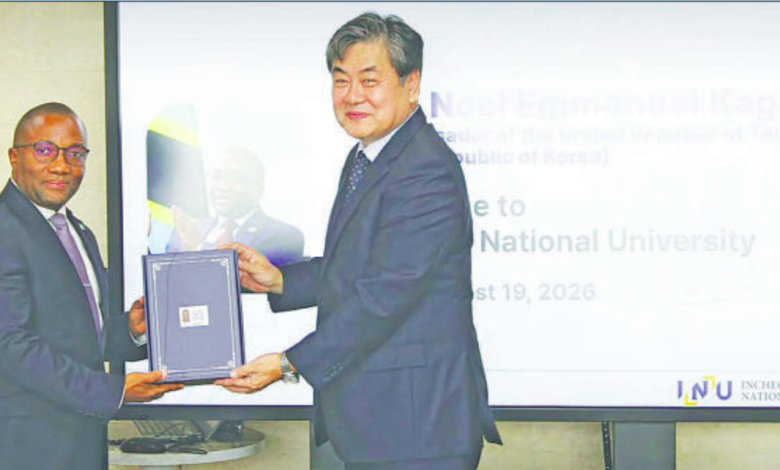
The Memorandum of Understanding (MoU), signed earlier this month at Songdo Convensia in Incheon during the 2026 Incheon International Environmental Technology CONFEX, provides for cooperation in joint research, technology development and transfer, innovation, commercialisation, business partnerships and capacity building.
It also includes plans to establish an IIC branch in Tanzania. For Tanzania, however, the significance of the agreement lies less in importing Korean technology than in changing how technology is developed, adapted and commercialised locally.
Tanzania’s Ambassador to the Republic of Korea, Noel Kaganda, has stressed that the partnership should not leave Tanzania simply receiving technologies developed elsewhere. Instead, Tanzania and South Korea should work together to develop and produce technologies, with Tanzanian researchers and innovators actively participating.
That distinction addresses one of Tanzania’s persistent innovation challenges: moving promising ideas beyond prototypes and exhibitions into factories, markets and scalable businesses.
The new arrangement is intended to help bridge that gap. Under the framework, Tanzanian innovators will have opportunities to work with Korean research institutions, specialists and companies, gaining access to expertise that can help develop technologies and prepare them for commercial use.
The agreement also provides for technology matching, linking areas of demand in Tanzania with relevant technologies and capabilities within South Korea’s innovation ecosystem.
The cooperation could be particularly important as Tanzania and other African economies confront growing demand for climate and environmental technologies.
Kaganda has identified potential areas of cooperation including environmental technology, recycling and waste management, clean-carbon solutions, geotechnology, climate data and artificial intelligence, renewable energy, water technologies, sustainable agriculture and environmental monitoring.
These are not only environmental priorities but also emerging markets where technology companies can build businesses while addressing some of Africa’s pressing development challenges.
Education, Science and Technology Minister Prof Adolf Mkenda directed COSTECH in July to study countries such as South Korea and draw lessons from how science, technology and innovation were used to transform their economies.
The directive was issued on July 2 during the launch of COSTECH@40 activities and the National Information System for Science, Technology and Innovation (NISSTI).
The timing is significant. COSTECH@40 provides an opportunity to examine four decades of public investment in science, technology and innovation and determine what must change as Tanzania moves towards Development Vision 2050.
The government’s ambition is increasingly centred on building a knowledge- and innovation-driven economy, in which research is connected more directly to production, entrepreneurship, industrial competitiveness and commercialisation.
ALSO READ: Tanzania, S. Korea signs Us$2.5bilion deal
South Korea provides a compelling case study. Its economic transformation has been accompanied by sustained investment in research, human capital, technology development and industrial capacity.
The lesson for Tanzania, however, is not necessarily to reproduce Korea’s development model but to understand how the different components of an innovation economy can be connected.
A research institution can generate knowledge. A technology company can develop a product. An investor can provide capital. An industrial partner can manufacture it, while a market provides the demand required to scale.
Prof Heekwan Lee, Director of the Incheon Innovation Cluster, said the partnership would strengthen cooperation between Tanzania and South Korea through joint research, technology development and transfer, commercialisation, joint ventures and exchanges.
The framework, he said, would enable both countries to work together in turning research and innovation into practical solutions and economic opportunities.
COSTECH Director General Dr Amos Nungu and Prof Lee are designated representatives under the cooperation framework, providing institutional leadership as the partnership moves towards implementation.
The proposed IIC branch in Tanzania is expected to operate within COSTECH’s broader innovation ecosystem.
Its activities are expected to include technology scouting, incubation, soft-landing support and assistance with commercialisation, with the Dar es Salaam Technology and Business Incubator (DTBi) identified as an important component of the implementation structure.
The emphasis on technology scouting is particularly important. Innovation systems can fail when entrepreneurs develop technologies without a clear understanding of who needs them, what customers are willing to pay or what technical and regulatory requirements must be met before products reach the market.
The partnership therefore envisages demand mapping, technology assessment, cohort development and efforts to build a clearer picture of Tanzania’s climate and technology ecosystem.
This could provide a more systematic way of matching problems with solutions. Instead of asking only what technologies can be imported, Tanzania can begin with a different question: what problems need solving and which technologies, local or international, can address them?
The answer could create opportunities for both Tanzanian and Korean companies. Intellectual property and technology licensing are also expected to receive attention, while capacity-building and technology-transfer programmes could strengthen local expertise.
The IIC forum and related initiatives are expected to connect Tanzanian innovators with international partners beyond Korea, potentially giving local technology companies access to wider research, investment and commercial networks.
For entrepreneurs, the value of the partnership may ultimately be measured by what happens after the prototype.
Patience Abraham Karua, Chief Executive Officer of Buni Innovation Hub and DTBi under COSTECH, points to barriers that have long confronted African innovators. Technical expertise is only one challenge.
Financing, intellectual property management, market access, industrial partnerships and the ability to test technologies at scale can determine whether an innovation survives.
A prototype can prove that an idea works. It does not prove that the idea can become a business. That is why the proposed cooperation is significant.
It seeks to bring together several resources needed to move an innovation towards commercialisation: technical expertise, research partners, technology developers, investors and potential markets.
For Tanzania’s emerging technology sector, that could represent a meaningful shift. The partnership’s emphasis on environmental and climate technology could place Tanzania in an increasingly important segment of the global innovation economy.
Climate change is creating demand for technologies capable of monitoring environmental conditions, improving resource efficiency, reducing waste and lowering emissions.
Artificial intelligence and data technologies are expanding that opportunity. Climate data can support agricultural decisions, environmental monitoring and infrastructure planning.
AI can process large amounts of information and identify patterns that would be difficult to detect manually.
Recycling technologies can turn waste into economic inputs, while renewable energy and water technologies can address basic infrastructure challenges.
For Tanzania, the opportunity is to ensure that local companies and researchers are not merely consumers of these technologies but participants in their development.
That is consistent with Kaganda’s emphasis on knowledge-sharing, technology transfer and commercialisation, as well as the role of information and communication technology and artificial intelligence in advancing environmental sustainability.
The partnership is designed to work in both directions. Tanzania brings research capabilities, local knowledge, technologies and an understanding of African markets.
South Korea brings technological expertise, research networks, industrial experience and companies capable of helping take technologies towards commercial scale.
The opportunity lies in connecting those strengths rather than treating the relationship as a one-way transfer of know-how.
That could allow Tanzanian innovators to learn from Korea while giving Korean institutions and companies greater exposure to African markets and locally developed solutions.
It also creates the possibility of moving away from a model in which Africa primarily receives imported technologies towards one in which African researchers and entrepreneurs participate in technology development, adaptation and commercialisation.
The MoU creates a framework, not an automatic pipeline of investment or commercially successful technologies.
The agreement allows COSTECH and IIC to jointly mobilise resources through funding proposals, concept notes and grant applications.
The real value of the partnership, however, will depend on the projects and investments that follow.
Success should therefore be measured through tangible outcomes: joint research projects, technology-transfer agreements, researcher and innovator exchanges, prototypes tested under real-world conditions, partnerships between Tanzanian and Korean companies, investment opportunities, intellectual-property and licensing deals and ultimately technologies reaching the market.
NISSTI could provide another important piece of the infrastructure. COSTECH is developing the national platform to bring together information on researchers, research projects, publications, innovation activities and research funding.
Together, NISSTI and the international partnership with IIC could address two sides of Tanzania’s innovation challenge: better coordination of knowledge and research resources at home and stronger international channels for turning that knowledge into technologies, enterprises and economic value.