

Aquaponics tech boosts food security, family income, nutrition through fish and vegetable farming
MWANZA: AQUAPONICS technology has been introduced to promote food security, economic growth and improved nutrition at the family level. This integrated farming system allows for the simultaneous cultivation of fish and vegetables on the same farm, making efficient use of space, water and resources.
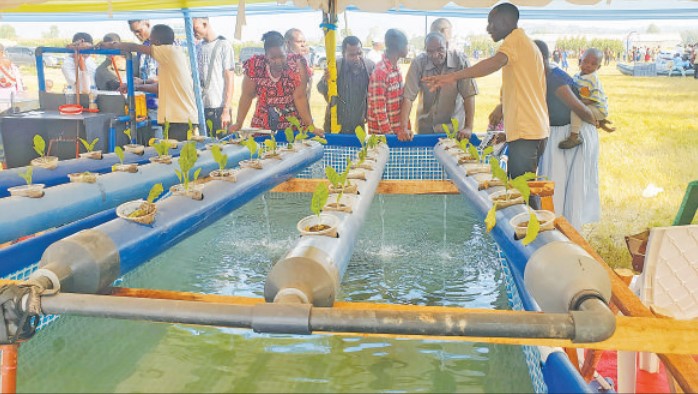
Its recent demonstration at the 2026 Nanenane exhibition in Mwanza showcased its potential to transform small-scale farming across the region. How the aquaponics system works The aquaponics setup presented by the Fisheries Education and Training Agency (FETA) at Nyegezi Campus is a mobile, compact farm composed of various materials.
Its core components include a sturdy plastic fish pond, PVC pipes, steel pipes, buckets, wood and other equipment. The fish pond, which is placed directly on the ground, is connected to a network of pipes that circulate water between the fish and vegetable sections. The system operates on a simple yet effective cycle.
Water from the fish pond is channeled through steel pipes into the PVC pipes above, which are perforated to hold small plastic cans filled with soil for vegetable planting. The water then flows through these cans, nourishing the vegetables and carrying away waste.
ALSO READ: Kongwa officers asked to drive Dira 2050 at grassroots
Solid and liquid waste from the fish, primarily leftover feed and urine, are collected in buckets beneath the system. The science behind fish waste as fertiliser FETA Senior Trainer Mr Ndaro explains that fish urine contains nitrates, which convert into nitrogen, a vital nutrient for plant growth. As water circulates through the system, it is filtered by the perforated cans and the wicklined holes, which absorb pollutants and purify the water.
This process ensures that the water returning to the fish pond is clean and nutrient-rich, supporting a sustainable cycle. The perforated cans are spaced about 15 centimetres apart on the PVC pipes. The number of cans can be adjusted based on the pipe’s length, but it is recommended not to exceed three-quarters of the pipe’s capacity to maintain proper water flow and oxygen levels.
Proper management of vegetable health is essential; weak plants should be removed and treated with pesticides to prevent contamination of the fish pond. Vegetables grown in aquaponics systems typically mature within two to three months, providing quick yields for farmers. Besides vegetables, the system can support tomato cultivation, and in some countries, even rice, thanks to the guaranteed water supply.
The fish and vegetables are harvested simultaneously, after which the pond is cleaned and prepared for the next cycle. Farmers are advised to set the system in open spaces to maximise sunlight and air circulation, both critical for healthy plant and fish growth.
The technology is not limited to tilapia but can also be used for catfish (locally known as ‘Kambare’ or ‘Kamongo’), which are known for their resilience in harsh environments. However, catfish farming, especially for ‘Kamongo,’ requires higher initial investment due to their meat-eating habits and higher feed costs. The fish used in aquaponics are fingerlings weighing between five and ten grams.
These are stocked into the pond and typically take about six months to reach a harvest weight of 250 to 500 grams, depending on the feed supplied. If they are fed a balanced diet of minerals, proteins, vitamins and carbohydrates, they can grow to over a kilogram in nine months.
Tilapia, in particular, requires a diet with more than 35 per cent protein to support proper growth. The demand for fingerlings continues to increase, especially with the expansion of cage-fish farming in Lake Victoria. This growth in aquaculture presents a lucrative opportunity for farmers to produce high-quality fish for local markets and export.
ALSO READ: WB backing puts Tanzania’s PPP ambitions to the test
FETA also trains farmers in fingerling production, emphasising the importance of selecting healthy male and female fish. The female fish lay eggs, which she guards in her mouth temporarily before depositing them in fertilisation sites where males fertilise the eggs. Both parents may continue to care for the eggs by keeping them in their mouths.
Farmers are instructed to monitor egg development closely. When the eggs turn brown, they are mature and can be harvested and placed into a specially prepared water bottle that maintains a temperature of 27 to 30 degrees Celsius and provides enough oxygen.
The eggs hatch within three days, with the hatchlings carrying yolk sacs that serve as initial nutrition for about three days. Afterward, the young fish are transferred to bowls and fed a specialised diet in flour form.
All equipment used in fingerling production is connected to the water filtration system, which removes waste and recycles water back into the system. After 21 days, fingerlings are ready for the growth phase in the main pond. FETA emphasises the need for high-level supervision and professionalism throughout the fingerling production process.
Any interruption could lead to issues such as egg rot or low survival rates. Proper management ensures a steady supply of healthy fingerlings, vital for meeting the growing demand driven by cage-fish farming expansion.
Exhibition visitors, including Mr Samweli Odunga from Ilemela District, praised aquaponics technology for its affordability and suitability for family farms. Unlike deepwater cage farming, which requires significant capital investment, aquaponics can be adopted with relatively low costs, provided farmers receive ongoing training and close supervision.
The future of aquaponics in small-scale farming FETA advocates for farmers to embrace aquaponics as a means to diversify income sources, improve nutrition and promote sustainable farming practices. The system’s modular and mobile design allows farmers to set up farms in open spaces, making it accessible even in limited land areas.
By combining fish and vegetable farming, smallholders can maximise land use, reduce water consumption and produce food year-round. This integrated approach aligns with sustainable development goals, especially in regions where water scarcity and nutrition deficiencies are prevalent.
Despite its promise, aquaponics faces challenges such as the need for technical knowledge, consistent supervision and initial capital. Farmers require continuous training to optimise production and prevent system failures. Support from government agencies and development partners is crucial to scaling up this technology.
Aquaponics technology presents a viable, eco-friendly solution for smallholder farmers seeking to improve food security, nutrition and income. Its ability to produce fish and vegetables simultaneously, using minimal space and resources, makes it an attractive option for rural communities.
With proper training, supervision, and investment, aquaponics can revolutionise family farming, contributing to sustainable development and resilience against climate change. As more farmers adopt this innovative system, it has the potential to transform regional food systems and promote economic growth at the grassroots level.




I’m grateful for the useful information shared in this post. The article is well written and offers valuable insights. Thank you for consistently providing quality content.
I appreciate the helpful knowledge shared here. The article is easy to understand and offers meaningful information. Thank you for producing content that truly adds value.