DSE rally tests domestic demand strength
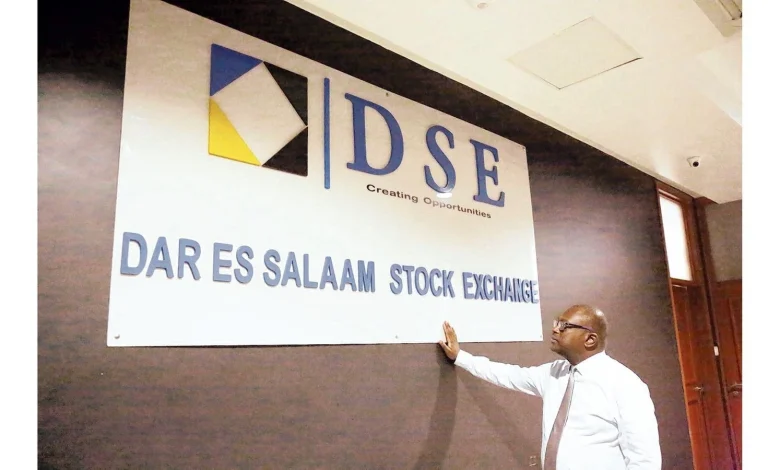
DAR ES SALAAM: THE Dar es Salaam Stock Exchange (DSE) experienced a rebound in trading activity during the week ended August 28, 2026, marked by robust liquidity expansion and broad-based market valuation gains.
Total equity turnover surged by 124.79 per cent week-on-week to reach 52.3bn/-, up from 23.2bn/- recorded in the prior week.
Traded share volumes mirrored this aggressive momentum, jumping 236.79 per cent to 24.45 million shares compared to 7.26 million shares transacted previously.
Foreign participation remained net negative, with net foreign outflows widening significantly to 20,426.91/- (20.43bn/- ) from 3,099/- (3.1bn/-) in the preceding week (a 559.08 per cent expansion in net selling pressure).
Despite the heavy foreign offloading, market valuations rallied strongly across all segments, Total Market Capitalisation expanded by 4.57 per cent to close at 38.7tri/-, Domestic Market Capitalisation rose by 6.47 per cent to 26.9tri/- and ETF Market Capitalisation grew by 3.83 per cent to settle at 220.08bn/-.
Market liquidity was concentrated in large-cap banking and beverage counters, with the top two banks alone absorbing over 86 per cent of total weekly turnover.
NMB dominated the trading floor by generating 36,064.45/- (36.1bn/-), representing a commanding 68.86 per cent share of aggregate market turnover.
Fellow banking giant CRDB followed with 9,314.54/- (9.31bn/-) in traded value, capturing 17.79 per cent of total turnover.
TBL maintained solid institutional liquidity, recording 4,456.18/- (4.46bn/-) 8.51 per cent of market turnover. VODA and AFRIPRISE rounded out the top five liquidity drivers, contributing 643.17m/- (1.23 per cent) and 492.79m/- (0.94 per cent) respectively.
The gainers’ board was headlined by major banking and industrial stocks that registered double-digit price rallies during the week.
Turnover leader NMB led the upward charge, advancing 20.34 per cent to close the week at 2,130/- per share. MBP followed with a sharp 17.39 per cent climb to settle at 2,160/-, while PAL rallied 11.11 per cent to close at 350/-.
Crosslisted NMG gained 7.84 per cent to finish at 275/- and TOL appreciated by 5.71 per cent to end the trading session at 1,850/-.
Conversely, MCB posted the steepest decline of the week, sliding 8.14 per cent to close at 395/- per share. DCB followed closely with a 7.92 per cent drop, finishing at 465/-.
Industrial cement producers faced notable profit-taking, with TCCL giving up 7.00 per cent to close at 3,720/- and TPCC slipping 4.35/- to 5,720/-. SWIS capped the top losers list, receding 3.07 per cent to settle at 2,530/-.
Foreign investor access to deepen capital markets Tanzania is taking steps to attract more foreign investors and strengthen its capital markets following the government’s decision to open the market to non-resident investors through the 2026 Foreign Exchange (Amendment) Regulations.
The reforms are expected to improve foreign exchange inflows, increase market liquidity and broaden the investor base.
They also allow foreign investors greater access to Tanzania’s government securities and capital markets, creating opportunities for increased participation in local financial markets.
Opening Tanzania’s capital markets to foreign investors could increase market liquidity, attract foreign capital, reduce reliance on external borrowing and deepen the country’s financial markets.
DSE pushes for alternative mining SMEs funding
DSE is encouraging mining SMEs to diversify their funding sources beyond traditional bank loans and explore private investment, venture capital and capital market financing.
Through its DSE Enterprise Acceleration Programme (DEAP), DSE brought together 43 mining-related companies in Mwanza to introduce alternative financing opportunities and help businesses become more investment-ready.
The initiative aims to help mining SMEs to Access long term capital for growth and expansion, Strengthen financial management, internal controls and corporate governance.
Become better prepared to attract investors, reduce reliance on bank loans and increase local participation in Tanzania’s mining value chain.
The initiative supports Tanzania’s Mining Vision 2030, which seeks greater local participation in mining and related businesses. On August 26th, 2026, the Central Bank was in the market offering treasury bills to investors.
The offerings included 49.9bn/- for the 35-day maturity Treasury bill, 69.9bn/- for the 91-day T-bill, 79.9bn/- for the 182-day T-bill and 89bn/- for the 364-day T-bill.
Investor demand in this auction was relatively weak for the shorter maturities, with the 35- day and 91-day Treasury bills recording under subscription.
The 35-day bill received a subscription rate of 81.63 per cent, while the 91-day bill recorded 57.2 per cent. In contrast, demand was strong for the longer maturities, with the 182-day bill recording a subscription rate of 168.96 per cent and the 364-day bill attracting particularly strong interest at 255.7 per cent.
The Bank of Tanzania allotted exactly the amounts offered for the 182-day and 364-day bills, while accepting all bids submitted for the undersubscribed 35-day and 91-day bills. Yields continued to decline for all the maturities.
The 364-day Treasury bill, in particular, recorded a decline in its weighted average yield, easing from 6.7441 per cent in the mid-August auction to 6.6492 per cent in the current auction, a decrease of 9.46 basis points.
This decline in yield was accompanied by a slight increase in the minimum successful price, which rose to 93.5891 from 93.5454 in the previous auction. Inflation for the month of July stood at 4.2 per cent.
Secondary market bond trading contracted notably during the week ended 28th August 2026 compared to the preceding week (17th – 21st August 2026).
Total turnover fell by 58.16 per cent to 35.24bn/- (down from 84.22bn/-), accompanied by a 42.58 per cent decrease in trading activity from 155 trades down to 89 trades.
Market activity was overwhelmingly anchored in longduration government papers, with the ultra-long 25-year sovereign segment capturing 83.08 per cent (29.28bn/- across 35 trades) of total secondary market turnover.
Corporate debt issuances also maintained active retail and institutional participation across various tenors.
ALSO READ: DSE turnover falls 22 pc as market holds firm, reforms deepen liquidity
Secondary market trades 24 to 28 August
The Tanzanian equity market enters the coming weeks with a more constructive tone, but the sharp divergence between strong domestic price appreciation and elevated foreign selling suggests that the recent rally should be viewed with some caution.
The increase in market activity indicates renewed investor interest, particularly in large-cap counters, although the concentration of liquidity in a few stocks means that the sustainability of the broader market advance will depend on whether participation continues to widen beyond the dominant banking counters.
Domestic investors likely to remain the main market support
The strong rise in domestic market capitalisation despite substantial foreign net selling points to increasing resilience among local investors. This could become an important feature of the market in the near term, particularly if foreign selling persists.
However, sustained gains will require domestic liquidity to move beyond opportunistic buying in a handful of heavily traded counters and into a broader range of listed companies.
The coming weeks may, therefore, provide an important test of the market’s underlying depth.
If turnover remains elevated while participation broadens across sectors, the recent recovery would be a stronger indication of improving market sentiment.
Conversely, a rapid decline in turnover accompanied by continued concentration in a few large counters would suggest that the rally is becoming increasingly narrow.
Banking counters likely to remain the market’s primary catalyst. The banking sector is likely to continue influencing the direction of the DSE in the short term.
The sector’s recent strength, together with the dominance of NMB and CRDB in market liquidity, suggests that investors continue to favour large, liquid financial institutions.
This preference is likely to persist as investors seek counters with stronger liquidity and greater capacity to absorb sizeable orders.
Nevertheless, the magnitude of the recent gains raises the possibility of short-term profit-taking, particularly among investors who entered the market ahead of the latest advance.
Rather than interpreting any moderation in banking share prices as a reversal of the broader trend, investors should watch whether selling is absorbed at relatively stable price levels.
Continued accumulation after periods of profit-taking would provide a more convincing signal of underlying demand. Equity valuations may encourage rotation rather than indiscriminate buying.
Following the recent broad market appreciation, investors are likely to become increasingly selective.
The next phase of the market may therefore be characterised less by a uniform rise in share prices and more by rotation between sectors and individual counters.
Investors who have benefited from the recent appreciation may begin reallocating towards companies whose valuations have not yet fully reflected their earnings potential.
This could create opportunities among fundamentally sound counters outside the most actively traded banking stocks, particularly where liquidity improves sufficiently to support institutional participation.
The performance of industrial and consumer-facing counters will therefore be worth watching.
A recovery in these segments alongside continued strength in financial stocks would provide greater evidence that the market’s positive momentum is becoming broadbased.