‘JNHPP proves our ability’
RUFIJI: PRESIDENT Samia Suluhu Hassan has said the successful completion of the Julius Nyerere Hydropower Project (JNHPP) demonstrates Tanzania’s capacity to implement strategic projects, calling for the achievement to serve as a catalyst for other major national projects.
“The completion of this project confirms our capacity. It should be a catalyst for pushing other strategic projects so that we can build a stable and selfreliant nation,” President Samia said yesterday when commissioning the project in Rufiji, Coast Region.
With an installed capacity of 2,115 megawatts, JNHPP is Tanzania’s largest single electricity generation project, raising the country’s total installed generation capacity to 4,646MW.
The plant is already supplying nearly half of the electricity on the national grid, providing additional capacity to support industrialisation, investment and economic growth.
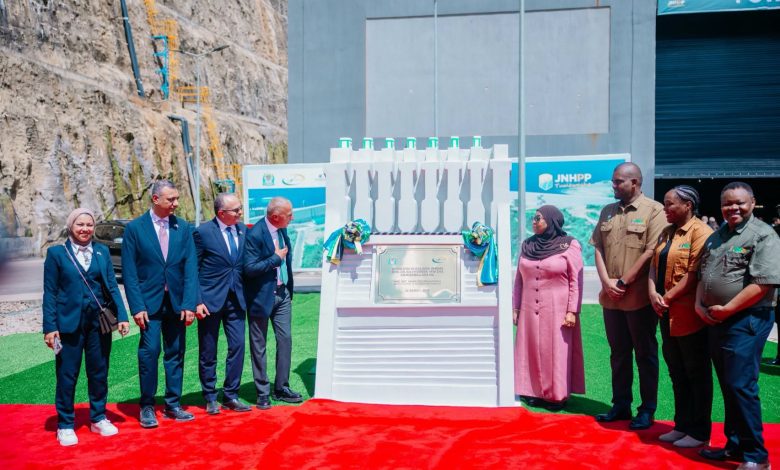
President Samia officially commissioned the project by unveiling a dam-shaped commemorative plaque before Egyptian Prime Minister Dr Mostafa Kamal Madbouly and former African Development Bank President Dr Akinwumi Adesina.
“I am pleased to declare that the Julius Nyerere power generation station has been officially commissioned today, August 22, 2026,” she said.
Reflecting on the project’s journey, President Samia recalled her visit to the site on December 22, 2022, when she presided over the closure of the Rufiji River diversion channel to allow the dam reservoir to start filling.
She said the process, which was initially expected to take three years, was completed within 18 months. The project was constructed at an estimated cost of 7.452tri/-, financed entirely through domestic resources.
President Samia dismissed criticism that the project could become a “white elephant”, saying construction of major transmission lines was progressing and the plant had significant benefits for the country.
“This is not a white elephant. The construction of major transmission lines is proceeding at pace, and this project carries enormous benefit for the nation,” she said.
She reminded Tanzanians that the project belonged to them, urging citizens to protect it for future generations.
She noted that although foreign contractors were still involved in some ongoing works, all technical staff currently operating the station were Tanzanians.
“This is your project. Take care of it forever,” President Samia said.
She traced the project’s origins to founding President Julius Kambarage Nyerere, crediting him with the vision of harnessing the Rufiji River for the country’s energy needs.
She also paid tribute to former presidents Ali Hassan Mwinyi, Benjamin Mkapa, Jakaya Kikwete and John Magufuli for advancing the project, with construction beginning in 2019.
“When we make decisions that serve the nation’s interest, we must not lose heart simply because the path to success proves difficult,” she said.
The commissioning came two days after the energisation of a new 345-kilometre, 400-kilovolt transmission line from Chalinze to Dodoma and a substation at Zuzu.
“Dodoma now has reliable power. There is no more rationing,” President Samia said.
She directed regional and district security committees to work with residents to protect the strategic infrastructure from damage or sabotage.
Speaking at the ceremony, Dr Adesina described JNHPP as Tanzania’s largestever electricity generation project and a statement of national confidence.
“Every megawatt must become an opportunity. That is how infrastructure becomes development; that is how power becomes prosperity,” he said.
Energy Minister Deogratius Ndejembi said the project had strengthened Tanzania’s capacity to connect and trade electricity with markets in Eastern and Southern Africa.
He said the country’s membership in the East African Power Pool (EAPP) and Southern Africa Power Pool (SAPP) placed Tanzania in a strategic position to connect regional electricity markets.
The plant has nine generating units, each capable of producing 235MW.
Mr Ndejembi said the additional generation capacity raised total installed capacity to 4,646MW against peak national grid demand of 2,271MW, creating a surplus of 2,375MW.
He said the surplus provided an opportunity for Tanzania to expand electricity trade, noting that the country had already entered into agreements and discussions with Zambia to supply power and had an agreement with Kenya to buy and sell electricity according to demand.