WFP empowers Tanzania’s youth as different voices share common aspirations on international youth day
DAR ES SALAAM: ACROCSS the world, young people are standing at the center of one of the defining questions of our time: how can societies turn a rapidly growing youth population into an engine of opportunity, innovation and sustainable development?
For millions of young people, the challenge is not a lack of ambition. It is the gap between their aspirations and the opportunities available to them. They want quality education, decent employment, access to technology, good health, financial independence and the chance to contribute meaningfully to their communities.
Yet many continue to face barriers that include unemployment, limited access to finance, inadequate skills, inequality, climate-related pressures and exclusion from decision-making. These challenges may look different from one country to another, but the aspirations behind them are strikingly similar.
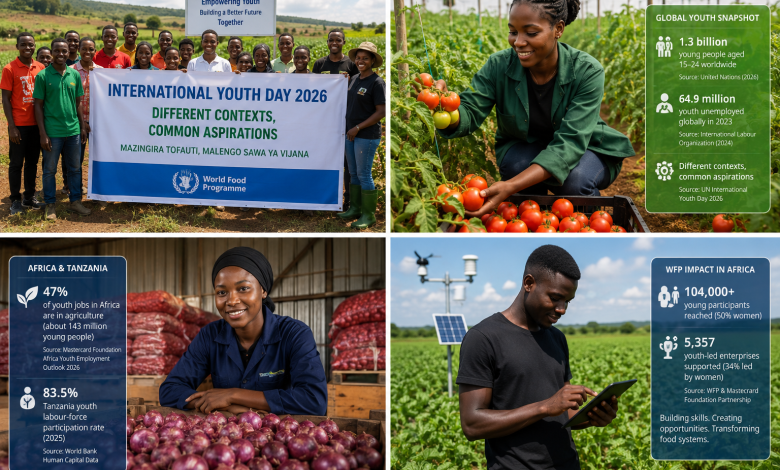
That reality was at the heart of this year’s International Youth Day, commemorated under the global theme “Different Contexts, Common Aspirations”, or “Mazingira Tofauti, Malengo Sawa ya Vijana.” The theme offered a powerful reminder that although young people may grow up in very different economic, social and cultural circumstances, they share many of the same hopes for their future.
For Africa, where young people represent a significant and growing share of the population, the question of how to create meaningful opportunities for youth is particularly urgent. The continent has the potential to benefit enormously from its youthful population, but that potential can only become a demographic dividend when young people are equipped with the skills, health, opportunities and enabling environment required to participate fully in economic and social development.
In Tanzania, the issue is becoming increasingly important as the country seeks to transform its economy, strengthen human capital and implement the aspirations of Tanzania Development Vision 2050.
Speaking during the International Youth Day 2026 celebrations in Tanzania, United Nations Resident Coordinator in the United Republic of Tanzania, Ms. Susan Ngong, said the country was at a critical point in its development journey and needed to see its young population as an opportunity for transformation.
ALSO READ: Panda Academy empowers 50 Young women to build thriving beauty businesses in Tanzania
“Tanzania stands at a defining moment in its development journey. With one of the largest youth populations in our history, our country has a unique opportunity to transform this demographic reality into a powerful demographic dividend,” she said.
“A demographic dividend does not happen automatically. It is created through deliberate investments in people, especially young people,” she noted.
She highlighted that, For Tanzania, such investment goes far beyond simply increasing the number of young people entering education or employment. It means building a generation capable of creating businesses, developing technologies, participating in public life.
Ms. Ngong linked this investment directly to the country’s long-term development ambitions, stressing the importance of education, health, innovation, digital skills, entrepreneurship, decent employment and meaningful youth participation.
“In short, it requires investing in human capital. Human capital is the engine that will drive the aspirations of Tanzania Development Vision 2050,” she emphasized “Tanzania’s young people must not simply become consumers of technology they must become creators of technology, innovators, researchers, entrepreneurs and leaders of Africa’s digital transformation,”
Ms. Ngong said Yet the conversation about youth development cannot be limited to urban technology hubs and highly skilled graduates. Some of the most important opportunities for young people are being created in sectors that have traditionally been viewed as less attractive, including agriculture. In Tanzania, agriculture remains a major source of livelihoods and economic activity.
According to the World Food Programme (WFP), agriculture provides livelihoods for around 70 percent of the population, while women make up a large proportion of the sector’s labour force. WFP has also identified youth and women as important groups in its efforts to strengthen resilient livelihoods and food systems in the country.
This is where programmes supporting young people across agricultural value chains become particularly significant. The World Food Programme (WFP), working with partners including the Mastercard Foundation, has been supporting young people in Africa to access skills, markets, finance, technologies and entrepreneurship opportunities within food systems.
The partnership, launched in 2022 as a five-year initiative, covers eight African countries, including Tanzania, and focuses particularly on increasing employment opportunities for young people and young women.
In Tanzania, this approach is reflected through initiatives such as Vijana Kilimo Biashara (VKB), which supports young people in agricultural value chains while helping them develop the skills and business connections needed to move from subsistence activities towards more sustainable enterprises.
One of them is Jessica Lyatuu, a 30-year-old horticulture farmer from Babati in Manyara Region. Jessica’s journey illustrates the difficulties many young Tanzanians face when trying to build livelihoods. After completing her studies in agriculture and livestock, she worked as an intern at an agrovet shop but earned no income. She later secured employment in Mbeya, where her first salary was only 200,000 Tanzanian Shillings.
Determined to build a future through agriculture, she rented a quarter-acre plot and began growing tomatoes and cucumbers. The harvests were promising, but low prices offered by middlemen meant that much of her income disappeared.
“Watching other youth succeed while I struggled affected my confidence. But I still saw farming as something I wanted to pursue,” Jessica recalls.
Her situation began to change in 2023 when she joined the VKB programme, implemented by WFP with support from the Mastercard Foundation. Through the programme, Jessica gained training in crop management, input application, pest control and post-harvest handling. She also became part of collective marketing arrangements, enabling farmers to combine their produce, negotiate better prices and reach larger markets.
ALSO READ: Young Tanzanian women turn Agriculture into a pathway to jobs and economic transformation
“What started as a quarter-acre plot producing around 100 crates of tomatoes expanded into a two-acre operation producing as many as 700 crates per acre,” she said.
She added that, “Her increased income enabled her to reinvest in farming, support her children’s education and contribute towards building her family home,” The business has also created opportunities beyond Jessica herself. She now employs one permanent worker and can provide seasonal work to up to six young people during peak periods. “VKB training has given me more than technical skills.
It has given me confidence to dream big and farm with a business mindset,” she says Jessica’s experience demonstrates an important point about youth employment: opportunity does not always mean moving young people away from agriculture.
Sometimes, it means changing the conditions under which agriculture is pursued. Another example is Wema Paulo, a 26-year-old entrepreneur from Ilkiding’a village in Arusha Region. Unlike Jessica, Wema saw an opportunity not primarily in producing crops but in solving a problem within the agricultural value chain. After joining VKB in 2024, she received entrepreneurship and business development training. Through the programme, she identified a challenge facing onion farmers in her community: inadequate storage m
eant farmers were often forced to sell immediately after harvest, when prices were low. She developed a proposal for an onion storage facility and presented it in a VKB youth entrepreneurship competition. Her idea won first place, giving her the resources to construct a facility capable of storing up to 2,000 kilograms of onions.
Today, farmers can store their onions for as long as six months, reducing post-harvest losses and giving them the opportunity to wait for more favourable market prices. Her story demonstrates that youth participation in agriculture is not limited to farming. Young people can create businesses in storage, transportation, processing, mechanisation, technology, marketing, finance and other parts of the food system.
That broader approach is consistent with WFP’s work in Tanzania, where the organisation’s country strategy places emphasis on strengthening food systems, resilient livelihoods, market access and opportunities for rural youth and women.