DIRA 2050: FROM PLAN TO ACTION. Economic diplomacy is Tanzania’s new growth strategy
DAR ES SALAAM: AS Tanzania embarks on the implementation of Dira 2050, the government is increasingly turning diplomacy into a tool for economic transformation, using international partnerships, regional integration and strategic engagement with global powers to attract investment, expand trade and accelerate development. The shift reflects a broader evolution in the country’s foreign policy.
According to the government, diplomacy is no longer viewed solely through the lens of political relations and international cooperation. Instead, it is increasingly being deployed to support economic growth, industrialisation, technology transfer, skills development and job creation.
That approach is prominently reflected in the Ministry of Foreign Affairs and East African Cooperation’s 2026/27 budget, which links Tanzania’s international engagement directly to the ambitions outlined in Dira 2050. According to Dira 2050, Tanzania aspires to become a prosperous, inclusive and self-reliant nation with a one-trillion-dollar economy by 2050, underpinned by an industrialised, knowledge-based and globally competitive uppermiddle-income economy.
ALSO READ: Govt strengthens digital registration of vital events
The government says economic diplomacy will be one of the key instruments for achieving that ambition by unlocking foreign investment, attracting technology, securing development financing, opening new export markets and strengthening Tanzania’s position in the global economy.
Presenting the ministry’s budget estimates in the National Assembly, Foreign Affairs and East African Cooperation Minister Ambassador Mahmoud Thabit Kombo said the government’s diplomatic agenda would continue to focus on strengthening bilateral, regional and international cooperation while advancing economic diplomacy and protecting Tanzania’s interests globally.
The priorities, he said, are aligned with Dira 2050, the Fourth Five-Year Development Plan and the government’s broader development agenda.
“Our priorities for the 2026/27 financial year will continue to focus on strengthening bilateral, regional and international cooperation, coordinating implementation of economic diplomacy, protecting the country’s image and interests internationally, and improving institutional capacity,” the minister told the House.
The ministry is seeking parliamentary approval for a budget of 359.3bn/- for the coming financial year, of which 46.4bn/- is earmarked for development expenditure.
The ministry’s budget speech illustrates how foreign policy is increasingly being used to support national development objectives. Over the past year, Tanzania’s diplomatic engagements have helped secure investment commitments, development financing, concessional loans, grants, technology partnerships and market access arrangements spanning Africa, Asia, Europe and the Middle East.
The ministry says such partnerships will be critical to implementation of Dira 2050, particularly in infrastructure development, industrialisation, digital transformation, human capital development and private-sector growth.
Dira 2050 identifies strategic regional and global engagement as one of the important enablers of economic transformation, recognising the importance of stronger international partnerships in achieving long-term development goals.
Among the notable achievements highlighted in the budget is Tanzania’s growing ability to leverage international cooperation to finance strategic projects. Relations with the Republic of Korea, for example, have resulted in the approval of a concessional financing package worth 2.5 billion US dollars through the Economic Development Cooperation Fund (EDCF).
The financing is supporting projects that include the expansion of Muhimbili National Hospital, construction of Binguni Hospital in Zanzibar, development of Bagamoyo Fishing Port and establishment of a railway training institute in Dodoma.
The Korean government has also designated Tanzania among its five priority partner countries in Africa for development cooperation between 2026 and 2030.
Officials say the designation reflects growing confidence in Tanzania’s economic prospects and long-term development agenda.
Building strategic partnerships in Asia
The ministry’s economic diplomacy strategy is particularly evident in its engagement with Asian economies.
Relations with Japan have yielded significant support across infrastructure, maritime security, fisheries and healthcare.
ALSO READ: CAG urges AI use in graft fight
Through cooperation arrangements linked to the Tokyo International Conference on African Development (TICAD), Tanzania secured funding for modern maritime patrol vessels and coastal security initiatives aimed at enhancing maritime safety and supporting economic activities along the Indian Ocean coastline.
Japan is also financing projects under the Economic and Social Development Programme, including acquisition of Tanzania’s first deep-sea fishing vessel, fisheries infrastructure and cold-storage facilities designed to increase productivity in the blue economy.
Meanwhile, a major healthcare partnership with Japan’s Tokushukai Medical Corporation will finance the construction of a Centre of Excellence for Kidney Treatment and Transplant Services at Benjamin Mkapa Hospital.
The project, valued at approximately 1.5 billion Japanese Yen, is expected to strengthen specialised healthcare services, support medical research and reduce the need for Tanzanians to seek treatment abroad.
China remains another key development partner
In January 2026, a high-level visit by Chinese Foreign Minister Wang Yi reinforced cooperation in trade, infrastructure and investment. One of the immediate outcomes was China’s decision to write off an interest-free loan worth 100 million Renminbi, equivalent to about 34bn/-, easing financial obligations on the government.
China also reaffirmed its commitment to financing development projects under the Forum on China-Africa Cooperation framework and continued implementation of technical assistance programmes in agriculture, healthcare and skills development.
According to ministry officials, such partnerships provide access not only to financing but also to technology, expertise and innovation that will be important in supporting the aspirations outlined in Vision 2050.
Expanding regional integration
Regional integration remains another major pillar of Tanzania’s development ambitions. Government officials view regional connectivity as essential for expanding markets, facilitating trade, attracting investment and supporting industrialisation.
Dira 2050 identifies integrated logistics as one of the country’s strategic transformation drivers and envisages Tanzania leveraging its geographic location to become a leading regional trade and logistics hub. The ministry, therefore, continues to prioritise cooperation through the East African Community (EAC), Southern African Development Community (SADC) and other regional organisations.
During the review period, Tanzania and Uganda signed a memorandum of understanding on development of a Standard Gauge Railway (SGR) link connecting Isaka, Lusahunga and Murongo in Tanzania with Kikagati and Mpondwa in Uganda. The project is expected to improve transport efficiency and deepen economic integration between the two countries.
Tanzania also participated in the launch of the Uvinza-Musongati SGR project linking Tanzania and Burundi. Once completed, the railway is expected to strengthen regional trade corridors and facilitate movement of goods across East Africa. In another major regional infrastructure initiative, the East African Crude Oil Pipeline project had reached 79 per cent completion by early 2026 and is expected to become operational later this year.
The government says the project is expected to generate revenue, attract investment and create employment opportunities while reinforcing Tanzania’s position as a regional energy hub.
Opening markets and promoting exports
Dira 2050 places strong emphasis on export growth, value addition and private-sector-led development. To support that objective, the ministry has continued working to secure market access for Tanzanian products abroad.
One notable achievement involved diplomatic efforts that helped remove restrictions on exports of Tanzanian meat to Qatar following concerns related to Foot and Mouth Disease. The reopening of the market in March 2026 is expected to benefit livestock producers and exporters seeking opportunities in the Middle East. The ministry has also intensified efforts to market Tanzania as an investment destination.
ALSO READ: Zanzibar, China partner on health research
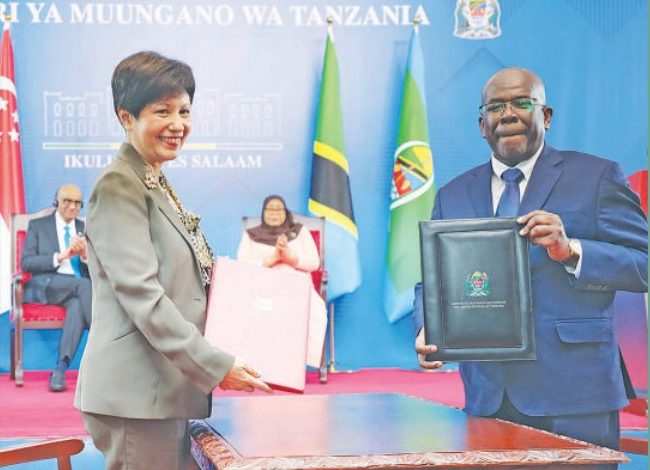
At the Africa-Singapore Business Forum and related ministerial meetings, Tanzania showcased investment opportunities to more than 700 business leaders from Asia and Africa, highlighting prospects across sectors including mining, agriculture, manufacturing, logistics and finance. Negotiations are also progressing on agreements with Singapore covering investment protection, avoidance of double taxation, trade facilitation and political consultations.
Officials say the measures are expected to strengthen investor confidence and encourage greater commercial engagement. The ministry says expanding export markets will be essential to achieving Vision 2050’s ambition of building a diversified, competitive and globally integrated economy.
Investing in people and skills
Beyond infrastructure and trade, the government’s diplomatic engagements are helping expand opportunities for education, training, research and technology transfer. The ministry reported that hundreds of Tanzanians have benefited from scholarships and capacitybuilding programmes offered by partner countries including China, India and Indonesia.
China alone has made available approximately 800 training opportunities for Tanzanians, while India has continued supporting both short-term and long-term training programmes through its Indian Technical and Economic Cooperation initiative. Indonesia has expanded scholEconomic diplomacy is Tanzania’s new growth strategy KEY HIGHLIGHTS arship opportunities under its international education programmes, with more than 300 Tanzanians identified as potential beneficiaries by April 2026.
According to Dira 2050, building a highly educated, skilled and innovative workforce will be essential to driving productivity, competitiveness and long-term economic transformation. Officials say the future economy envisioned under the national development blueprint will depend not only on infrastructure and investment but also on human capital, scientific research, technological advancement and innovation.
Strengthening Tanzania’s global profile
As the country seeks to attract more investment and tourism, the government is also working to strengthen Tanzania’s visibility and influence internationally. The ministry argues that a strong international profile enhances investor confidence, creates new partnerships and increases opportunities for Tanzanian businesses abroad. Recent diplomatic engagements have included efforts to secure support for Tanzania’s bid for a non-permanent seat on the United Nations Security Council for the 2029–2030 term.
China has already expressed support for the candidature. The government has also continued participating actively in regional and international forums addressing trade, peace, security, climate change and sustainable development.
According to the ministry, these engagements help protect national interests while ensuring Tanzania remains a respected and influential voice in global affairs. For policymakers, the significance of economic diplomacy extends far beyond individual agreements or projects. The broader objective, according to the government, is to create an international environment that supports long-term economic transformation.
Dira 2050 envisages a Tanzania that is industrialised, globally competitive and fully integrated into regional and international value chains. The document states that achieving that ambition will require substantial investment, technological advancement, modern infrastructure, access to international markets and strong international partnerships.
Government officials believe diplomacy will play a central role in unlocking those opportunities. The Foreign Affairs Ministry’s budget suggests that embassies, international partnerships and regional cooperation frameworks will increasingly function as instruments of economic development alongside their traditional diplomatic roles.
As implementation of Dira 2050 gathers pace, the government says foreign policy will increasingly be used to mobilise investment, attract technology, develop human capital, strengthen regional integration and expand economic opportunities. According to officials, the role of diplomacy in Tanzania’s development agenda is evolving beyond conventional state-to-state relations.
As the country pursues the aspirations outlined in Dira 2050, economic diplomacy is expected to become an increasingly important tool for supporting industrialisation, trade expansion and longterm economic transformation.