Airtel ranks among top three dividend payers as government pushes higher returns from public investments
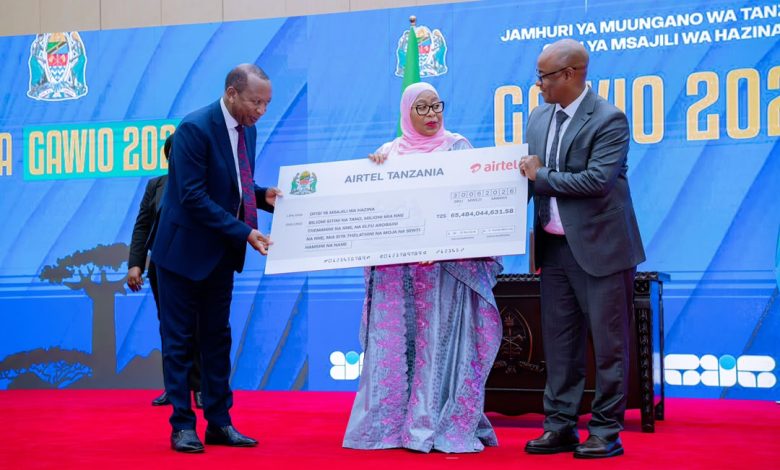
DAR E SALAAM: AIRTEL ranked among Tanzania’s three largest dividend-paying companies this year after handing the government TZS 65.48 billion, underscoring the growing role of public-private partnerships in generating revenue as the country accelerates its digital economy agenda.
Airtel Tanzania was the third-largest commercial contributor during the government’s annual Gawio Day ceremony at State House on June 30, 2026, behind Twiga Minerals, which paid TZS 221.9 billion, and NMB Bank, which contributed TZS 96.9 billion.
The dividend, which represents the government’s 49% stake in Airtel Tanzania, brings the company’s cumulative payments to the state to about TZS 350 billion since 2019, making it the only private telecommunications company in Tanzania to consistently pay dividends to the government.
The payout comes as President Dr. Samia Suluhu Hassan steps up efforts to make public investments generate stronger financial returns while reducing reliance on external financing for development.
“This year we have received TZS 1.327 trillion, compared with TZS 1.028 trillion last year,” Dr. Samia said during the ceremony. “That is an increase of TZS 300 billion, or 30%.”
She said the increase showed that institutions once dependent on government funding were becoming contributors to the national budget.
“We have moved from institutions consuming public funds to institutions returning money to the government,” she said.Dr. Samia said stronger dividend payments would help Tanzania finance more of its own development and reduce dependence on external borrowing.
She said the country’s financing gap had narrowed significantly and expressed confidence that Tanzania could largely finance its own development within two years if current trends continue.
The government collected a record TZS 1.327 trillion in dividends and statutory contributions this year, according to Treasury Registrar Nehemiah Mchechu.
Commercial companies contributed TZS 800 billion, while non-commercial public institutions contributed TZS 406 billion. The remaining TZS 121 billion came from other sources.
Mchechu ranked Twiga Minerals, NMB Bank and Airtel Tanzania as the top three commercial dividend payers.
For Airtel, the latest payment reflects both its financial performance and its strategic partnership with the government.
Airtel Tanzania Board Chairman Eliud Sanga said the dividend demonstrated the value created through long-term investment, good governance and cooperation between the public and private sectors.
“This amount is tangible proof of the value built through sustainable investment, sound business management and good governance,” Sanga said.
He said Airtel’s contribution should not be measured only by dividends but also by its investment in digital connectivity, which supports businesses, education, public services and economic growth.
Managing Director Charles Kamoto said the dividend reflected the confidence that customers continue to place in Airtel’s services.
“This contribution reflects the trust that millions of Tanzanians place in our services every day and our commitment to delivering sustainable value to all shareholders,” Kamoto said.
He said Airtel invested more than USD 316 million between 2021 and 2025 to expand and modernise its network.
ALSO READ: Samia demands results-driven public sector to fast-track national development
The Airtel Tanzania is continuing to roll out 4G and 5G services, fibre infrastructure and home broadband while expanding Airtel Money to improve financial inclusion.
“Connectivity is no longer a luxury. It is an essential tool for economic growth, innovation, education and social inclusion,” Kamoto said.
For Airtel Tanzania, maintaining its position among the country’s top three dividend-paying companies highlights the increasing importance of telecommunications to Tanzania’s economy, where investment in digital infrastructure is becoming a growing source of both government revenue and long-term economic growth.