TASAF, scholars join forces to shape Vision 2050
DAR ES SALAAM: As Tanzania prepares to begin implementing the National Development Vision 2050 in July 2026, policymakers, researchers, development practitioners and social protection experts are converging around a common message: sustainable national development requires investment in people.
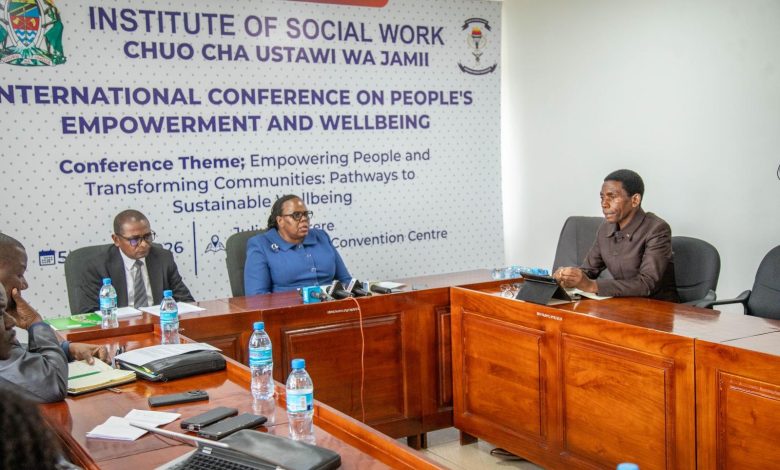
Briefing the media on Wednesday in Dar es Salaam, ahead of today’s first International Conference on Human Empowerment and Social Wellbeing, organised by the Institute of Social Work (ISW) and supported by the Tanzania Social Action Fund (TASAF).
Speakers described the conference as a timely platform for generating evidence-based solutions to some of the country’s most pressing social and economic challenges while contributing directly to the implementation of Vision 2050.
Taking place at the Julius Nyerere International Convention Centre (JNICC) in Dar es Salaam, today’s conference will bring together scholars, policymakers, development partners and practitioners from 11 countries to exchange ideas on empowerment, social protection and inclusive development.
Speaking during the briefing, Institute of Social Work Rector Dr. Joyce Nyoni said the conference marks a major milestone for the institution and reflects its commitment to connecting education, research and policy to improve people’s lives.
The Institute of Social Work, a government-owned higher learning institution operating under the Ministry of Community Development, Gender, Women and Special Groups, serves three primary functions: training professionals, conducting research and providing professional consultancy services.
Through these roles, the institution seeks to generate knowledge and practical solutions that support social welfare and community development.
According to Dr Nyoni, the conference demonstrates the Institutes growing role as a centre for ideas, research and social transformation.
“The conference is not an ordinary academic event,” she said. “It is an international platform where researchers, policymakers and development practitioners can exchange knowledge, experiences and evidence that can help shape policies and programmes that improve people’s lives.”; Held under the theme, ‘Empowering People and Transforming Communities: Pathways to Sustainable Well-being,’; the conference is expected to attract participants from Tanzania, Uganda, Nigeria, Namibia, Lesotho, Norway, Hungary, Kenya, Austria, Zimbabwe and South Africa. Here, the Guest of Honour is expected to be the Minister for Community Development, Gender, Women and Special Groups, Dr Dorothy Gwajima.
The conference programme will feature keynote speakers from six countries, including Professor Blanka Storen Vaczy of Norway, Professor Nora Jakab of Hungary, Professor Adalbertus Fortunatus Kamanzi of Namibia, Eng. Professor Zaipuna Obeid Yonah of Tanzania, Professor Emma E.O. Chukwuemeka of Nigeria and Dr. Aramanzan Madanda of Uganda.
Presentations and discussions will focus on six strategic themes: gender inclusion and women's empowerment; child development, protection and rights; entrepreneurship, innovation and digital transformation; mental health and social well-being; financial literacy and business development; and workplace empowerment.
Elaborating, Dr Nyoni noted that the diversity of participating countries will provide valuable opportunities to learn from international experiences while exploring solutions that can strengthen inclusive development in Tanzania. She further said that the conference is being organised at a particularly significant moment as the country prepares to implement Vision 2050.
The vision aims to transform Tanzania into an upper-middle-income economy by 2050 while ensuring that citizens enjoy dignity, social well-being and equal development opportunities. One of the visions key pillars, Human Capabilities and Social Development, focuses on expanding access to quality education, healthcare, social protection and employment opportunities.
Dr Nyoni said achieving those goals will require strong research, scientific evidence and professional expertise. The conference is therefore expected to generate research-based policy recommendations that will be submitted to relevant ministries as a contribution to the early implementation of Vision 2050. “We wanted this conference to become part of the national conversation at the very beginning of Vision 2050 implementation,” she said.
“The discussions and recommendations that emerge here will contribute to shaping policies that promote sustainable and inclusive development,”
She further stressed the importance of strengthening collaboration between academic institutions and policymakers. The conference seeks to bridge the gap between classroom knowledge, research findings and real-world policy implementation, particularly in areas affecting vulnerable and marginalized populations.
For the Institute, the conference also represents a step toward greater international collaboration. Dr. Nyoni said global partnerships are increasingly necessary as countries face interconnected social and economic challenges that require shared knowledge and innovative solutions.
She described the event as an opportunity to position the Institute of Social Work as a leading contributor to international discussions on social welfare, community development and public policy.
TASAF Executive Director Mr. Shedrack Mziray echoed the sentiments, describing the conference as an important platform for dialogue, learning and collaboration among institutions working to transform communities and improve livelihoods.
Explaining further, he added that TASAF is partnering with the Institute of Social Work to support the conference and facilitate the exchange of ideas that can strengthen social protection systems and community empowerment initiatives.
Mr Mziray said the conference theme aligns closely with TASAF’s mission and long-standing efforts to reduce poverty and improve the welfare of vulnerable populations. Since its establishment in 2000, TASAF has played a central role in Tanzania’s social protection agenda through a community-driven development approach.
Over the years, its programmes have evolved from supporting community infrastructure projects to implementing large-scale social protection interventions focused on vulnerable households. Its flagship Productive Social Safety Net (PSSN) programme has reached more than 1.3 million households and benefited approximately 5.2 million Tanzanians across Mainland Tanzania and Zanzibar.
The programme provides support through cash transfers, public works initiatives, household economic strengthening programmes and improved access to social services, particularly targeting women, children and young people.
According to Mr. Mziray, TASAF’s interventions have contributed not only to reducing immediate hardship but also to strengthening resilience, expanding economic opportunities and improving human development outcomes. The organization uses a range of targeting mechanisms, including geographic targeting, social targeting, proxy means testing and digital verification systems, to ensure support reaches households experiencing extreme poverty, food insecurity and other forms of vulnerability.
Reflecting on more than two decades of implementation, Mr. Mziray highlighted several achievements. TASAF has delivered cash transfers to more than 1.37 million households, supported over 74,000 savings groups with nearly one million members and facilitated more than 32,000 public works projects that have created employment opportunities while improving community infrastructure.
These interventions have generated measurable results. Household consumption among beneficiaries has increased by nearly 20 percent, while household income has risen by 37 percent. Monthly business profits have increased by 42 percent, demonstrating the programmes contribution to local economic growth. Food security has improved significantly, supported by increased household spending on food and essential needs.
Savings behaviour among beneficiaries has strengthened, with monthly savings increasing by approximately 41 percent, helping families build resilience against future economic shocks. The programme has also contributed to improved access to education, particularly for girls from poor households, increased use of healthcare services and greater participation of women in household decision-making processes.
In addition, more than 60 percent of cash transfers are now delivered through electronic payment systems, supporting Tanzania’s broader agenda of digital financial inclusion. Mr. Mziray said these achievements demonstrate the importance of empowerment as a foundation for long-term well-being.
“Our programmes are designed to equip individuals and communities with the tools, opportunities and support they need to become self-reliant and resilient,” he said.
“Empowerment allows people to participate fully in economic, social and civic life.”
He noted that TASAF’s work aligns closely with both Vision 2050 and the Sustainable Development Goals by promoting inclusive growth, social justice and human development.
The conference, he said, will provide an opportunity not only to showcase Tanzania’s achievements but also to learn from international experiences and identify innovative approaches that can strengthen social protection systems and community empowerment efforts.
Mr. Mziray also commended the Institute of Social Work for its contribution to education, research and professional development, describing the institution as an important partner in building the skilled workforce needed to design and implement effective social programmes. Both speakers reinforced that the conference goes beyond academic discussions.
It is intended to address real challenges facing citizens, including poverty, gender inequality, child welfare, mental health, entrepreneurship and economic empowerment.
As Tanzania embarks on the implementation of Vision 2050, the conference is expected to serve as a platform for generating practical ideas, evidence-based recommendations and strategic partnerships that can contribute to a more inclusive, resilient and prosperous future.
The organizers believe that empowering people remains the most effective pathway to sustainable development and that lasting national progress depends on ensuring that no one is left behind.