Riding rails of development
- From SGR to mega power projects, Tanzania’s infrastructure drive boosts growth, expands the national debt
DAR ES SALAAM: AS the sleek electric train glides quietly out of the station, its polished silver coaches and orange stripes reflecting the morning sun, Tanzania’s Standard Gauge Railway (SGR) offers more than just a journey, it tells the story of a nation on the move.
From the bustling platforms of Dar es Salaam to the wide-open plains stretching inland, the modern train cuts across landscapes once defined by slow, winding travel, ushering passengers into a new era of speed, comfort and connectivity.
Yet, as the train hums forward along the steel tracks, another set of figures has been rising behind the scenes. The massive infrastructure investment powering this transformation has come with a price: A steadily growing national debt that has helped finance the ambitious railway project and other major development initiatives.
The Fiscal Reality
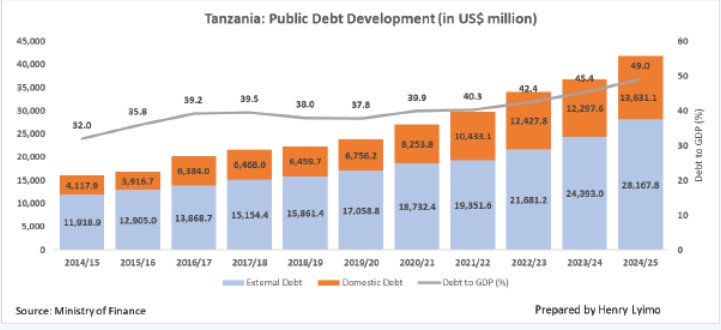
According to the latest Debt Sustainability Analysis (DSA), Tanzania’s public debt stood at 41.8 billion US dollars at the end of June 2025, equivalent to 49 per cent of Gross Domestic Product (GDP).
This represents a 13.9 per cent increase from 36.7 billion US dollars, or 45.4 per cent of GDP, recorded in June 2024. By February 2026, analysts and rating agencies estimated the debt-to-GDP ratio had edged slightly higher to about 49.6 per cent.
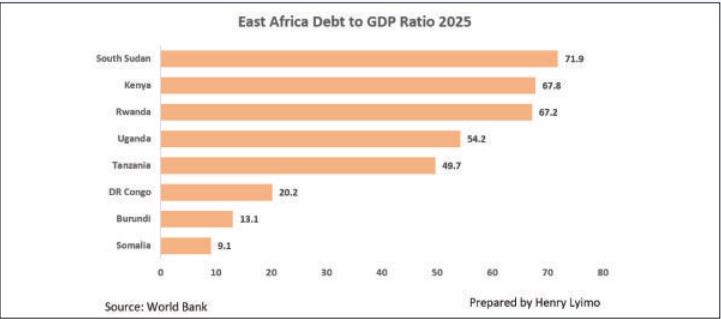
While these figures represent a historical high, they remain within international safety zones. Under the IMF and World Bank’s Debt Sustainability Framework for countries with Tanzania’s debt-carrying capacity, the safe threshold for the present value of public debt is 55 per cent of GDP.
By remaining at roughly 49.6 per cent, Tanzania maintains a “moderate” risk of debt distress, leaving a slim but vital buffer to absorb potential economic shocks.
Finance Minister, Ambassador Khamis Mussa Omar says the latest DSA indicates that Tanzania’s debt remains sustainable in both the medium and long term, with borrowing closely aligned to national development priorities and risks remaining under control.
Vision 2025 policy direction on public debt
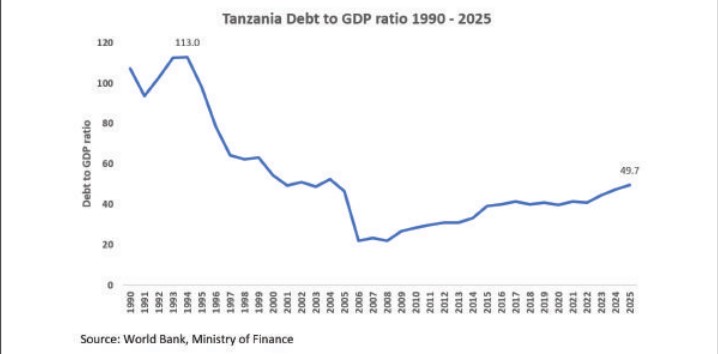
At the height of Tanzania’s debt challenges in the early 1990s, the country’s debt burden exceeded the size of its national income. Three decades later, despite major investments in infrastructure, the ratio remains less than half of those levels, reflecting the gains achieved through economic reforms, debt relief and prudent macroeconomic management during the Vision 2025 era.
The remarkable turnaround ranks among Tanzania’s most significant macroeconomic achievements since the adoption of the Tanzania Development Vision 2025, the country’s long-term development blueprint conceived in the late 1990s.
World Bank data show that Tanzania’s debt-to-GNI ratio exceeded 100 per cent during the early 1990s, peaking at more than 110 per cent at a time when the economy was struggling with slow growth, heavy dependence on external financing and mounting debt obligations.
The debt burden placed enormous pressure on public finances, limiting the government’s ability to invest in critical sectors such as education, health, infrastructure and productive industries. It was against this backdrop that Vision 2025 was formulated.
The blueprint sought to transform Tanzania into a strong, resilient and middle-income economy through sound macroeconomic management, fiscal discipline, private sector-led growth and prudent utilisation of public resources.
While the vision did not prescribe a specific debt ceiling, it emphasised the importance of ensuring that the nation lived within its means and maintained a stable macroeconomic environment capable of supporting long-term development. Over the following years, Tanzania embarked on a series of economic and financial reforms that helped restore macroeconomic stability.
Improved domestic revenue mobilisation, tighter expenditure controls, stronger public financial management systems and sustained economic growth gradually reduced the country’s debt burden.
ALSO READ: The IFC, opportunity TZ cannot afford to miss
The gains were further reinforced by international debt relief initiatives, including the Highly Indebted Poor Countries (HIPC) Initiative and the Multilateral Debt Relief Initiative (MDRI). The results were dramatic. By 2006, Tanzania’s debt-to-GNI ratio had fallen to about 22 per cent, down from more than 110 per cent a decade earlier.
The decline provided the government with greater fiscal space to expand social services, invest in infrastructure and support economic transformation. Riding rails of development From SGR to mega power projects, Tanzania’s infrastructure drive boosts growth, expands the national debt In recent years, the ratio has risen gradually as the government borrowed to finance strategic projects aimed at accelerating growth and industrialisation.
Investments in flagship projects such as the Standard Gauge Railway (SGR), the Julius Nyerere Hydropower Project and other transport and energy infrastructure have contributed to the increase. Nevertheless, the debt burden remains far below the levels recorded before the implementation of Vision 2025.
Financing Transformation: The “Big Five”
The growth in debt is largely a direct result of massive capital outlays for the “Big Five” flagship infrastructure projects designed to catalyse future economic growth. Among these flagship investments are the ongoing rollout of the Standard Gauge Railway (SGR), the 2,115-megawatt Julius Nyerere Hydropower Plant (JNHPP) and the East African Crude Oil Pipeline (EACOP).
The government has also invested heavily in expanding the national road network and modernising Air Tanzania Company Limited (ATCL) to strengthen connectivity within the country and beyond. Together, these projects form part of what policymakers describe as strategic “anchor investments” designed to unlock future economic growth.
Supporters of the strategy argue that the long-term benefits of improved transport, energy and logistics infrastructure will far outweigh the cost of borrowing.
Moody’s Affirms Stability
International credit rating agency Moody’s Ratings has echoed this cautious optimism. On February 20, 2026, the agency affirmed Tanzania’s B1 long-term foreign and local currency issuer ratings, maintaining a stable outlook. Although a B1 rating falls within the speculative category, Moody’s noted that Tanzania remains capable of meeting its financial obligations despite rising debt levels.
The stable outlook signals confidence that the country’s economic fundamentals and macroeconomic management remain broadly sound. In global financial markets, such an assessment carries weight, helping Tanzania preserve investor confidence and stabilise borrowing costs at a time when many developing economies are facing tighter financial conditions.
Parliamentary Backing: Real World Debt Service Execution
This international confidence was anchored in concrete numbers on Tuesday when the Minister for Finance, Ambassador Omar presenting the ministry’s 2026/27 budget estimates to the National Assembly in Dodoma, detailed the state’s meticulous debt-servicing execution. Far from defaulting or stalling, Tanzania has treated its maturing debt obligations with aggressive fiscal discipline.
“For the 2025/26 financial year, the ministry planned to ensure the timely settlement of maturing government debt totalling 14.219tri/–,” the finance minister informed the august House. “As of April 2026, a total of 9,737.7 billion shillings—equivalent to 68.5 per cent of the annual target—had been received and disbursed to service the matured debt.
Of this amount, 4,445.1 billion shillings went toward servicing external debt, while 5,292.6 billion shillings was utilised for internal debt settlement.” According to the Minister, this structural precision in meeting domestic and global financial obligations is exactly what keeps Tanzania insulated from the debt crises plaguing other frontier economies.
“This efficiency in servicing maturing debt has enabled our country to maintain its strong creditworthiness across regional and international financial markets,” the Minister emphasised. This disciplined economic diplomacy has earned historic institutional validation on the global stage.
The minister proudly announced to lawmakers that Tanzania has officially emerged as the overall winner of the Commonwealth Public Debt Management Award, alongside the prestigious award for the Best Government Debt Management Office in the African Region.
This dual recognition provides powerful political and institutional cover for the government’s borrowing framework, proving that the machinery behind Tanzania’s debt portfolio is currently operating at world-class efficiency.
Borrowing for Productivity: The Energy
Multiplier Government planners say the borrowing strategy is guided by the principle of “productive debt” loans channeled into projects that expand economic capacity.
This approach is embedded in the Third National Five-Year Development Plan (FYDP III) and the country’s long-term blueprint, Tanzania Development Vision 2050. One such project is the Julius Nyerere Hydropower Plant, which reached full operational capacity in early 2025.
The 2,115-megawatt facility acts as the “master key” that unlocks the productivity of all other investments. It is anticipated that completion of JNHPP creates a powerful ripple effect: Manufacturing Surge: Lower electricity tariffs allow local cement, steel, and textile factories to operate 24/7, reducing the cost of locally made goods and making them competitive for export.
SGR Operational Savings: As the SGR is fully electrified, its operational costs are significantly lower than diesel-reliant railways. The surplus power ensures that the “Blue Trains” run on domestic green energy rather than expensive imported fuel. Regional Power Trading: Tanzania is positioned to become a net exporter of electricity through the East African Power Pool (EAPP), turning a domestic utility into a regional revenue stream.
The Logistics Multiplier: Land-Locked to Land-Linked
The electrified SGR is the second pillar of this strategy. Designed to link Dar es Salaam with inland regions and neighbouring countries such as Rwanda, Burundi, and the Democratic Republic of Congo, the railway is expected to reduce transport costs, shorten travel time, and strengthen Tanzania’s role as a regional logistics hub.
At the heart of this surge is a move to capitalise on Tanzania’s unique geography. For every kilometre of SGR track laid toward the borders, the cost of inland logistics is projected to drop by nearly 40 per cent.
This turns Tanzania from a “land-locked” gateway into a “land-linked” trade bridge. Meanwhile, the expansion of Air Tanzania has been aimed at improving international connectivity and boosting tourism.
The airline currently operates a fleet of 16 aircraft, including Boeing 787-8 Dreamliners and Boeing 737 MAX jets. During the 2024/25 financial year, ATCL generated 157.7 million US dollars (about 402bn/-) in revenue an increase of nearly 88 per cent compared with the previous year while contributing 52.35bn/- in taxes and fees.
The government plans to acquire eight additional aircraft, expanding the fleet to 24 to strengthen the airline’s role in supporting tourism and trade.
Looking Beyond Debt
While borrowing has financed these large-scale investments, policymakers acknowledge that relying solely on debt cannot sustain long-term development. Under Vision 2050, Tanzania aims to transition toward more diversified financing models.
A key target is increasing the tax-to-GDP ratio from about 12.8 per cent to 20 per cent, reducing reliance on borrowing by strengthening domestic revenue collection.
The government is also encouraging greater private sector participation through Public-Private Partnerships (PPPs) and innovative financing mechanisms such as green bonds. Strategic sectors including mining, energy and logistics are increasingly expected to generate their own investment capital.
Gathering Speed
Moody’s affirmation signals confidence, but challenges remain. Structural constraints such as relatively low per capita income and vulnerability to external shocks continue to shape the country’s economic outlook. Nevertheless, the next phase of Vision 2050 focuses on ensuring that the current period of heavy investment translates into sustained economic expansion.
The strategy centres on 45 large-scale anchor projects, including initiatives such as the proposed Bagamoyo Eco-Maritime City and the country’s liquefied natural gas (LNG) programme, aimed at boosting exports and strengthening foreign exchange reserves. For policymakers, the underlying bet is clear: by investing heavily in infrastructure today, Tanzania will build a more connected and industrialised economy capable of generating the growth needed to outpace its rising debt.
As the sleek electric train continues its journey across the Tanzanian landscape, it carries with it not only passengers but also the hopes and financial calculations of a nation investing boldly in its future.
Indeed, as Tanzania prepares to implement the Development Vision 2050, the lessons of Vision 2025 remain highly relevant: debt can be a powerful tool for development when supported by sound policies, strong institutions and a commitment to fiscal sustainability.