Africa urged to unlock local capital
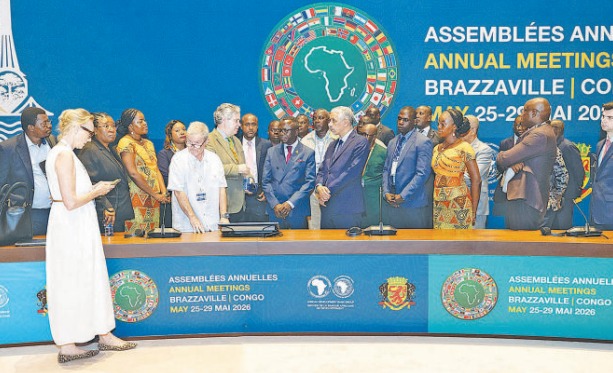
BRAZZAVILE: AS global economic uncertainty reshapes development financing, African leaders, policymakers and financial experts gathering in Brazzaville for the 2026 of the African Development Bank (AfDB) Group Annual Meetings are increasingly united around one central message: Africa must finance more of its own future.
The discussions in the Congolese capital come at a time when the continent faces mounting fiscal pressures driven by rising debt servicing costs, declining development assistance, geopolitical tensions and tighter international financial conditions.
Against that backdrop, delegates warned that Africa can no longer depend primarily on external aid and concessional financing to sustain long-term growth, industrialisation and climate resilience.
Instead, the focus is shifting toward domestic resource mobilisation, stronger regional financial systems and innovative investment models capable of unlocking the continent’s vast but underutilised capital base.
According to the AfDB statement, Africa’s financing requirements remain enormous. Estimates show the continent requires more than 1.3 trillion US dollars annually to achieve the Sustainable Development Goals (SDGs), while infrastructure financing needs alone range between 184 billion and 221 billion US dollars each year.
Climate financing gaps are estimated at more than 213 billion US dollars annually through to 2030, while accelerating structural transformation across African economies could require over 400 billion US dollars every year.
Yet despite these daunting figures, the AfDB’s African Economic Outlook 2025 report argues that Africa possesses significant untapped domestic financial potential.
According to the report, the continent could mobilise approximately 1.43 trillion US dollars annually from domestic revenue sources if governments strengthen institutional governance, improve tax administration and reduce financial leakages.
For many delegates attending the meetings, this represents both Africa’s greatest challenge and its greatest opportunity.
AfDB Vice-President for Private Sector, Infrastructure and Industrialisation, Mr Solomon Quaynor, said on the sidelines of the summit, Africa possesses substantial resources capable of supporting long-term development if properly harnessed.
“Africa has enormous untapped potential, from natural resources and renewable energy to youthful human capital and domestic savings,” he said, adding the challenge is how to unlock these resources efficiently and channel them into productive investments that support industrialisation, infrastructure and jobs.
He said it reflected growing concern among African policymakers over the changing nature of global development finance.
In recent years, developed economies have increasingly prioritised domestic economic recovery, energy security and geopolitical competition, leading to tighter global capital markets and reduced concessional financing flows for developing countries.
The Covid-19 pandemic, geopolitical conflicts and changing global trade dynamics have further complicated the financing landscape, increasing borrowing costs for many African economies already burdened by debt vulnerabilities.
“These global shifts are increasing the cost of capital for African countries while reducing access to concessional financing,” Mr Quaynor said.
This makes domestic resource mobilisation and regional financial cooperation more important than ever before.
The changing global environment is also forcing African governments to rethink traditional development models that relied heavily on external aid, sovereign borrowing and commodity exports.
Increasingly, policymakers are exploring how pension funds, sovereign wealth funds, domestic capital markets and private sector investment can play a larger role in financing infrastructure, energy and industrial projects.
AfDB Vice-President for Finance and Chief Financial Officer Hassatou N’Sele said strengthening African financial institutions would be critical in building resilience against future external shocks.
“Africa cannot continue depending primarily on external financing for its development ambitions.
“We need stronger African financial systems, stronger partnerships among regional institutions and more innovative approaches capable of attracting both domestic and international investment,” Ms N’Sele said.
She also underscored the growing importance of blended finance, climate finance instruments and digital financial systems in expanding investment opportunities across the continent.
Analysts attending the meetings noted that Africa’s long-term growth prospects remain strong despite current financing constraints.
The continent holds more than 60 per cent of the world’s remaining arable land, over 30 per cent of global mineral reserves and nearly half of global renewable energy technical potential.
At the same time, Africa’s rapidly growing population is expected to become one of its most significant economic advantages.
The continent’s population is projected to rise from approximately 1.5 billion people in 2025 to nearly 2.5 billion by 2050, making Africa both the world’s youngest and fastest-growing region.
For policymakers, the challenge lies in transforming this demographic expansion into productive economic growth through investment in education, industrialisation, entrepreneurship and job creation.
Mr Quaynor argued that Africa’s youthful population should be viewed as a strategic economic asset rather than a social burden.
“Africa’s youth are not a burden; they are one of the continent’s greatest assets,” he said. “The challenge is creating the right environment for productive employment, entrepreneurship and innovation.”
Beyond demographics and natural resources, delegates also highlighted the increasingly important role of the African diaspora in supporting economic development through remittances, investments and knowledge transfer.
AfDB’s Vice-President, People and Talent Management Complex, Jacques Edjangue called for stronger regulatory and investment frameworks capable of encouraging greater diaspora participation in development financing.
The discussions carry particular significance for countries such as Tanzania and other East African economies, where governments are seeking sustainable financing for strategic sectors including transport infrastructure, energy, manufacturing, agriculture and climate adaptation projects.
He said stronger regional financing mechanisms and deeper capital markets could help East African economies reduce reliance on expensive external borrowing while supporting industrial growth and regional trade integration.
However, experts cautioned that unlocking Africa’s domestic capital potential will require substantial governance reforms, stronger institutions and improved policy consistency.
Persistent challenges such as illicit financial flows, weak tax systems, fragmented regional markets and limited industrial capacity continue to constrain the continent’s ability to convert its vast resources into broad-based economic transformation.
There are also concerns that rising global fragmentation could further marginalise developing economies if African countries fail to strengthen regional cooperation and collective bargaining power in international financial negotiations.
The message emerging from Brazzaville is increasingly clear: Africa’s future development may depend less on external assistance and more on how effectively the continent mobilises and manages its own financial, natural and human resources.