Rio’s Tanzania visit: Fame, finance, value, strategy?
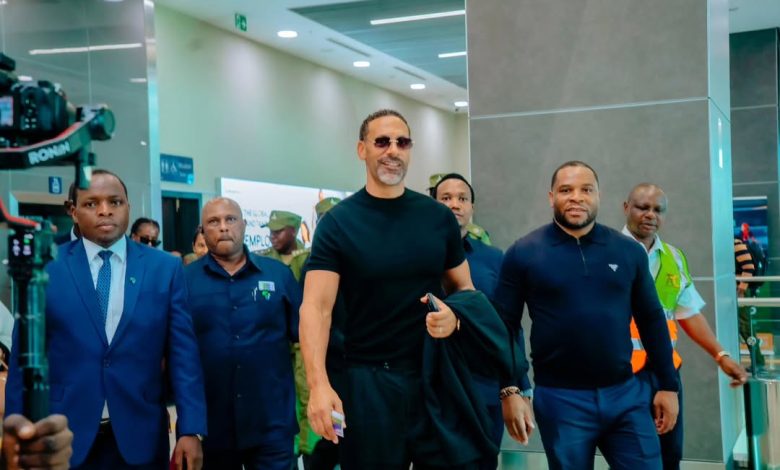
TANZANIA:RIO Ferdinand’s visit to Tanzania has transitioned from a sports and tourism story into a debate.
The criticism has been sharp. Some argue that Rio has not played professional football for years, so his influence is no longer strong enough to justify a major national reception.
Others say the itinerary looked too ceremonial, moving through official spaces rather than being structured like a proper tourism campaign. The strongest criticism is that he did not post enough during the visit, which many saw as a red flag. If the objective was tourism promotion, critics ask, why did the invited celebrity not actively push Tanzania to his own global audience?
Those questions are fair. But the government’s defence also deserves serious assessment. Gerson Msigwa clarified that public funds were not used and that Rio came through the relationship between the current Minister for Information, Culture, Arts and Sports, Paul Makonda and Rio’s wider circle of friends.
That changes the financial argument significantly. If taxpayers did not fund the visit, then the debate cannot simply be framed as public money wasted on a retired footballer. The better question becomes whether Tanzania took full advantage of a low-cost opportunity to access global football attention.
From that angle, the government’s case becomes stronger. Rio is no longer an active player, but he remains a former Manchester United and England defender, a Premier League figure and a recognised football media personality. His current value is not on the pitch. It is in recognition, networks, credibility and access to football audiences. In tourism and sports diplomacy, retired stars can still be useful commercial assets if their influence is properly activated.
This matters because Tanzania is approaching AFCON 2027, which it will co-host with Kenya and Uganda. CAF officially confirmed the three East African countries as hosts of the 2027 Africa Cup of Nations, making the tournament a major regional sports and tourism opportunity.
AFCON is not only about football. It is about hotels, airlines, restaurants, domestic transport, fan tourism, media services, sponsorship, hospitality and national branding. Tanzania cannot wait until 2027 to start positioning itself. It must build football-linked tourism awareness early.
Tourism is already one of Tanzania’s strongest economic sectors. International arrivals reached about 2.29 million in 2025, up 7.1 per cent year-onyear, while tourism earnings climbed to about 3.95 billion US dollars, compared with about 3.90 billion US dollars in 2024. That means even a small increase in arrivals can carry real financial value.
The numbers make the argument clearer. If a sportstourism campaign linked to Rio Ferdinand, AFCON 2027, Serengeti, Zanzibar and Kilimanjaro attracted only 10,000 additional visitors and each visitor spent an average of 1,500–2,500 US dollars, Tanzania could generate roughly 15 –25 million US dollars in direct visitor spending. If the campaign influenced 50,000 visitors, the potential direct spending could rise to 75 –125 million US dollars. That excludes wider benefits such as park fees, taxes, jobs, transport, food supply chains, hotel occupancy, domestic flights and local tour services.
This is why Rio’s visit should not be judged only by whether he still plays. The more important question is whether his presence can be converted into measurable content, visibility and tourism demand.
In modern tourism marketing, the visit itself is not the product. The content is the product. Posts, reels, interviews, photos, captions, hashtags, media rights and follow-up campaigns are what convert a celebrity visit into measurable value. This is why the complaint about Rio not posting enough should not be dismissed as social media gossip. If the objective is international visibility, then his own platforms matter.
Makonda’s response was that Tanzanians should not only wait for Rio to post, but should also push the positive content created around the visit globally. That argument has some truth. A country cannot outsource all promotion to a visiting celebrity. Local media, tourism agencies, influencers, hotels, airlines and tour operators must also amplify the story. But it is still an incomplete defence.
ALSO READ: Why Ferdinand sees Tanzania’s big sporting moment
Future visits should have clear content deliverables agreed in advance: Number of posts, posting dates, platforms, destinations to be highlighted, campaign tags, interviews and rights for Tanzania to reuse the material.
Makonda also introduced a more ambitious economic angle: Tanzanite. He explained that during discussions, Rio suggested that if Tanzanite could be used in Rolex watches, it might raise the mineral’s global value and that he could seek a sit-down with Rolex manufacturers because of his close links in that circle.
This idea is attractive, but it must be treated carefully. Tanzanite is one of Tanzania’s most unique resources. It is rare, globally recognisable and geographically tied to Tanzania. Linking Tanzanite to a major luxury watch brand would be a major branding win. It could reposition the gemstone from a tourist purchase into a luxury material associated with exclusivity, rarity and national identity.
But this is not yet value. It is only a lead. Rolex is a tightly controlled global luxury brand. Its material choices are not changed simply because someone knows someone. For Tanzanite to enter such a supply chain, Tanzania would need certification, consistent quality, ethical sourcing, reliable supply, luxury branding and formal commercial engagement. Rio may open a door, but the country must walk through it with institutions, industry players and a serious proposal.
Regional comparison makes the point clearer. Rwanda’s “visit Rwanda” campaign with Arsenal became famous because it bought repeated football visibility. The partnership was reportedly worth around 10 million UK pounds per year and is expected to end in June this year after years of political criticism. Tanzania may not need to copy that model immediately. A relationship-driven visit by a football legend can be a cheaper tactical move, especially if it opens tourism, football and luxury-brand conversations.
Morocco offers another lesson. Its tourism growth has not been built on celebrity alone. It combines destination branding, aviation, infrastructure, hotels, major events and football visibility. South Africa also shows that African regional travel matters. Tanzania should therefore use AFCON 2027 not only to target Europe, but also Kenya, Uganda, Rwanda, Nigeria, Ghana, South Africa, Zambia, the Gulf and the African diaspora.
Rio was not the strategy. He was an entry point. Tanzania must now turn that entry point into a campaign that sells AFCON 2027, Serengeti, Zanzibar, Kilimanjaro, Tanzanite, football development and the wider national brand. If that happens, the visit can be defended as economic diplomacy. If nothing follows, critics will be right that Tanzania hosted fame but failed to capture