

Reimagining EAC trade opportunities through deepened Tanzania-Kenya ties
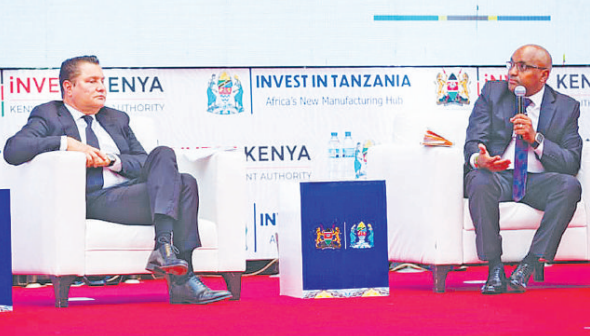
DAR ES SALAAM: THIS week, a high-level delegation of public and private sector players gather in Dares-Salaam for the Tanzania – Kenya Business Forum, a landmark conference that comes on the backdrop of renewed diplomatic efforts by President Samia Suluhu Hassan and her counterpart President William Ruto for the two nations to scale diplomatic and economic cooperation.
Undoubtedly, the largest economies within the East African Community (EAC) find themselves at crossroads as their economic alignment or lack thereof determines the trajectory of the bloc’s regional integration.
In the face of shifting supply chains and geopolitical realignments, the conference theme; ‘Unlocking Private Sector Growth and Investment’ speaks to the reality of a region that is forced to choose between positioning itself as a competitive economic force or to remain as a fragmented marketplace.
Understanding the strategic potential of Tanzania – Kenya Trade
Touted as ‘a pair bound with endless possibilities,’ the two economies are deeply linked by geography, history and markets with trade volume between these two countries having surpassed 1 billion US dollars in 2025.
With an average trade growth rate of over 7 per cent annually in recent years, the real opportunity lies not in simply increasing trade volumes, but in transforming the nature of the relationship to move from transactional exchanges to integrated production ecosystems.
For decades, intra-African trade has been constrained by fragmentation, with countries trading raw materials rather than building integrated regional industries.
Even within the EAC, intra-regional trade remains modest relative to its potential, despite recent growth. In 2025, intra-EAC trade rose by 15 per cent to 4.8 billion US dollars, a positive signal but still far below the scale needed to drive structural transformation.
At its core, the strategic importance of Tanzania–Kenya trade lies in scale, structure and potential. Kenya’s economy is anchored in a relatively diversified industrial and services base, while Tanzania’s strength lies in its abundant natural resources, expanding agricultural output and growing energy sector.
This structural complementarity creates a natural foundation for mutually beneficial trade. This dynamism, if properly harnessed, can evolve from simple exchange into deeply integrated value chains.
The current trade volumes, while steadily growing are a hint to the expansive underlying potential that has not been explored yet. While bilateral trade has expanded consistently over the past decade, it remains significantly below what comparable regional blocs achieve.
For instance, intra-regional trade within the European Union accounts for roughly 60–70 per cent of total member state trade, while in Association of Southeast Asian Nations, it stands at about 20–25 per cent.
By contrast, intra-trade within the East African Community remains in the range of 10–15 per cent underscoring the significant headroom for expansion if structural bottlenecks are addressed and deeper economic integration is achieved.
The strategic importance of Tanzania–Kenya trade also extends beyond the region, particularly in the context of the African Continental Free Trade Area (AfCFTA). As Africa moves toward deeper continental integration, strong bilateral corridors will serve as building blocks for broader trade networks.
This is especially critical when one considers the scale of the opportunity where AfCFTA brings together a market of over 1.3 billion people with a combined GDP of approximately 3.4 trillion US dollars.
The United Nations Economic Commission for Africa projects that by 2045, intraAfrican trade would increase by 45 per cent and enhance Africa’s GDP by 1.25 while boosting expansion in sectors such as agri-food by 60 per cent industry by 48 per cent, services by 34 per cent and energy and mining by 28 per cent.
Within this continental context, Kenya and Tanzania are uniquely positioned to anchor transformation in East Africa given their geographic positioning anchored by the ports of Mombasa and Dares-Salaam which provides access not only to their domestic markets but also to a hinterland of over 200 million people across the EAC and neighbouring countries.
As protectionism rises and sustainability manufacturing standards tighten, traditional export pathways are becoming more difficult to access. This means that the region risks being locked out of the most valuable parts of global value chains if it doesn’t take deliberate steps to enhance business capabilities and produce competitively for these markets.
Private sector players as the catalysts for growth
The deliberations that took place in Dar-es-Salaam places the private sector at the centre of this critical conversation given their role as owners of capital whose input injects new dynamism into this entire matrix. For financial services players like KCB Group, the opportunity to position ourselves as ecosystem enablers is very much here with us.
This means being at the forefront in building integrated financial solutions that reduce transaction costs, mitigate currency risks and enable seamless payments across markets through interventions like the Pan-African Payments Settlement Systems (PAPSS).
The potential of scalable partnerships between governments, development institutions and private sector players to unlock value chains in agriculture, manufacturing and services cannot be understated.
By doing this, we shall be able to empower critical sectors of the economy including women and youth-led enterprises, which represent a significant but underleveraged segment of the economy.
ALSO READ: TZ-Kenya business council to push trade to 2.6tri/-
Leveraging our robust trade finance solutions, regional branch networks and digital banking platforms, what we shall be doing is to reduce friction in crossborder commerce and unlock new growth opportunities.
Ultimately, the success of Tanzania–Kenya economic integration efforts will not be determined solely by flowery policy frameworks or trade agreements, but by the ability of the two nations to stepchange in more productive sectors to unlock structural transformation, deepen regional value chains and build a more competitive and resilient economic partnership.


İstanbul genelinde konaklama, VIP partner, otel karşılama ve lüks gece hayatı seçenekleri hakkında son derece kapsamlı ve faydalı bir paylaşım olmuş. Özellikle İstanbul escort bayan, VIP eskort ve otel transfer hizmeti arayanlar için bölge bölge hazırlanan güncel portföy ilanlarını aşağıdan detaylıca inceleyebilirsiniz:
– Mecidiyeköy Escort İlanları: Mecidiyeköy Escort VIP Partner
– Beylikdüzü Escort İlanları: Beylikdüzü Escort Bayan
– Ümraniye Eskort İlanları: Ümraniye Eskort Bayanlar
– Fatih Escort İlanları: Fatih Escort Tarihi Yarımada
– Beşiktaş Escort İlanları: Beşiktaş Escort VIP Partner
– Ataşehir Escort İlanları: Ataşehir Escort Bayanlar
– Bakırköy Eskort İlanları: Bakırköy Eskort VIP Transfer
– Sarıyer Escort İlanları: Sarıyer Escort VIP Partner
– Üsküdar Escort İlanları: Üsküdar Escort Bayan
– Kadıköy Eskort İlanları: Kadıköy Eskort VIP Partner
– Maltepe Escort İlanları: Maltepe Escort Bayanlar
– Bostancı Escort İlanları: Bostancı Escort VIP Partner
– Şişli Escort İlanları: Şişli Escort Bayan
– Kadıköy Moda Eskort: Kadıköy Moda Eskort
– Üsküdar Sahil Escort: Üsküdar Sahil Escort
– Mecidiyeköy Eskort: Mecidiyeköy Eskort Bayan
– İstanbul Escort Genel: İstanbul Escort VIP Partner
– Maltepe Eskort Rehberi: Maltepe Eskort İlanları
– Fatih Eskort Rehberi: Fatih Eskort Bayanlar
– Ümraniye Escort Rehberi: Ümraniye Escort VIP Partner
– Beşiktaş Eskort Rehberi: Beşiktaş Eskort İlanları
– Ataşehir Eskort Rehberi: Ataşehir Eskort Bayan
– Beylikdüzü Escort Rehberi: Beylikdüzü Escort VIP Partner
7/24 otel karşılama, bağımsız modeller ve VIP seyahat rehberi arayanlar güncel kataloğu yukarıdaki bağlantılardan doğrudan inceleyebilirler. Paylaşım için teşekkürler! [svmfbgtdbrbgcrpvbw]
Son günlerde mahalledeki eski binaların yıkım sürecini izlerken ister istemez kendi yaşadığım yerin güvenliğini düşünmeye başladım. Süreç hem çok yavaş ilerliyor hem de insanı biraz geriyor, acaba benzer durumlarla karşılaşanlar nasıl bir yol izledi? [hhenpriatsdwddbssu]