Tanzania tests waters with elite swim coaching
DAR ES SALAAM: For a country defined by vast lakes, a long Indian Ocean coastline and year-round warm weather, Tanzania has an obvious but underutilised sporting asset: water. Yet swimming has historically remained on the margins of the national sports conversation, overshadowed by football and athletics.
That may be starting to change.
Beyond competition, swimming offers clear public value. It is a life skill in a nation where water bodies are central to daily life and transport. It is also a low-impact, full-body sport that supports health, discipline and mental resilience. At elite level, it opens doors to international scholarships and competition.
Against this backdrop, efforts to build structured swimming programmes are gaining importance—not just for medals, but for safety, opportunity and diversification of the sports economy.
It is within this context that Monti International School has announced a 10-day high-performance swimming camp in Dar es Salaam, signalling a more deliberate push to develop the sport locally and regionally.
The initiative aligns with the broader ambition articulated by Paul Makonda, Minister for Information, Culture, Arts and Sports, to expand the development of multiple sporting disciplines across the country.
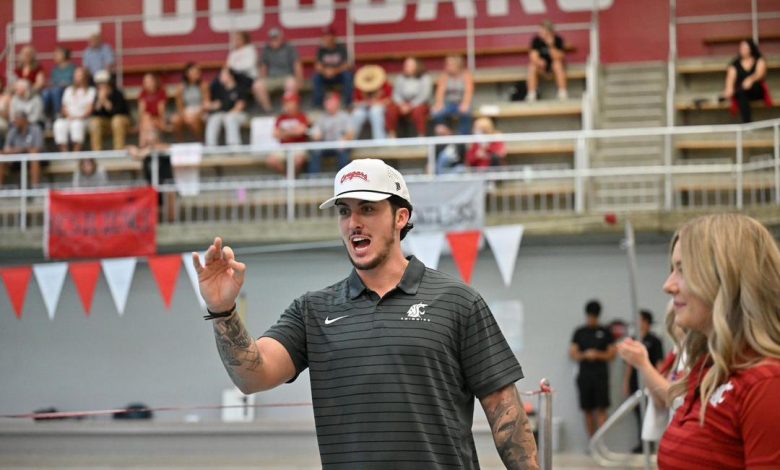
Scheduled for May 5 to May 14, 2026, the camp will take place at the school’s Mikocheni campus in Dar es Salaam. It will be led by American coach Austin Pillado, whose résumé reflects experience at one of the most competitive levels of collegiate swimming in the United States.
Pillado currently serves as Associate Head Coach of the women’s swimming team at Washington State University.
He was also part of the technical staff that secured a national collegiate championship title during his time at Arizona State University under competitions organised by the National Collegiate Athletic Association. His exposure to Olympic champions and world record holders places him among a class of coaches rarely accessible in East Africa.
For Tanzania, where structured elite coaching in swimming is limited, this represents more than a routine training camp. It introduces methodologies, discipline and performance standards that are typically out of reach for most local athletes.
Monti International School’s Founder and Director, Fatma Fernandes, said the initiative is designed to close the gap between local potential and global expectations.
“We aim to bridge the gap between local talent and global standards. By bringing in top-level coaches like Austin, we enable our youth to receive professional training and analysis comparable to that of the world’s best athletes,” she said.
The camp will introduce a level of technical sophistication not commonly seen in the region. Notably, it will use underwater camera systems to provide real-time feedback on swimmers’ form something that, until recently, might have sounded more like Olympic preparation than a local training session. For young swimmers, seeing exactly what their stroke looks like beneath the surface can be the difference between guesswork and measurable improvement.
Participants will also be exposed to structured sessions beyond physical training. These include race strategy, nutrition planning and a concept known as the “Fifth Stroke”, a modern approach focusing on efficiency, transitions and the often-overlooked technical elements that separate good swimmers from elite performers.
The programme itself is modelled on training systems used in U.S. universities competing in NCAA events. It aims to strengthen mastery of the four primary strokes freestyle, backstroke, breaststroke and butterfly, while improving endurance and speed. In short, it treats swimming not just as an activity, but as a science.
Monti’s investment in infrastructure underpins this ambition. The school has developed a 25-metre Olympic-standard swimming pool, positioning itself as one of the few institutions in the country with facilities capable of supporting high-performance training. Importantly, the school says the facility is intended to serve not only its students but also the wider community.
That broader access matters. One of the persistent barriers to developing swimming in Tanzania has been limited infrastructure. Pools are scarce, often privately owned, and not always accessible to aspiring athletes. Without consistent access to proper facilities, talent identification and development become difficult.
The camp is expected to attract swimmers from across East Africa, turning it into a regional rather than purely local initiative. However, organisers have deliberately limited the number of participants to ensure each swimmer receives close attention, an approach that prioritises quality over scale.
From a business and development perspective, the initiative reflects a growing recognition that sports can be an investment sector, not just a recreational activity. Structured training programmes, international coaching partnerships and modern facilities create ecosystems where talent can be nurtured, retained and potentially monetised through scholarships, competitions and sponsorships.
There is also a signalling effect. Hosting a coach with Pillado’s background sends a message that Tanzania is open to integrating global expertise into its sports development pipeline. For young athletes—and their parents, it suggests that pursuing swimming seriously is no longer an unrealistic ambition.
At a policy level, the initiative aligns with the objectives of the National Sports Council, which is mandated to develop, coordinate and regulate sports in the country. Expanding into disciplines like swimming supports diversification, reduces overreliance on a few sports, and broadens opportunities for youth engagement.
And perhaps, with a touch of humour, it also answers a simple question: in a country surrounded by water, shouldn’t more people know how to move through it fast?
If sustained, initiatives like this could begin to reshape how swimming is perceived in Tanzania from a leisure activity to a structured, competitive sport with clear pathways. The challenge, as always, will be continuity. A single camp can spark interest; consistent programmes build champions.
For now, the starting whistle has been blown or perhaps, more appropriately, the first splash has been made.