Time for UN reforms
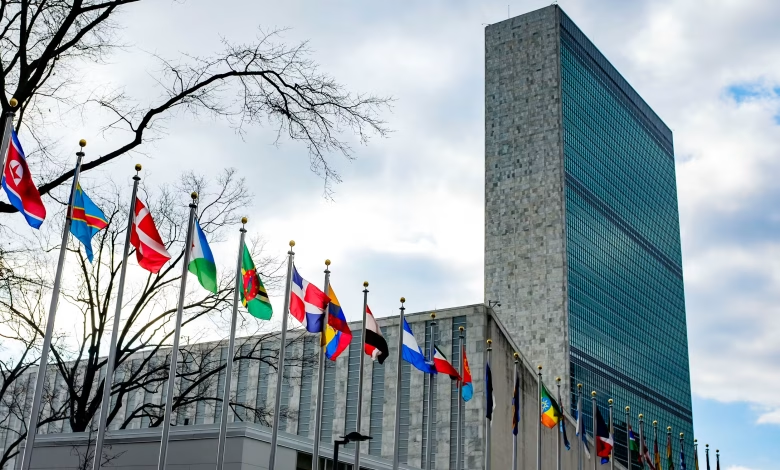
DAR ES SALAAM: TANZANIA has renewed its call for reforms of the United Nations (UN) and international financial institutions so that they can address challenges.
The call was made by Vice-President, Dr Philip Mpango at the General Debate of the 80th Session of the UN General Assembly that for the UN to remain relevant and true to its noble mission, it must embrace change.
ALSO READ: UNGA 80: Dr Mpango opens Tanzania-US Trade and Investment Forum
There is in place ‘UN80 Initiative’. This is the UN’s systemwide effort, launched by Secretary-General António Guterres in March this year to make the organisation more effective, efficient and responsive to complex global challenges ahead of its 80th anniversary.
It consists of three workstreams focusing on internal efficiencies and cost reductions, a mandate implementation review and broader structural and programmatic realignments, with the goal of delivering better outcomes for people and strengthening the multilateral system.
The initiative is supported by member states through General Assembly resolutions and aims to accelerate progress on the Sustainable Development Goals (SDGs) and the Pact for the Future.
Key aspects of the UN80 Initiative include efficiency and cost reduction: The initiative includes proposals for internal cost-cutting measures, improved service delivery and greater accountability within the UN system to free up resources for its core mission.
There is also an aspect of mandate review, whereby a significant part of the reform is a review of existing mandates to identify and remove outdated or duplicative mandates and to improve the delivery of others, with an ambitious plan to leverage AI for this purpose.
Structural and programmatic realignment is another issue. The initiative proposes broader structural changes and realignments of programmes across UN agencies to create a more integrated and effective system, organised around thematic clusters like peace and security, development and human rights.
Strengthened impact and agility is another issue, whereby the ultimate goal is a more agile and accountable UN that can respond effectively to current and future global crises, enhance its relevance and deliver more impact at a time of increasing needs and constrained resources.
It is high time reforms are adopted at the UN. Member states are involved in the process, considering reports and proposals and have the option to launch intergovernmental processes for decisions that require their approval.
The initiative involves wide-ranging consultations across the UN system, including staff and thematic clusters, to gather input and develop concrete options.
Why it matters: The UN80 initiative is crucial for the UN’s continued effectiveness. It aims to demonstrate the multilateral system’s ability to adapt and improve, particularly in delivering on the Sustainable Development Goals (SDGs) and the Pact for the Future. Let all stakeholders play their part to ensure they happen.