Vultures are veterinary officers in the Savannah
DAR ES SALAAM: AS the clock ticks toward the annual Serengeti migration — a journey that tragically claims the lives of over 250,000 wildebeests before it even begins in the park’s southern region it’s clear that smart, proactive measures must be taken to clean and protect the environment.
This is important because the spectacular annual migration across the Greater Serengeti Ecosystem involves not only wildebeests, but also a diverse range of animals and bird species that are integral to this natural wonder.
Normally this happens between November and December when a strong contingent of more than 2,000,000 animals arrive on the southern part of the greater Serengeti ecosystem.
The second largest group in the migration consists of zebras and gazelles.
However, they are not alone other species, including lions, cheetahs, hyenas, jackals and large birds such as vultures and marabou storks, follow the migration for their own survival and hunting opportunities.
Zebras are very smart animals because it is said that they the ones that trigger the move from Serengeti.
Instead of going to Maasai Mara through a route full of difficulties most of them turn to Maasai Plains.
In the early morning hours of November, a group of zebras from Serengeti National Park arrives in the Ngorongoro Crater.
While others are busy grazing on the fresh grass, one zebra stands apart exhausted and uneasy after a long, gruelling journey filled with challenges.
As time passes, its condition worsens and it begins to show clear signs of collapse, teetering on the edge of death.
As this unfolds, vultures circle high in the sky scanning the ground from thousands of feet above.
Spotting the weakened zebra, they begin to take a keen interest, sensing an opportunity for an easy meal. Driven by curiosity, some of the vultures descend and perch on nearby trees, patiently waiting for the zebra to collapse and become their meal for the day.
It’s this very behaviour that inspired James Hadley Chase to title one of his many books The Vulture is a Patient Bird.
Before many people’s eyes, these birds are not beautiful. In simple words, beauty can be defined as a characteristic of an animal, idea, object, person or place that provides a perceptual experience of pleasure, on other hand ugliness is a property of a person or thing that is unpleasant to look upon and results in a highly unfavourable evaluation.
To be ugly is to be aesthetically unattractive, repulsive, or offensive that why before many people’s eyes due to its life style and daily activities the vulture is not beautiful, an outcast and very dirty animal.
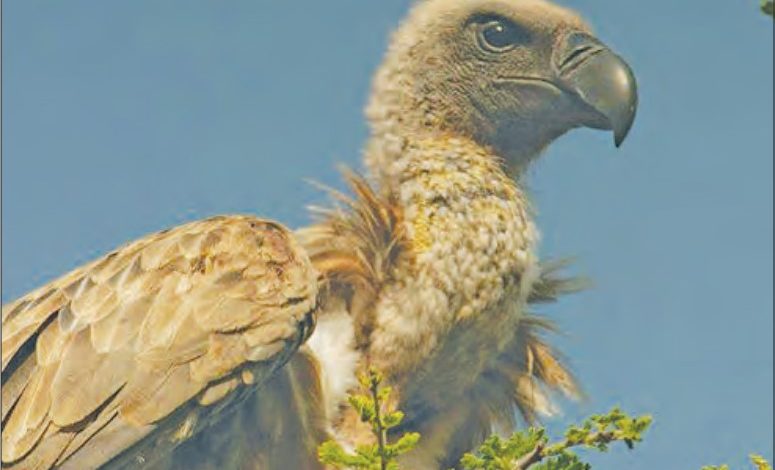
Vultures are group of scavenging birds of prey which live on carcasses of dead animals on African plains and they are characterised by bald heads and entirely lacking normal feathers which are found on other birds.
Vultures are bald headed because the bare skin may play an important role in thermoregulation because the birds have been observed to hunch their bodies and tuck in their heads in the cold and open their wings and stretch their necks in the heat.
A group of vultures can be called a wake, committee, kettle, venue, or volt—each term describing a specific behaviour. ‘Kettle’ refers to vultures in flight, ‘committee’ describes those resting in trees, while ‘wake’ is used for a group feeding on the carcass of a dead animal.
The action of feeding on carcasses of dead animals is what gives the vulture unpleasant images before many people’s eyes but from their point of view, scientists say these birds play an important role on the environment.
At the time when preys are abundant, vultures look very ugly because they are not active as they sit sluggishly, sleeping or half asleep on a branch of an acacia tree while digesting their food.
On the other hand, vultures play a very important ecological role of cleaning the savannah where hundreds of animals die every day due to natural causes such as illness and ageing.
Vultures play an initial and crucial role of decomposition process by opening the skeleton for powerful bacteria which will grinded the bones to dust while increasing soil fertility.
This makes the vultures to be number one and more efficient in the natural process of cleaning the forest than hyena and jackals which depend on their nostrils to collect smell of a decomposed body from the air and spend many hours to locate it in the middle of jungle.
In the wild many eland, bushbuck, buffalo, waterbuck and other antelopes die because of age and illness than falling into accident of being killed by predators.
Due to some of morphological hindrance it’s very difficult for an older lion incapable of hunting to see a carcass of an antelope laying in the middle of Savannah full of bushes, trees and ground with wrinkles.
This is like searching a needle on the floor of a darkroom although every day there is at least a single dead body of a mammal within an area of 100 square miles.
Getting carcass in a national park full of scavengers is very competitive task and winners are those who are gifted with sharp eye sighting and are quick in their actions.
This is an easy task to a Vulture who is equipped with Telephoto Vision system making them to pin point clearly a dead body from the sky even at thousand miles.
The system work in their eyes like a camera whereby an object is photographed and an image is sent to the brain for scrutiny and action.
This ability give vulture an upper hand against ground dwelling scavenger such as hyena, jackal and old lions who depend mainly on their noose to sniff in the air and wait for wind to show them a location with a dead body.
Once a vulture spots a carcass on the ground it will go down at a speed of 18 miles per hour sending powerful waves with signals to others who may be up to 20 miles away.
After 20 minutes all vultures in the air will congregate at the sight but not every one of them is capable of tearing up the tough skins of a zebra or other mammals which is built hard to meet hard condition of the Savannah.
There are about two species of vultures, who do this for others mainly the griffon vulture and lapped faced vulture who is also known as Nubian vulture.
These vultures are very big with a body height of 95 to 115 centimetres and wing span of 2.5 to 3 metres and may weigh 6.5 to 9.2 kilogrammes for male and 10.5 and 13.9 kilogrammes for female.
Nubian vulture are equipped with flexible neck with no feathers to enable them penetrate smoothly deep into a carcass after splitting the skin with their hard and sharp beak.
Unlike other species who wait for a dead body Nubian vulture are regarded as notorious bird because sometime they attack and kill weaker animals before eating their flesh.
People like Wangureme, Waikizu, Wanata and others who live around Serengeti National Park has marked Nubians vulture by the name of Veterinary Officer because they check the meal before allowing others to feast on it.
From Europe and Asia Griffon vulture migrate to Serengeti Greater System during the annual migration.
They are identified by their flat head on a short but flexible neck with special feathers resistant to liquid and bloody, their eyes are also protected with a transparent glassy material to enable them to see clearly when deepened into a carcass.
Like Nubian Vulture the Griffons are equipped with a long sharp beak which they use to tear skins.
Their bodies are covered by brown shining feathers which make them to look in control when you watch them in action.
Griffon Vulture are prejudice and pompous before other weaker species of vulture because sometime they may come to sight and refuse to open the skin of a dead animal as they walk majestically with their wing extended.
At this point other vulture will start to eat soft part of the dead animal or wait for Hyena and Jackals to do it for them.
Griffon Vulture administer ways or procedure to followed with other vulture when feasting on a carcass, normal they will spurn of a group after he feels they need to leave others especially juvenile to take their chance.
Vulture are equipped with special intestines with corrosive acid able to grind everything including harmful bacteria which attack and kill animals but die before causing problems to them.
The Swahili names for vulture birds is Tumbusi and with their large wings are able to go down at a speed of 18 miles per hour while sending powerful waves with signals to others in the sky 20 miles away which may take 20 to 30 minutes to congregate on the killing sight.
In some animal’s sanctuaries in Africa while targeting vultures, poachers are using special poison which they put in vegetables and loaf of breads to kill animals such as buffaloes and zebras.
They do this knowing that the poisoned animal’s carcasses are then eaten by vultures which also take portions to feed their chicks resulting into a massive death different species of vultures which are found in the savannah of Africa.
The International Union for the Conservation of Nature’s or IUCN says that the problem between poachers and vultures started from the Far East in early 1970s, it caused painful effects in countries such India where there more than 60 million of vultures but up to the end of 1990 the country lost 99.9 per cent of these birds.
IUCN says this is a catastrophic phenomena in the history of conservation in Africa, due to the fact that one carcass may kill up 1,600 birds at once.
This is because its estimated that at least one bird may take a poisoned piece of meat to chicks hutched in a nestle on rocks some miles away from the killing sight. The IUCN also says that for the past 20 years, 1,500 pairs of breading vultures have been killed in South Africa but the ugly looking bird with beautiful actions is facing another problem in some East African countries.
It is believed that some farmers are using dead bodies of cattle to target leopard and lions which took their sheep, goat, cow but most of the time the carcass end up being eaten by vultures which are specialised on eating dead bodies.
In Tanzania and Kenya, it is not yet known how many vultures have been affected through this tedious action but the two giants of tourism in East Africa need these birds to remove dead bodies which fall along the way during Serengeti annual migration.
Species of vulture that are found in the savannah includes the Egyptian vulture also known as white scavenger vulture or pharaoh’s chicken which feed mainly on carrions.
Others are Kolbe’s vulture is capable flying to a long distant location in the park to feed on a carcass of a zebra, griffon vulture is a scavenger, feeding mostly from carcasses of dead animals which it finds by soaring over open areas while moving in flocks.
The hooded vulture is a native to sub-Sahara Africa where it often moves in flocks searching for carcasses and is very abundant in different national parks where it is not afraid of people.