TZ, Russia boost strategic alliance
DAR ES SALAAM: TANZANIA and Russia have significantly deepened their bilateral relations over the past twelve months, with both countries expressing readiness to further expand cooperation in key strategic sectors for mutual benefit.
The bilateral ties have continued to gain momentum across several strategic areas, expanding beyond long-standing political solidarity to encompass trade, economic development, investment, energy, security, education, technology and people-to-people exchanges, all anchored in shared development goals.
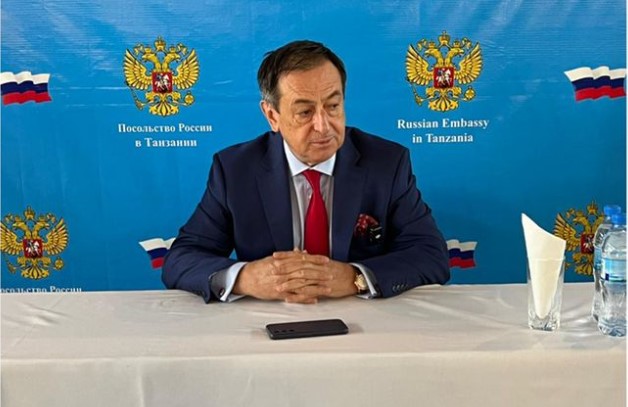
This was highlighted by the Russian Ambassador to Tanzania, Mr Andrey Avetisyan, while presenting his end of year report on the state of relations between the Russian Federation and Tanzania.
He described 2025 as a particularly strong year, marked by tangible progress across priority cooperation areas.
“Political relations between our two countries remain strong and stable, providing a solid foundation for expanding cooperation in other sectors,” he said.
He asserted that decades long friendship between Tanzania and Russia is now being reinforced by growing economic, trade and investment engagement.
“Our traditional friendship of many decades is now being enriched by close political relations as well as growing trade, economic and investment cooperation,” he said.
In the trade and economic sector, he pointed to the second meeting of the Joint Intergovernmental Commission on Trade and Economic Relations, held in St Petersburg in May. The meeting was co-chaired by Tanzania’s Minister for Planning and Investment, Professor Kitila Mkumbo and Russia’s Minister for Economic Development, Mr Maxim Reshetnikov.
According to Mr Avetisyan, discussions focused on practical decisions and concrete agreements, with strong participation from Tanzanian businesspeople underscoring expanding private-sector engagement.
ALSO READ: Govt unveils bold youth plan
“Key areas advanced during the meeting included energy, logistics and transport, agriculture, information and communication technologies and industrial cooperation,” he said.
He added that both sides expressed readiness to translate discussions into implementable projects delivering tangible benefits. On energy and investment cooperation, Mr Avetisyan cited the inauguration of the Mkuju River uranium project in Ruvuma Region, implemented by Russia’s stateowned nuclear corporation Rosatom.
He said the project is expected to generate more than 4,000 jobs by 2030, while also supporting social development initiatives such as schools, health facilities and wildlife conservation.
“Beyond strengthening Tanzania’s long-term energy security, the project has the potential to become one of the cornerstones of the country’s broader economic transformation,” he said.
On security and defence cooperation, the ambassador pointed to the August visit of a Russian Navy training ship to Dar es Salaam.
“The visit was significant not only because it brought 300 Russian naval cadets to Tanzanian shores, but also because it included 15 Tanzanian cadets, the first in their country’s history to participate in a long-distance Russian maritime training voyage,” he said.
He noted that the visit demonstrated Russia’s interest in expanding defence education ties and symbolically broadened the scope of bilateral cooperation. He also highlighted increased high-level political engagement during the year, citing the November 6 visit of the first Deputy Head of the Russian Presidential Administration, Mr Sergey Kiriyenko, to Dodoma.
During the visit, Mr Kiriyenko delivered a personal message from President Vladimir Putin to President Samia Suluhu Hassan.
“The message congratulated President Samia on assuming the presidency following the 2025 elections and reaffirmed Russia’s readiness to expand cooperation in economic, scientific, humanitarian and energy fields,” he said.
He added that the visit of Mr Kiriyenko is the first to an African country since assuming responsibility for several Global South portfolios, which signalled Moscow’s growing attention to Tanzania and commitment to sustained political dialogue.
Mr Avetisyan further said both countries have expressed strong readiness to deepen cooperation across all existing and emerging areas in 2026, guided by mutual respect, shared interests and economic complementarity He announced that the third meeting of the Joint Intergovernmental Commission on Trade and Economic Relations will be held in Tanzania next year, describing the decision as a sign of trust, continuity and a results-oriented partnership.