State pledges to lower Kigamboni Bridge road toll
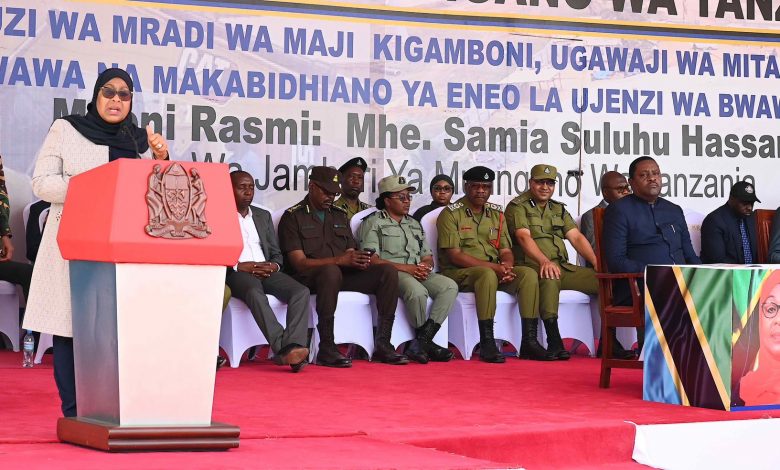
THE government will consider reducing the rates of road toll charged at the Kigamboni’s Mwalimu Nyerere Bridge instead of scrapping it completely, President Samia Suluhu Hassan has said.
She said the fees are being charged for the sake of servicing the loan that was spent on the construction of the infrastructure that came into effect in April 2016.
The bridge was constructed at a cost of 135 million US dollars (313.5bn/-) becoming the first of its kind in East Africa at the time.
The bridge which was thereafter christened Nyerere Bridge is a joint venture between the National Social Security Fund (NSSF) and the government.
Speaking in Kigamboni on Friday, President Samia said the fees will continue to be charged to motorists as they use the bridge, since it was constructed by using funds that were secured on loan agreement.
“We can’t remove the charges completely, instead we can consider reducing it, the bridge was constructed through a loan that has to be refunded to creditor,” she said.
Her statement came in response to a request issued by the Kigamboni Member of Parliament Dr Faustine Ndugulile who asked the government to consider scrapping the road toll in a bid to reduce the cost of living for Kigamboni residents.
This comes just seven months after the government announced a new payment system which will allow users of the bridge to pay in bundles on daily, weekly and monthly basis, an arrangement which is believed to be affordable.
Under the introduced arrangement, a user who opts for the daily charges to move to and from Kigamboni will only be subjected to pay once for all trips per day.
Besides, the weekly and monthly payment arrangement will be delayed for some time as the system goes through maintenance.
The indicative prices which were issued require motorcyclists famously known as ‘bodabodas’ to pay 300/- per trip and 500/- per day while on weekly basis they be required to pay 2,000/- and 5,000/- per month.
Speaking in a telephone interview with this newspaper, Deputy Minister for Works and Transport (Works portfolio) Godfrey Kasekenya said the road toll review was aimed at providing relief to the residents of Kigamboni as well as offering an alternative means of transport which will reduce congestion at the ferries.
“Majority of the people living in Kigamboni were forced to park their vehicles due to the charges, a factor that pushed the government to review the prices, which will allow users to pay the tolls on daily, weekly and monthly basis,” said Eng Kasekenya.
Before new charges, for instance, a commuter bus was paying 5,000/- to cross the bridge, meaning that if the commuter crosses 20 times a day it pays a total fee of 100,000/-, which is 3m/- per month.
A motorist with a saloon car was paying 1,500/- to cross over, which means a resident who was crossing twice a day paid almost 100,000/- per month.
Nyerere Bridge is a 680-meter-long cable suspension link that connects the Dar es Salaam ward of Kurasini to the Kigamboni District across the Kurasini creek.
It has 2.5 km approach roads where 1km is on Kurasini side and 1.5 Km is on the Kigamboni side.