Samia’s speech in focus: Defending stability against engineered disorder
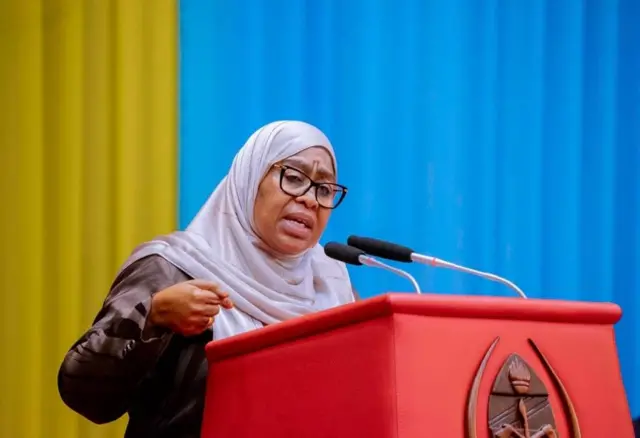
DAR ES SLAAM: AT moments when a nation’s stability feels strained, it is not the volume of competing voices that determines the way forward but the clarity of thought guiding those entrusted with leadership.
Tanzania now stands at such a juncture, confronted by tension, misjudgments and the subtle attempts of a few to distort the collective calm that citizens have long upheld.
In these periods, the measure of national resilience is revealed not through reactionary impulses but through the sober wisdom and steadiness of its institutions and leaders.
President Samia Suluhu Hassan’s recent posture reflects precisely this demand for level-headedness.
Her tone, firm yet reflective, signals a broader appeal that extends beyond government corridors to the conscience of the nation itself Dr Samia’s address to elders in Dar es Salaam last Tuesday began with a warmth that felt deliberate, almost disarming, before she moved into the urgency of her message.
She spoke not with the cadence of a politician repeating rehearsed lines, but with the steadiness of someone who believed deeply in what she was trying to convey.
“What happened after the 29 October election was not an accident, not frustration, not confusion,” she said, her tone even but unmistakably emphatic.
“It was an organised attempt to destabilise this country.”
That line, delivered without theatrics, set the stage for the remainder of her remarks: Tanzania, she warned, had faced a coordinated effort to shake its foundations, and she would not allow such an attempt to succeed under her leadership.
There was a grounded certainty in the way she spoke, as if the events of recent weeks had shifted from noise to clarity in her own mind.
And as she continued, it became evident that this was a speech shaped not only by crisis management, but by broader reflection on sovereignty, responsibility, and the future of the nation’s political culture.
Standing before regional elders and senior government officials, she argued that the mobilisation of young people onto the streets was, in her view, not an expression of organic discontent but a planned effort to topple the government by force. The suggestion was stark, yet she did not attempt to soften it.
ALSO READ: Wisdom thrives: Samia’s call for unity, restraint and national healing
She pushed back firmly on criticism that security agencies had used excessive force, countering with a question that cut through much of the debate: “What is ‘less force’ when groups arrive prepared to burn the country?”
It was delivered calmly, almost conversationally, yet it carried the weight of someone trying to spell out the limits of state restraint when confronted with what she described as an attempted uprising.
Her words suggested not only frustration with the criticism but a desire to shift the conversation towards the reality she believed the state had faced. That frustration was not limited to domestic voices.
Samia addressed directly the remarks from foreign governments and some religious leaders who had criticised the government’s handling of the unrest.
“We do not interfere in other nations’ internal affairs,” she reminded them, “and we expect the same respect.”
It was one of the clearest articulations of her stance on sovereignty to date. Her argument drew on a broader regional sentiment: that African states, while cooperating with international partners, deserve political space free from external prescriptions.
She went further, noting that Tanzania’s relationships abroad are built on mutual benefit, not instruction.
“We work with partners in a win–win relationship,” she said, “not a teacher–student one.”
The line resonated partly because it expressed a sentiment many Tanzanians hold privately, that development cooperation should not translate into political oversight.
But it also signalled that her administration would continue to push back against what it perceives as overreach.
Her comments on foreign critique flowed naturally into her response to domestic religious criticism, particularly from Catholic bishops who had condemned the conduct of security forces and the narrowing of political space.
She did not name them, but her meaning was clear enough that no one in the room required clarification.
“Advice is welcome,” she said, deliberately measured. “Directives are not.”
The distinction mattered: she was positioning the state as a listener, but not a subordinate.
It was one of the moments in the speech where her tone carried both courtesy and firmness — a blend that has become something of a signature during tense political moments. For supporters, it sounded like responsible leadership; for critics, it risked sounding dismissive.
Yet it aligned with her wider argument that the state has responsibilities it cannot outsource, particularly in moments of instability.
When she turned to the role of young people in the unrest, her voice shifted again, this time towards something closer to concern than reprimand.
She described many of the youths involved as having been “coached like parrots,” repeating phrases and demands they barely understood.
The phrasing was blunt, but it opened into a deeper reflection on civic education and the gap she believes Tanzania has allowed to widen.
She said the nation was paying the price for leaving young people to “raise themselves” without adequate guidance in navigating political messaging.
It was one of the more introspective parts of her speech, acknowledging state shortcomings even as she held organisers responsible for manipulation.
By linking the unrest to broader structural issues, she repositioned the crisis not merely as a security challenge but as a generational one, requiring long-term investment rather than temporary enforcement measures.
To that end, she highlighted the establishment of a Ministry of Youth, describing it as an intentional effort to shape civic understanding among the next generation.
“Peace is not kept by force alone,” she said.
“It is kept by raising a generation that understands its responsibility to the nation.” Here, she sounded less like a president reacting to a crisis and more like a leader mapping out a long-term strategy.
The creation of the ministry had drawn mixed reactions in previous weeks, with some viewing it as an attempt to placate young people after the unrest, while others saw genuine promise in its mandate.
Her framing suggested she belonged firmly to the latter camp. Reactions to the speech began circulating online almost immediately.
They varied, but reflected the complexity of public sentiment rather than simple approval or disapproval.
A Tanzanian in Arusha wrote that “chaos is expensive” and that even those uncomfortable with the president’s tone understood the fear of instability.
A university student in Morogoro countered that calling the entire unrest a “project” felt like an attempt to avoid accountability for the actions of security forces, a reminder that young citizens remain wary of power even when they agree with the need for peace.
A Kenyan political commentator described the speech as “the classic stability argument,” cautioning that such arguments rely heavily on public trust in institutions.
And from the diaspora, a young Tanzanian in the UK wrote that Samia’s remarks about youths being coached felt familiar, recalling how easily political passion can eclipse understanding when one is young. T
aken together, these reactions painted a portrait not of a population uniformly persuaded or uniformly resistant, but of a society wrestling with its own anxieties, hopes and memories.
In many ways, that complexity mirrored the speech itself. Samia’s remarks were neither defensive nor triumphant; they were forceful, reflective and unmistakably inward-looking.
By blending blunt warnings with calls for collective responsibility, she attempted to define the moment not as a political rupture but as a national crossroads.
Her closing words, “Protecting this country is a duty we share”, carried both reassurance and expectation.
It was a reminder that, in her view, stability is not merely the work of the state but the outcome of a society choosing peace over manipulation, clarity over confusion, and long-term unity over short-term political gain.