Relief for productive sectors as EFTA launches 50bn/- Corporate Bond
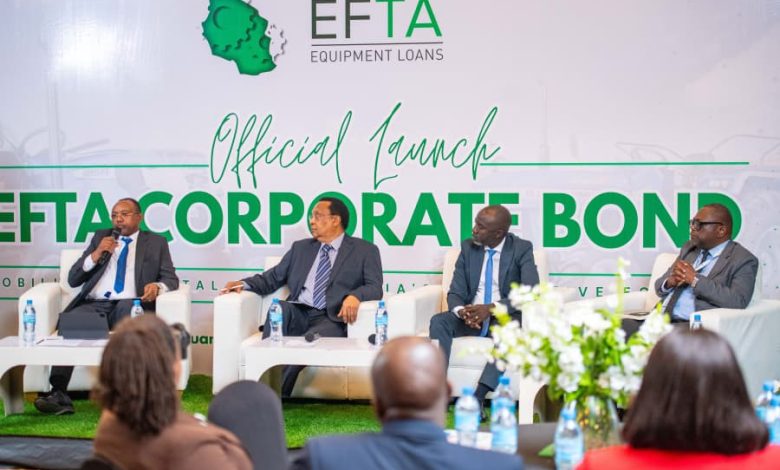
DAR ES SALAAM: EQUITY for Tanzania Limited (EFTA) has launched a 50bn/- corporate bond as a strategic move to strengthen financing for productive sectors through the capital markets.
The bond officially launched recently in Dar es Salaam, bringing together key stakeholders from the financial sector, institutional investors, and capital market participants. The event sparked broader discussions on the role of capital markets in driving Tanzania’s real economy.
This comes after it was established that access to capital emerged as a major constraint to the growth of productive sectors.
In most cases, farmers who need modern equipment, transporters who require commercial vehicles, and small industries depend on machinery to add value to their products.
According to EFTA’s Chief Executive Officer, Nicomed Bohay, the core objective of the bond is to align long-term capital with long-term income-generating assets.
“We finance assets such as tractors, commercial vehicles, and industrial machinery that generate income over several years. For these sectors to grow sustainably, they require long-term capital that matches the lifespan of those assets,” he said.
Funds raised through the bond will be directed toward sectors including agriculture, transportation, construction, mining, and agro-processing — all critical pillars of Tanzania’s productive economy.
One of the most notable features of the issuance is its annual interest rate of 14 percent, described by market observers as both competitive and attractive within Tanzania’s corporate bond market.
Capital market analysts say this marks one of the highest coupon rates offered by a corporate bond in the domestic market, positioning the instrument as an appealing option for investors seeking higher returns within a regulated framework.
“We carefully assessed market conditions and the strength of the asset portfolio we finance. The 14 percent coupon reflects the value we offer to investors while ensuring business sustainability,” he added.
For investors, the bond sets a new benchmark in the fixed-income space, particularly at a time when many are searching for stronger yield alternatives.
Professor Andrew Temu, an agricultural economist, Executive Chairman of Diligent Consulting, and former Associate Professor at Sokoine University of Agriculture (SUA), emphasized that access to long-term capital is fundamental to transforming productive sectors.
“Africa does not lack demand for productive assets; the real challenge is access. Long-term capital enables institutions to support farmers and entrepreneurs in expanding production and increasing incomes,” Prof Temu said.
He noted that capital markets can serve as a critical bridge between domestic savings and productive investment needs.
On his part, David Magabe, Market Development Manager at Capital Markets and Securities Authority (CMSA), said the participation of institutions such as EFTA signals the continued growth and deepening of Tanzania’s capital markets.
“Issuances like this expand investment choices and help channel capital into productive sectors. It is a clear sign of a maturing and growing market,” Magabe said.
Muhumiza Buberwa, Dar es Salaam Zone Manager at CRDB Bank, added that collaboration between banks and capital market institutions strengthens the overall financial ecosystem.
“Through capital markets, we see opportunities to diversify funding sources and support the real economy. This contributes directly to job creation and business growth,” Buberwa said.
Overall, EFTA’s corporate bond appears to be more than just a capital-raising instrument. With a 14 percent coupon and a senior secured structure, the initiative meets investor expectations for strong returns and supports long-term financing for Tanzania’s productive sectors.
In an economy that requires patient capital to unlock its industrial and agricultural potential, the move could serve as a model for how capital markets can drive structural transformation and sustainable growth.