OIC and G55, a litmus test for Mwinyi’s presidency
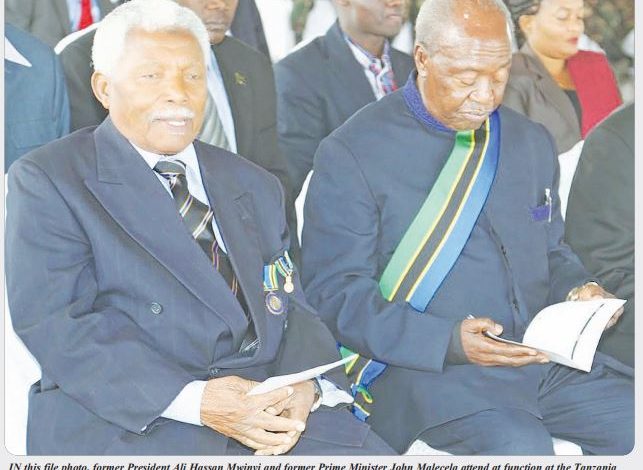
TANZANIA: IN his autobiography compiled in his book titled ‘Safari Ya Maisha Yangu, Mzee Mwinyi admits that one of the issues that troubled his presidency is the move masterminded by G55, a group of leaders who distinguished themselves in the early 1990s as staunch proponents of a three-tier system of government.
Consisting of 55 Members of Parliament, though later the number increased, the group called for the establishment of three governments, namely the Tanganyika Government, the Zanzibar Government and the Federal Government. The G55 campaign was led by the late Njelu Kasaka and supported by other former politicians, including Jenerali Ulimwengu and Matheo Qaresi.
“This matter disturbed me to a great extent, and I never expected it to unfold during my leadership,” admits Mzee Mwinyi in his book.
According to Mzee Mwinyi, one of the reasons that propelled G55 to campaign for the adoption of a three-tier government structure was Zanzibar’s decision to join the Organisation of Islamic Cooperation (OIC), formerly Organisation of the Islamic Conference.
However, Mzee Mwinyi says the decision by Zanzibar to join OIC was not based on religious factors, rather it was caused by Zanzibar’s desire to receive financial aid to help in its plans to fight poverty.
He says the then Zanzibar President Dr Salmin Amour believed joining OIC was in the best interest of Zanzibar, as it brought high hopes of soliciting and securing financial assistances from Arabic countries.
He recalls that on September 23, 1991, the then Minister for Foreign Affairs and International Cooperation Hassan Diria sought advice from the then Attorney General Damian Lubuva on the matter.
However, Judge Lubuva clearly responded that it was not possible for Zanzibar to join OIC on its own, unless the Isles government convinced the Union government to implement the idea, giving it a national picture. But, Zanzibar failed to convince the Union government to do so.
Despite the advice by Judge Lubuva to the Zanzibar government, Dr Amour went ahead with the idea whereby in 1992 he asked a Foreign Affairs official stationed at the Tanzanian embassy office in Riyadh, Saudi Arabia, Siwajibu Bakari Siwajibu, a Zanzibari, to secretly apply for OIC membership.
However, the secret leaked, prompting newspapers to start publishing stories about the matter, with others thinking Tanzania had secretly joined the Islamic organisation.
On January 10, 1993, Zanzibar confirmed to have joined OIC, but making it clear that religious and political matters would not be part of the operationalisation of the agreement. In short Zanzibar stated that joining OIC would neither have political nor religious implications on Tanzania affairs, and that the move did not pose any threats on the Union.
Mwinyi says the clarification from Zanzibar government on the matter did not calm down the dusty political atmosphere, forcing him, on January, 28, 1993 to address the nation on the matter through Dar es Salaam elders.
“In my address I refuted the swirling rumour and other media reports that claimed that Tanzania had joined an entity called Islam in Africa Organisation (IAO), including trying to explain why Zanzibar joined OIC and the need to have a fresh look at the country’s constitution to see what Zanzibar can do and what it can’t do, especially on issues related to aid and development cooperation. However, my efforts did not help to calm the situation,” he says in his book.
He says when the Parliament convened, seven MPs led by Njelu Kasaka asked the deputy speaker, who was leading the session, to accept the fact that the matter was serious as it could affect the country’s constitution. The MPs then called for thorough investigation.
According to Mzee Mwinyi, an investigation focused on three key issues or terms of reference
(i) Establishing if indeed Zanzibar had joined OIC
(ii) If, the answer to the first issue is Yes, an investigation should find out if it was legal for Zanzibar to join OIC solely, and
(iii) Carrying out an analysis, if Zanzibar had not breached the country’s constitution. As the Parliamentary Standing Committee on Governance, Constitution and Legal Affairs, under its then Chair Philip Marmo (Mbulu) was about to conclude compiling its investigation report, CCM caucus was convened on February 15, 1993.
Serving also as CCM Vice National Chair, Dr Amour addressed the caucus, during which he offered clarification on why Zanzibar joined OIC and why Tanzanians were not supposed to be worried with the decision. On February 18, 1993 when Mzee Mwinyi was scheduled to start a working tour of Shinyanga Region, Mr Marmo, tabled the committee’s report in Parliament, confirming reports of Zanzibar joining OIC and not Tanzania.
The repot categorically made it clear that Zanzibar’s decision had violated the country’s constitution that placed all the country’s foreign affairs and international relations in the hands of the government of the United Republic of Tanzania.
The committee also cleared the government from claims that Tanzania had joined Islam in Africa Organisation (IAO) though in its investigation it learnt that there existed correspondences between IAO, the Ministry for Foreign Affairs International Cooperation and BAKWATA since November 1989.
The committee further called for instituting disciplinary measures against two Zanzibar government ministers-Mr Taimur Saleh Juma and Iddi Pandu Hassan- for refusing to appear before it for questioning.
Dr Amour, who was also serving as Second Vice-President of the United Republic of Tanzania and CCM Vice Chairman, and then Zanzibar Chief Minister Dr Omar Ali Juma were blamed for what had transpired.
The blame was also apportioned to Zanzibar government for what had happened bearing in mind it was aware that it could not solely join OIC.
Following the political turbulence and the fierce debate that unfolded in Parliament, OIC later leant of the problem after which it indefinitely suspended Zanzibar membership before Zanzibar itself withdrew its membership from the organisation.