Inside TASAF project that turns aid into assets
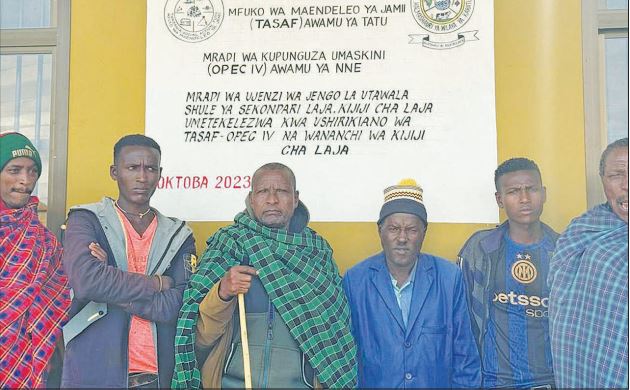
ARUSHA: ON a warm December morning in Karatu District, Arusha Region, the atmosphere carried both celebration and reflection.
Community leaders, journalists, development partners and residents gathered to mark the closure of the Fourth Tanzania Poverty Reduction Project (TPRP IV), funded by the OPEC Fund and implemented by the Tanzania Social Action Fund (TASAF).
What ended that day was not simply a project cycle, but a chapter of transformation written by communities themselves.
Standing before the audience, TASAF Executive Director Shedrack Mziray spoke with measured pride.
Since its launch in January 2020, TPRP IV had grown into one of Tanzania’s most impactful community-driven development initiatives.
Its mission was clear: reduce poverty, strengthen social services and empower communities to shape their own futures.
Five years later, its results were visible in classrooms, water points, livelihoods and renewed confidence across Arusha, Mwanza, Iringa, Geita and Simiyu regions.
In Karatu, the project’s impact could be felt in the simple fact that children now attend school nearby instead of walking long distances.
Across target regions, classrooms were built and rehabilitated, health facilities improved and water sources brought closer to households. These were not abstract investments.
They shortened daily journeys, improved safety and restored dignity to families who previously struggled to access basic services.
TPRP IV was deliberately designed to go beyond infrastructure. It sought to build resilience.
Households were supported to diversify income through livestock keeping, non-agricultural self-employment and small enterprises.
This shift proved critical in communities vulnerable to climate shocks and economic uncertainty.
Many families reported increased incomes, improved food security and greater ability to meet essential needs.
Poverty reduction, the project demonstrated, is strongest when it combines assets with opportunity.
Women and youth were central to this transformation. Rather than passive beneficiaries, they became decision-makers, entrepreneurs and leaders.
Women participated actively in savings groups, project committees and income-generating activities.
By the end of implementation, women headed more than half of participating households.
Their involvement reshaped local power dynamics and ensured that development outcomes reflected real household priorities.
Data from recent assessments underscored the scale of impact.
More than 1,450 households directly benefited from TPRP IV interventions, with a response rate of 96.7 per cent.
These numbers told a story of reach, but the deeper narrative lay in how communities used the support.
Savings groups flourished. Nearly nine out of ten households were aware of savings schemes and many gained accesses to loans for the first time.
For families long excluded from formal finance, this access meant resilience instead of desperation.
ALSO READ: Coast region plans to sustain TASAF projects
Entrepreneurship training reached over 80 per cent of participating households.
New businesses emerged, from small retail ventures to livestock enterprises.
Incomes rose, with more families earning above 200,000/- during implementation.
For women in particular, economic empowerment translated into greater autonomy and social standing.
Leadership roles once out of reach became attainable and income became a tool for long-term security.
Education outcomes were another defining success. The construction of classrooms, dormitories and sanitation facilities had a direct effect on enrolment and retention, especially for girls.
With safe boarding facilities and improved learning environments, early pregnancies declined and attendance improved.
Parents spoke of renewed hope as daughters stayed in school and envisioned futures beyond early marriage.
At the heart of TPRP IV was community ownership. Villagers identified priorities, contributed labour and assumed responsibility for maintaining assets.
This participatory approach ensured relevance and sustainability. Projects were not imposed; they were built with local knowledge and protected by local pride.
Environmental and social safeguards were observed throughout, ensuring that development did not come at the expense of safety or sustainability.
Strong political commitment supported these efforts. National and local leaders aligned behind the project’s goals, while local government authorities integrated completed assets into district and village plans.
This coordination ensured continuity beyond the project’s lifespan. Schools, water systems and health facilities were not left as isolated interventions but became part of broader development frameworks. Yet the journey was not without challenges.
Delays in payments, planning gaps and unmet needs in water and health infrastructure tested patience and systems.
TASAF acknowledged these shortcomings openly, treating them as lessons rather than failures. Capacity gaps at the community and PAA levels highlighted the need for stronger planning and streamlined processes, particularly for registering savings groups and sustaining financial inclusion.
Looking ahead, sustainability remains the guiding priority.
TASAF plans to strengthen maintenance systems, expand coverage to under served areas and deepen community participation.
Climate resilience will feature prominently, ensuring that assets support agriculture and environmental sustainability in an era of increasing uncertainty.
Building local capacity is no longer optional; it is central to lasting impact. Financial accountability anchored the project’s credibility. Funds from the OPEC Fund were used strictly for approved activities, supported by rigorous monitoring, reporting and audits.
Payments to beneficiaries were made directly as wages, reinforcing transparency and respect.
As the project closed, TASAF reaffirmed that all financial and technical obligations had been fully met.
Although TPRP IV has formally ended, its benefits endure. Skills acquired remain with community members. Assets continue to serve households.
Local governments remain committed to their upkeep.
The foundation laid allows TASAF to scale successful approaches and refine strategies for future phases, building on what communities have proven possible. Partnership was the project’s quiet strength.
The collaboration between TASAF and the OPEC Fund was rooted in shared goals: reducing poverty, creating productive assets and supporting sustainable livelihoods.
The partnership exemplified results-oriented development, translating resources into measurable change.
This transition aligns seamlessly with Tanzania’s broader development vision, including Vision 2025 and the National Social Protection Framework.
It reflects the government’s emphasis on human development, productivity and inclusive growth under the leadership of President Samia Suluhu Hassan.
As the ceremony concluded, gratitude filled the air.
Thanks were extended to communities whose commitment drove success, to partners who believed in local solutions and to the media for promoting transparency. TPRP IV closed not as an ending, but as a benchmark.
Its legacy is clear: when communities lead, poverty retreats and development takes root where it matters most.
Case study: Laja Village, where distance no longer defeats education The broad achievements of TPRP IV are perhaps best understood through the lived experience of Laja Village in Karatu District Council, Arusha Region.
For residents of this rural community, the Tanzania Social Action Fund’s approval of the OPEC-funded Poverty Reduction Project marked a decisive turning point, replacing long daily journeys with nearby access to secondary education.
Before the project, students selected to join secondary school walked up to eight kilometres each way in search of learning.
The journey was exhausting and, for many families, deeply worrying. When TASAF Executive Director Shedrack Mziray visited the village to inspect implementation, residents explained that the new secondary school had completely removed this burden, bringing education within safe and reasonable reach.
For villagers such as Christina Lucas, the change has been most significant for girls.
She recalled that before the school was built, female students bore the greatest risks and hardships. Long walks exposed them to fatigue, insecurity and vulnerability along the road.
“The presence of this school has reduced unnecessary truancy,” she said.
“A child walking eight kilometres faces many challenges. Sometimes they are escorted by motorcycle taxi riders, some of whom pose risks to our children’s safety.”
The introduction of boarding facilities has further strengthened protection. With students now residing in dormitories, safety and supervision have improved markedly.
Parents remain closely involved and according to residents, the environment has contributed to positive outcomes, including the absence of student pregnancies since the school opened.
Gratitude toward TASAF runs deep in Laja Village, yet it is paired with forward looking requests.
Residents have appealed for additional facilities, including science laboratories, a library and more teachers’ houses to support the growing school.
Christina Lucas expressed hope that President Dr Samia Suluhu Hassan, through TASAF, would once again consider the village.
“Our President has listened to us,” she said.
“This is an area that was once forgotten, yet now we have a modern school that many thought could only be built in Karatu town, not here in our village.”
Another resident, Andrea Mtupa, emphasised how daily life has changed for students.
Where they once walked eight kilometres to school and another eight kilometres home, they now attend a modern secondary school within their own community, built through TASAF’s OPEC-funded support.
Laja Village Executive Officer Daniel Mpigachai provided insight into the scale of investment behind the transformation. The school’s construction cost approximately 775m/- .
Of this, TASAF, through OPEC Phase Four, contributed about 660m/-, while the community raised roughly 115m/- through contributions of sand, gravel, stones, water and labour.
The shared investment reinforced a strong sense of ownership among residents. The school, registered in November 2023, officially began operations in 2024 with an initial intake of 26 Form One students.
Today, enrolment has grown to 63 students in Forms One and Two, all of whom are boarding.
According to village leaders, truancy has declined sharply and students’ motivation to learn has increased significantly.
The school has also opened its doors to children from neighbouring villages, extending its impact beyond Laja.
Village leaders have reiterated their request that, should another opportunity arise, TASAF consider supporting the construction of remaining facilities such as laboratories, classrooms, a library and additional teachers’ houses to meet rising demand.
For Laja Secondary School Headmaster Daniel Panga, the school’s influence extends beyond those already enrolled.
He noted that the presence of a modern secondary school has inspired primary school pupils, who now study with confidence, believing that their path to secondary education lies close to home.
Laja Village stands as a practical illustration of TPRP IV’s promise: when communities are supported to identify needs and build assets, development becomes tangible, protective and transformative turning distance into opportunity and hope into reality.