Human rights as a bridge: Dialogue and recovery after TZ’s elections

DAR ES SALAAM: AFTER examining how human rights were strained beyond popular headlines and how several rights intersected, and at times collided during Tanzania’s post-election period, a more urgent question now arises: What comes next? Human rights cannot end at naming violations or defending positions.
They must also guide accountability, healing and the restoration of trust. In moments like these, the true test of a human rights system lies not only in how it responds to crisis, but in how it helps a nation recover, reconcile and prevent a recurrence.
This article turns to that task. It explores how Tanzania can move from tension to dialogue, from contestation to consensus and from collision to coexistence using human rights as a bridge rather than a battleground. In recent weeks, it has been troubling to see Tanzania drawn back into cycles of demonstration threats and counter-threats.
Activists who openly or indirectly associated themselves with the violence of October 29, alongside some human rights organisations that condemned the Government for suppressing protesters’ rights, soon began organising another demonstration planned for December 9, the very day Mainland Tanzania marks its Independence. This back-and-forth is not healthy for the country.
What came as a breath of fresh air was the response of ordinary Tanzanians. Across the country, many commended the Government and, in particular, the security organs for maintaining peace and order. It was a reminder that the majority of Tanzanians value stability and reject violence.
Yet, a different narrative continued to circulate online. Calls for endless demonstrations, framed as a struggle for “A New Tanzania,” urged people to pick up where the violence of October 29 had ended. This is deeply worrying. Many Tanzanians including myself long for the peaceful moments that once defined this country.
Tanzania was known as a home of peace, a place neighbours turned to for mediation and reconciliation during political crises. That identity now feels under threat. So where is the solution, can human rights be part of it The answer lies with Tanzanians themselves.
Tanzania has been tested before. Since independence, the country has weathered major challenges from precolonial conflicts, to the Tanzania–Uganda War (1978–1979), the 1972 assassination of Abeid Amani Karume and the 1968 and 1982 plots against Mwalimu Julius Nyerere. Each time, the nation endured.
There is no doubt it can endure again. Human rights, if properly understood and responsibly applied, can be a powerful tool in that recovery. In one way or another, almost every Tanzanian, citizens and residents alike, was affected by the violence. Rights were violated at different levels and in different ways.
Those who lost their lives can no longer speak for themselves, which is why human rights defenders often speak loudest on their behalf. But for those still alive, a clear choice remains: To reject further violence. Beyond the right to life, earlier articles showed how many other rights were placed at a crossroads.
These included freedom of expression, the right to vote, freedom of worship, freedom of movement, access to information, access to social services, the right to own property and economic rights. None of these rights exists in isolation. When violence erupts, they all suffer. The impact was not limited to individuals.
ALSO READ: Tanzania names Independent Commission of Inquiry for Oct 29 Elections
The country itself was affected. Tanzania’s image took a sharp and painful turn. The reputation of being one of the most peaceful countries in East Africa, and even Africa, was shaken in broad daylight. Rebuilding that identity is now a national task. The effects cut across society. Women, children, youth, the elderly and persons with disabilities were affected.
So were political parties, religious institutions, security organs, business communities and government leaders. The economy did not escape unharmed. It is especially painful to hear calls that single out officers in uniform as targets of future demonstrations or violence, while ignoring the role many of them played in preventing the country from sliding deeper into chaos and widespread human rights violations.
That narrative is neither fair nor constructive. Tanzania now stands at a crossroads. Everyone has the right to be heard. True and lasting reconciliation begins by listening.
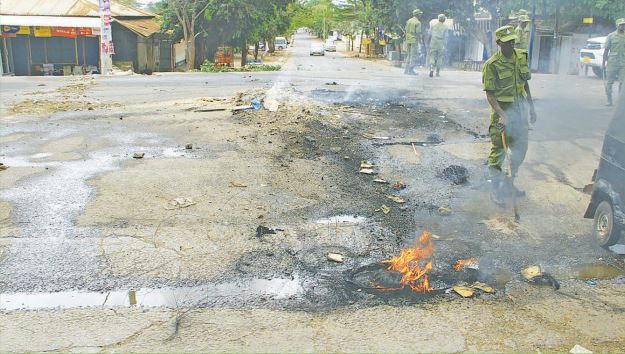
area of Moshi, Kilimanjaro during the 29th October unrest.
The establishment of the Commission of Enquiry offers a real opportunity. By inviting citizens to submit credible information on the causes, damage, accountability and impact of the violence surrounding the 2025 elections, the Commission has opened a door for national healing. This is the moment to walk through it.
One area that deserves renewed attention is the role of young people and civic education. Tanzania’s youth are energetic, idealistic and deeply invested in the country’s future. Yet without adequate civic education, that energy can be easily misdirected. Civic education is not about silencing dissent; it is about equipping young people with knowledge of their rights, responsibilities and lawful avenues for participation.
When young people understand the Constitution, electoral processes and the legal boundaries of protest, they are better positioned to demand change without exposing themselves or others to harm. Empowered with information rather than slogans, young Tanzanians can become builders of democracy rather than instruments of instability.
Other countries that experienced dark chapters have taken similar paths. Rwanda is a clear example, just at our North-West border. After the 1994 genocide,
Rwanda turned to community-based forums that enabled truth-telling and accountability at the grassroots. Later, the National Unity and Reconciliation Commission led a longterm reconciliation process.
The lesson was simple: When people feel heard and included in rebuilding their nation, they choose healing over endless tension. Tanzania must learn from this experience. If the country does not collectively say “enough is enough,” the effects of violence risk becoming normalised.
This warning was echoed by Zambia’s President, Hakainde Hichilema, during the swearing-in of President Samia Suluhu Hassan. He cautioned that peace, once lost, is extremely difficult to restore. Tanzania has enjoyed peace since independence, he reminded us, and that legacy must be protected because peace, security and stability are the foundations of development.
In this moment, genuine human rights defenders must rise and be counted. There is growing concern that the language of human rights has, at times, been used recklessly to advance agendas that do not reflect the will or well being of Tanzanians.
ALSO READ: Samia orders speedy implementation of all General Elections’ pledges
No one wants to die. Yet some activists continue to mobilise especially the youth to take grievances to the streets without respecting legal requirements for peaceful demonstrations. If more voices clearly and consistently condemn all human rights violations without selectivity, Tanzania can regain its footing. This is not a time to fuel further tensions or to take sides.
Political leaders, government officials, activists, elders, youth and human rights defenders alike share one responsibility: To protect and promote human rights in ways that preserve life, dignity and peace. Human rights should unite us, not divide us. This is the moment to use them as a bridge.
As this three-part series has shown, human rights are not abstract slogans reserved for moments of calm. They are lived realities, tested most severely in times of crisis. Tanzania’s postelection experience reminds us that rights can collide, narratives can compete and emotions can run high. But it also reminds us that recovery is possible.
Dialogue, accountability and inclusion remain the strongest tools for national healing. This is a moment for restraint, reflection and responsibility. Human rights must not be weaponised or selectively defended.
They must be upheld in full, for all, and in ways that preserve peace, dignity and unity. If Tanzania chooses this path, it will not only recover, it will reaffirm the very values that have long defined it as a nation of peace.