How solar power is rewiring East African agriculture
SONGEA: Did you know that solar power is rapidly transforming the agricultural landscape across East Africa?
This compelling question formed the heart of a five-day Regional Masterclass on the Productive Use of Solar Energy in Agriculture, a workshop organized by the African Centre for Media Excellence (ACME). Based in Kampala, Uganda, ACME designed the training to deepen journalists’ understanding of how solar technologies are reshaping modern farming systems.
The training event was held in Nairobi, Kenya, from October 20–24, 2025, and brought together 16 journalists from Tanzania, Kenya, and Uganda.
The primary objective of the masterclass was to build the capacity of agricultural journalists to accurately and effectively report on the emerging applications of solar energy in farming. Participants explored how solar technologies can contribute to irrigation, crop drying, food storage, preservation, and the installation of cost-saving power systems on farms.
ACME emphasized that solar-powered farming tools offer a more affordable, sustainable alternative to diesel generators, whose fuel costs continue to burden smallholder farmers across the region. Tanzania was represented by six journalists from a range of media organizations, including the Daily News, where the author serves as a Correspondent in Songea, Ruvuma Region. Kenya, the host country, fielded seven journalists, while three
attended from Uganda.
For many participants, the workshop offered a rare opportunity to explore cross-border agricultural innovations and learn from colleagues across East Africa.
Training Focus: Connecting solar energy to agricultural systems
Throughout the masterclass, participants engaged in both theoretical sessions and practical fieldwork designed to strengthen their analytical lenses. Facilitators emphasized the idea of “systems thinking”—an approach that encourages journalists to see solar-powered agriculture not as isolated technologies, but as interconnected systems that influence water use, crop productivity, farmer financing, environmental sustainability, and rural livelihoods.
One of the recurring themes was the importance of grounding stories in data.
Journalists were encouraged to collect, verify, and interpret information more rigorously. Facilitators urged them to investigate financing opportunities that farmers could use for water pumping, irrigation, and solar installations, including micro-loans, grants, and partnerships with local innovators.
ACME’s Program Manager for Training, Rachel Mugarura Mutana, played a central role in shaping the discussions. She challenged journalists to enter each story with curiosity and a clear strategy, asking probing questions that reveal both the challenges and the opportunities within solar-powered agriculture.
Rachel emphasized that multimedia storytelling—using photos, videos, graphics, and clear narrative structure—helps journalists amplify the impact of their work. She also highlighted the principles of solution journalism, a reporting approach that goes beyond describing problems to examining workable, evidence-based interventions.
Rachel reminded participants that effective storytelling is not only about reporting events but also about uncovering the deeper connections between solar energy, land use, resource management, and community resilience.
Solar technologies, she noted, present a tangible pathway toward sustainable agriculture, but journalists must explain these systems clearly and responsibly.
Field Visit: Experiencing solar-powered farming in Kenya
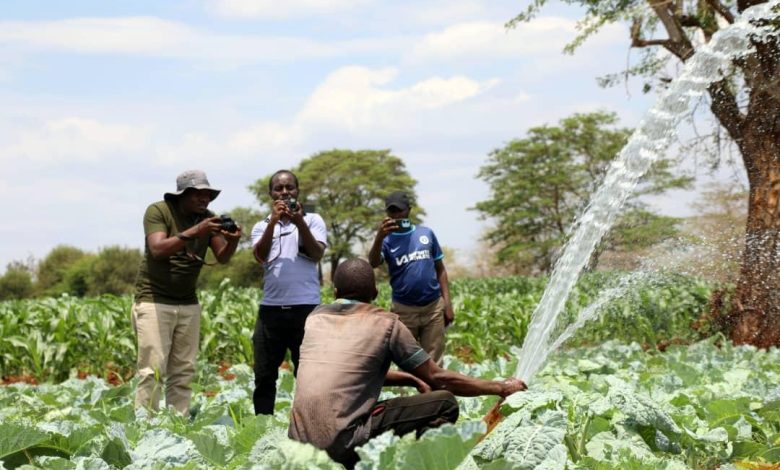
A major highlight of the training was a field excursion to Gachuriri Village in Embu County, more than 100 kilometers from Nairobi. The participants visited a mixed farm cultivating maize, vegetables, and various fruits. The farm is run by SOW-PRICISE Africa, an organization founded and directed by Linda Kamau in partnership with Pius Wambua.
During the visit, Linda explained that their farm operates entirely on solar-powered pumps installed along the nearby River Thiba. These pumps supply irrigation water to their crops, enabling the farm to maintain production without relying on costly diesel or petrol generators. Linda stressed that solar technology has drastically reduced their operational expenses, allowing them to channel more resources into expanding crop variety, improving yields, and enhancing farm efficiency.
Beyond supporting their own production, SOW-PRICISE Africa also offers irrigation services to surrounding smallholder farmers. At a fee of 2,000 Kenyan shillings per acre, the organization has become a vital agricultural partner for farmers seeking affordable irrigation solutions.
According to Linda, more than 100 farmers in Embu County have already benefited from their solar-powered services. Her partner, Pius, echoed the transformative potential of solar energy. He emphasized that many small farmers simply cannot keep up with escalating fuel prices, and solar-powered irrigation has become a lifeline for them.
Pius showcased a solar-charged battery cart designed to support various farm activities. This innovation which is locally manufactured demonstrates how adaptable and accessible solar technologies have become when local industries are empowered to build equipment tailored to farmers’ needs.
He argued that expanding domestic manufacturing capacity would reduce costs further and simplify maintenance for rural farmers.
Improved livelihoods through solar energy
The stories shared during the masterclass and field visit painted a consistent and compelling picture: farmers using solar-powered systems have experienced substantial improvements in their incomes, in some cases by as much as 30 percent.
These increased earnings enable families to invest in better housing, quality education, improved nutrition, and other development goals. One outstanding example is Steven Mutua, a farmer who collaborates with SOW-
PRICISE Africa. Steven explained that adopting solar energy dramatically changed his farming practices and household welfare. His productivity has increased year after year, and the knowledge and technical skills gained through SOW-PRICISE Africa have positioned him for long-term success. Steven’s story reinforced the idea that solar energy is much more than a technology—it is a tool for economic empowerment.
Similar realities in Tanzania
The challenges faced by Kenyan farmers are echoed across Tanzania. In Mkongo Gulioni Village in Namtumbo District, Ruvuma Region, a veteran fruit and vegetable farmer shared his struggle with high irrigation costs.
He previously spent more than 15,000/- per day on petrol for his generator. To reduce expenses, he switched to using gas, which cost him 25,000/- every three to four days. Although this approach was cheaper, it still strained his finances. After learning about the benefits of solar-powered irrigation, he expressed strong interest in transitioning to solar technology, hoping it would provide more sustainable and cost-effective relief.
Journalists appreciate ACME’s continued support
All 16 journalists expressed deep appreciation to ACME for organizing a high- quality, insight-rich training program. They commended ACME for its long- standing commitment to strengthening African journalism through expert-led instruction, hands-on field exposure, and opportunities to engage with real agricultural innovations.
Many described the masterclass as transformative, noting that the skills and knowledge gained would significantly enhance their reporting on agriculture and renewable energy. As a Correspondent for the Daily News Tanzania, I found Linda Kamau’s work particularly inspiring. Her success demonstrates that solar technology is not merely an alternative power source—it is a catalyst for agricultural transformation and improved livelihoods across East Africa.