China and Tanzania: Six decades of strategic partnership fuelling growth
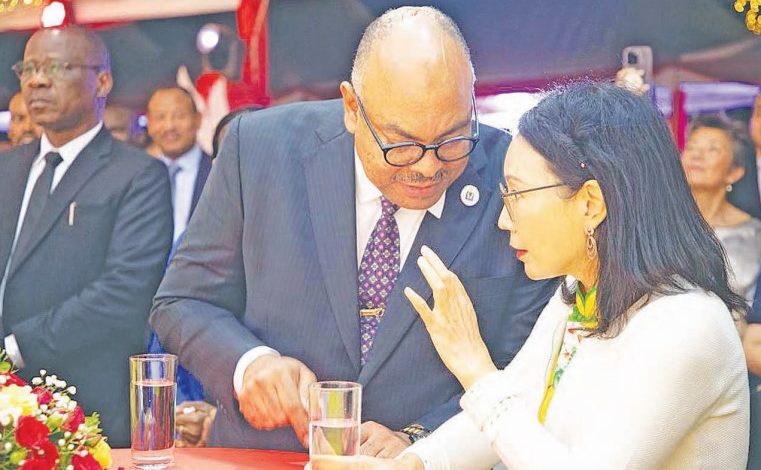
DAR ES SALAAM: THE recent celebrations at the Chinese Embassy in Dar es Salaam to mark the 76th anniversary of the founding of the People’s Republic of China in a nutshell brought together a distinguished gathering of diplomats, government officials, business leaders and members of the public.
Here, the atmosphere was festive yet dignified and typical of such a diplomatic occasion filled with the expected protocol of speeches, handshakes and carefully curated smiles.
Amidst the usual formalities, one subtle but unspoken hope lingered among the guests: That the speeches would be inspirational, not interminable. Fortunately, the keynote addresses by Ambassador Chen Mingjian, China’s Ambassador to Tanzania and Tanzania’s Minister for Foreign Affairs and East African Cooperation, Ambassador Mahmoud Thabit Kombo, delivered just that.
They captured the enduring depth and dynamic future of this pivotal bilateral relationship with clarity, substance and a spirit of genuine partnership. Ambassador Chen’s address opened by tracing the remarkable journey China has undertaken since its founding in 1949.
“From humble beginnings, China has risen to become the world’s secondlargest economy and a powerhouse of innovation,” she said, succinctly summarising a transformation that defies easy description.
She highlighted China’s leadership in manufacturing, deployment of the world’s largest 5G network and advances in clean energy and artificial intelligence. A particularly notable milestone was China’s GDP surpassing 18 trillion USD last year, a figure that underscores its economic heft despite global uncertainties.
In the course, she framed these achievements not as endpoints but as foundations for greater global engagement.
“China’s growth is not an end in itself but a platform to contribute actively to international development,” she noted, stressing the country’s commitment to the Global South.
China’s standing as Africa’s largest trading partner for 16 consecutive years, with trade reaching nearly 300 billion USD in 2024, serves as tangible proof. Ambassador Chen outlined how China’s flagship Belt and Road Initiative (BRI) exemplifies this global cooperation.
Engaging over 150 countries and numerous international organisations, the BRI has catalysed infrastructure development, energy projects and digital economy growth across Africa.
China’s commitment is not just economic but also developmental, seeking to build long-term partnerships. Turning specifically to Tanzania, Ambassador Chen noted that China has been Tanzania’s largest trading partner for nine straight years, with bilateral trade close to 9 billion USD in 2024.
Chinese enterprises are integral to landmark projects such as the Central Standard Gauge Railway (SGR), a transformative infrastructure backbone accelerating Tanzania’s industrialisation. Other projects cited include the Magufuli Bridge and Arusha Stadium, which have enhanced connectivity and uplifted communities.
Agriculture also plays a vital role in bilateral trade. China’s increased imports of high-quality Tanzanian produce—honey, avocados and wild aquatic products—support Tanzania’s agricultural modernisation efforts and rural development.
The ambassador further referenced the 2024 Forum on China-Africa Cooperation (FOCAC) Beijing Summit, noting successful initiatives such as the revitalisation of the TAZARA Railway and ongoing upgrades to medical and agricultural sectors funded by Chinese government aid and international partners. Reflecting on historical milestones, Ambassador Chen reminded the audience that 2024 marked the 50th anniversary of the TAZARA Railway, a symbolic emblem of China-Tanzania solidarity.
She also recalled the 60th anniversaries of President Julius Nyerere’s visit to China, the Treaty of Friendship and Premier Zhou Enlai’s historic visit to Tanzania events that laid the bedrock for this enduring partnership. In closing, Ambassador Chen reaffirmed China’s readiness to deepen cooperation with Tanzania, implementing consensus reached between their heads of state and advancing together toward modernisation and shared prosperity.
Minister Kombo: Tanzania’s vision for deepened cooperation and delivery
Following Ambassador Chen, Tanzania’s Minister for Foreign Affairs and East African Cooperation, Ambassador Mahmoud Thabit Kombo, conveyed warm congratulations to the People’s Republic of China and President Xi Jinping on China’s National Day.
Representing President Samia Suluhu Hassan, he expressed Tanzania’s admiration for China’s extraordinary progress and the inspiration it offers.
“China’s transformation offers lessons for Tanzania’s own development journey,” Minister Kombo observed.
He traced the historical roots of Tanzania-China relations to the friendship of their founding fathers, evolving into a comprehensive strategic partnership yielding tangible results across multiple sectors.
The Minister shared insights from his June visit to China, where he and Foreign Minister Wang Yi agreed to intensify coordination and accelerate implementation of joint initiatives.
“This year, Tanzania-China relations have been about deepening delivery,” he stated, underlining the importance of turning agreements into results.
Among the achievements highlighted were the completion of major infrastructure projects like the Magufuli Bridge, the Ngorongoro Lengai Geopark as the first geopark in Africa and the Zanzibar Radio and TV Project, with many other projects advancing steadily.
Minister Kombo also pointed to ongoing negotiations aligned with the FOCAC Beijing Action Plan (2025-2027), aimed at expanding collaboration. Chinese investment interest in Tanzania is growing robustly.
The Minister cited the imminent revitalisation of the TAZARA Railway and ongoing discussions on financing key infrastructure projects such as Standard Gauge Railway (SGR) Lots 5 and 6, alongside mining joint ventures at Liganga and Mchuchuma. Trade ties continue to thrive.
Minister Kombo applauded China’s duty-free access for all African exports and noted that more than 270 Tanzanian companies have registered with Chinese customs. This opens up the Chinese market to a broader range of Tanzanian goods, including sesame, cotton seed cake, dried cassava, soybeans, honey, avocados, dried chilies, sunflower seed cake and marine products delivering new opportunities for farmers and exporters.
People-to-people exchanges remain central to the bilateral relationship. Minister Kombo highlighted thousands of Tanzanian students benefiting from Chinese scholarships, returning with skills in engineering, medicine, agriculture and public policy.
He also celebrated expanded cultural programmes such as Kiswahili language studies in China and the Chinese Ambassador’s Award for academic excellence. In health cooperation, the Minister expressed gratitude for Chinese medical teams working in mainland Tanzania and Zanzibar.
He paid a poignant tribute to Dr Zhang Junquiao, a Chinese anesthesiologist who passed away while serving in Tanzania-a hero whose dedication epitomises the human spirit of this partnership.
On multilateral issues, Minister Kombo praised China’s steadfast advocacy for a fairer international order and collaboration within the United Nations. He affirmed Tanzania’s support for the OneChina policy and emphasised ongoing joint efforts on UN reforms, climate action, trade policies and human rights.
“China-Tanzania friendship is not a museum piece; it is a working partnership calibrated to deliver for our citizens,” Minister Kombo concluded. “Our objective is simple—a partnership that transforms opportunity into measurable outcomes: Jobs, exports and improved services for our people.”
A future built on shared ambition and solidarity
The speeches from Ambassador Chen and Minister Kombo collectively reveal a dynamic, multi-dimensional partnership transcending traditional diplomacy.
This relationship fuels economic transformation, technology exchange, health progress and cultural understanding. China’s role as a global development leader aligns well with Tanzania’s Vision 2050 ambition to become a middle-income, knowledgedriven economy.
Together, they focus on infrastructure, agricultural modernisation, capacity building and healthcare improvements pillars supporting Tanzania’s sustainable growth. Both countries also share a commitment to multilateralism and reforms in global governance, aiming to shape a more inclusive international system that serves the interests of developing nations.
The 2024 celebrations at the Chinese Embassy remind us that China-Tanzania relations are not just a matter of history but a vibrant, evolving partnership.
As they continue to implement strategic projects and deepen economic ties, they set an inspiring example of South-South cooperation reshaping Africa’s development landscape and contributing meaningfully to global prosperity.